. 2006;34(21):6256-63.
doi: 10.1093/nar/gkl755. Epub 2006 Nov 10.

Concentration dependent selection of targets by an SR splicing regulator results in tissue-specific RNA processing

Affiliations

Concentration dependent selection of targets by an SR splicing regulator results in tissue-specific RNA processing

Junlin Qi et al. Nucleic Acids Res. 2006.

Abstract

The splicing factor Transformer-2 (Tra2) is expressed almost ubiquitously in Drosophila adults, but participates in the tissue-specific regulation of splicing in several RNAs. In somatic tissues Tra2 participates in the activation of sex-specific splice sites in doublesex and fruitless pre-mRNAs. In the male germline it affects splicing of other transcripts and represses removal of the M1 intron from its own pre-mRNA. Here we test the hypothesis that the germline specificity of M1 repression is determined by tissue-specific differences in Tra2 concentration. We find that Tra2 is expressed at higher levels in primary spermatocytes of males than in other cell types. Increased Tra2 expression in other tissues reduces viability in a manner consistent with known dose-dependent effects of excessive Tra2 expression in the male germline. Somatic cells were found to be competent to repress M1 splicing if the level of Tra2 transcription was raised above endogenous concentrations. This suggests not only that M1 repression is restricted to the germline by a difference in Tra2 transcription levels but also that the protein's threshold concentration for M1 regulation differs from that of doublesex and fruitless RNAs. We propose that quantitative differences in regulator expression can give rise to cell-type-specific restrictions in splicing.


Figures
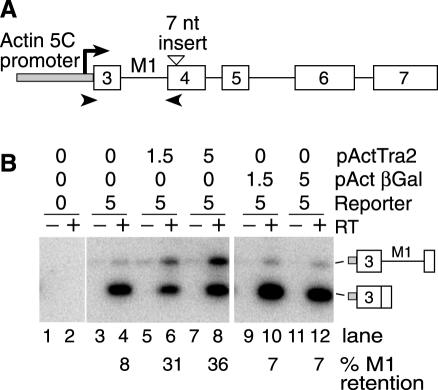
Figure 1
Figure 1
Drosophila S2 cells support Tra2 induced M1 retention. (A) A schematic diagram of the M1 splicing reporter pActTra2-Nae+1 is shown. The unfilled boxes indicate exons and the solid lines indicate introns deriving from the tra2 gene. The grey box indicates promoter sequences from the Actin 5C. The position of the predicted transcription start site is indicated (arrow). The position of the fusion of actin sequences with exon 3 is nearly coincident with the natural male germline transcription start site. The position of the 7 nt insertion in exon 4 used to disrupt translation is also indicated by a triangle. The positions of primers used for RT–PCR experiments are shown as arrowheads. (B) RT–PCR results on the M1 splicing reporter in transfected S2 cells. For each sample, both reaction with (+) and without (−) reverse transcriptase (RT) are shown. The amount of M1 retention is indicated below the gel lanes. The amount (micrograms) of pActTra2, pActβGal and pActTra2-Nae+1 (reporter) used in each transfection are indicated above the gel. The total amount of DNA used in each transfection was kept constant at 20 μg using empty vector plasmid for the balance. The PCR products of M1 retaining and M1-spliced forms are indicated with diagrams on the side.
Figure 2
Figure 2
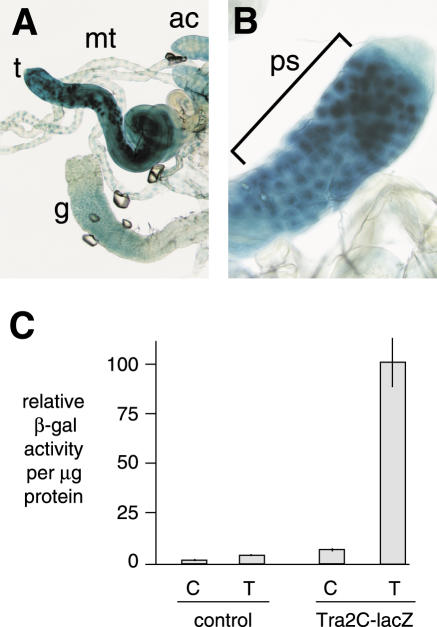
Tra2 is expressed at highest levels in the germline of male adults. Expression monitored using a β-galactosidase reporter transgene (C-lacZ) under the control of the tra2 promoter is shown. (A) Shows X-gal staining of testes (t) in comparison to malphigian tubules (mt), accessory glands (ac) and gut (g). A closeup view of the testis showing indicating staining of primary spermatocytes (bracket) is shown in (B). (C) Shows results from quantitative determination of β-galactosidase activity in extracts from various testes (T) and remaining carcass (C) in both normal w1118 male adults (control) and transgenic flies carrying the reporter in the same genetic background. Standard errors are indicated by the lines.
Figure 3
Figure 3
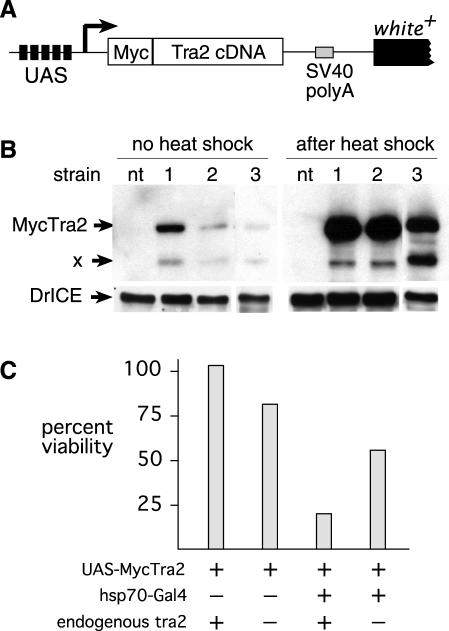
Increased expression of Tra2 under control of the hsp70 promoter reduces viability. A schematic diagram of the UAS-MycTra2 transgene is shown (A). The position of the 6×Myc tag at the protein's N-terminus and the position of five UAS elements is indicated. The arrow indicates the position expected for transcription initiation. Not shown are P element sequences from the transformation vector. When anti-Myc antibodies are used to probe a western blot on extracts (B) from female adults carrying the hsp70-Gal4 transgene and any of three UAS-MycTra2 insertions, a prominent band is observed at the expected size for the fusion protein (∼48 kDa). This protein is not present extracts of non-transgenic control females (nt). Lower molecular weight proteins (X) are also observed in transgenics and may represent degradation products or alternate initiations within the 6×Myc tag. Extracts prepared after heat shock and recovery have sharply increased levels of Myc-Tra2. As a loading control, the same blot was probed with an antibody against Drosophila drICE. (C) Shows that viability at 25° is reduced in flies carrying both hsp70-Gal4 and UAS-MycTra2 (line 1) as measured in relation to their siblings. Homozygosity for a tra2 loss-of-function mutation (tra2b) causes a slight reduction in measured viability of control flies (UAS-MycTra2), but the same mutation increases viability of flies driving expression from hsp70-Gal4 (P < 0.0001).
Figure 4
Figure 4
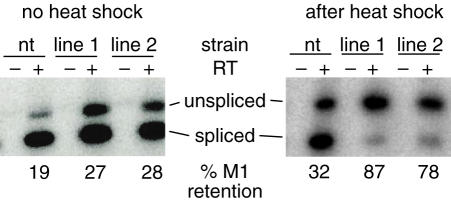
Increased Tra2 expression in females results in increased M1 retention. Low cycle RT–PCR analysis of M1 splicing in non-transgenic (nt) female adults and females carrying both hsp70-Gal4 and either of two UAS-MycTra2 insertions (lines 1 and 2) are shown. The percent of products with the M1 intron retained is indicated below the gel. The level of M1 retention is increased slightly without heat shock and more dramatically after heat shock and recovery. Reactions were performed both with (+) and without (−) reverse transcriptase. RNA samples are from the same individuals used for the western blot in Figure 3B.
Figure 5
Figure 5
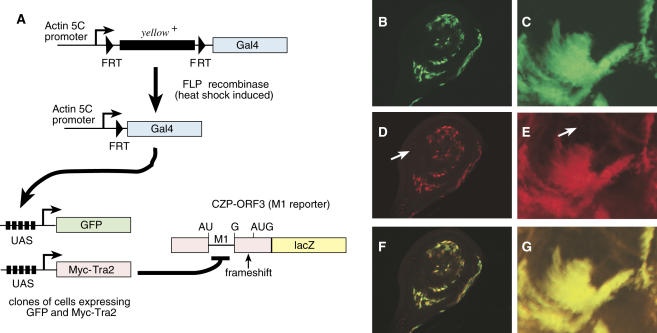
M1 retention in Drosophila somatic tissues expressing UAS-MycTra2. (A) A schematic diagram is shown of the strategy for producing Tra2 overexpressing clones. Induced expression of yeast FLP recombinase from a FLP transgene driven by the hsp70 promoter causes fusion of ubitquitously active actin 5C promoter with Gal4 coding sequences in random cells. Clones of GAL4 positive cells are detected by activation of UAS-GFP and also express UAS-MycTra2. These clones were generated in flies also carrying a Tra2-β-galactosidase reporter transgene (CZP-ORF3) which produces RNA ubiquitously, but only expresses β-galactosidase if the M1 intron is retained. The reporter contains a frameshift mutation blocking translation from open reading frames used when the M1 intron is removed and initiating in exons 2 or 3. Expression of the reporter protein in intron-retaining RNA results from translation initiation at an AUG codon located downstream of M1 in exon 4. Shown are results from whole mount immunofluorescent staining of a larval imaginal disc (B, D and F) or brain tissue (C, E and G) that include clones of cells overexpressing UAS-MycTra2. Green staining (GFP) marks cells in which UAS-Myc-Tra2 is activated by Gal4 (B and C) and Red staining (β-galactosidase) marks cells with increased M1 retention (D and E). A merge of the red and green channels is also shown (F and G). Arrows in (D and E) indicate examples of large areas where GAL4 and Myc-Tra2 are not expressed and the reporter is not induced. Note that GFP staining is cytoplasmic and the Tra2-β-galactosidase fusion protein from the reporter is nuclear.

References

    1. Graveley B.R. Sorting out the complexity of SR protein functions. RNA. 2000;6:1197–1211. - PMC - PubMed
    1. Lopez A.J. Alternative splicing of pre-mRNA: developmental consequences and mechanisms of regulation. Annu. Rev. Genet. 1998;32:279–305. - PubMed
    1. Watermann D.O., Tang Y., Zur Hausen A., Jager M., Stamm S., Stickeler E. Splicing factor Tra2-beta1 is specifically induced in breast cancer and regulates alternative splicing of the CD44 gene. Cancer Res. 2006;66:4774–4780. - PubMed
    1. Hofmann Y., Lorson C.L., Stamm S., Androphy E.J., Wirth B. Htra2-beta 1 stimulates an exonic splicing enhancer and can restore full-length SMN expression to survival motor neuron 2 (SMN2) Proc. Natl Acad. Sci. USA. 2000;97:9618–9623. - PMC - PubMed
    1. Hofmann Y., Wirth B. hnRNP-G promotes exon 7 inclusion of survival motor neuron (SMN) via direct interaction with Htra2-beta1. Hum. Mol. Genet. 2002;11:2037–2049. - PubMed

Publication types