. 2006 Dec;7(12):1259-65.
doi: 10.1038/sj.embor.7400824. Epub 2006 Nov 10.

The Survivin-Crm1 interaction is essential for chromosomal passenger complex localization and function

Affiliations

The Survivin-Crm1 interaction is essential for chromosomal passenger complex localization and function

Shirley K Knauer et al. EMBO Rep. 2006 Dec.

Abstract

The chromosomal passenger complex (CPC) of Aurora-B, Borealin, INCENP (inner centromere protein) and Survivin coordinates essential chromosomal and cytoskeletal events during mitosis. Here, we show that the nuclear export receptor Crm1 is crucially involved in tethering the CPC to the centromere by interacting with a leucine-rich nuclear export signal (NES), evolutionarily conserved in all mammalian Survivin proteins. We show that inhibition of the Survivin-Crm1 interaction by treatment with leptomycin B or by RNA-interference-mediated Crm1 depletion prevents centromeric targeting of Survivin. The genetic inactivation of the Survivin-Crm1 interaction by mutation of the NES affects the correct localization and function of Survivin and the CPC during mitosis. By contrast, CPC assembly does not seem to require the Survivin-Crm1 interaction. Our report shows the functional significance of the Survivin-Crm1 interface and provides a novel link between the mitotic effector Crm1 and the CPC.


Figures
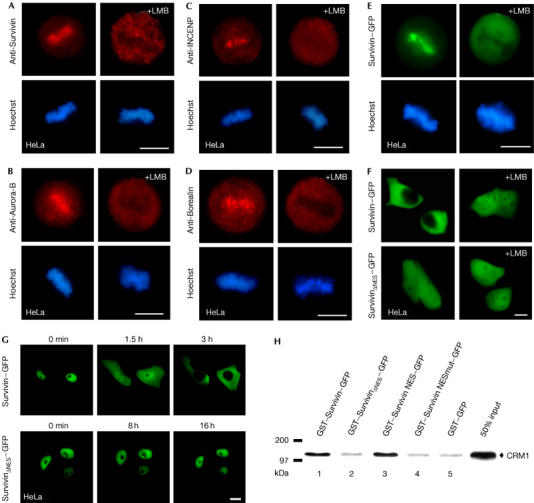
Figure 1
Figure 1
Survivin contains a leptomycin-B-sensitive nuclear export signal interacting with Crm1. (AE) The centromeric localization of (A) Survivin, (B) Aurora-B, (C) INCENP, (D) Borealin and (E) Survivin–GFP is affected by treatment with leptomycin B (LMB) for 6 h. Endogenous chromosomal passenger complex (CPC) proteins were detected by immunostaining (red). DNA was stained with Hoechst. (F) Survivin–GFP localizes to the cytoplasm and accumulates in the nucleus on LMB treatment, whereas SurvivinΔNES–GFP is equally distributed between the nucleus and the cytoplasm and does not respond to LMB. (G) Nuclear-injected GST–Survivin–GFP is efficiently exported, in contrast with export-deficient GST–SurvivinΔNES–GFP. GFP fusions were detected by fluorescence microscopy. Scale bars, 10 μm. (H) Survivin binds to Crm1 in vitro. 35S-labelled Crm1 protein was incubated with 4 μg of the indicated GST–GFP fusion proteins prebound to glutathione Sepharose beads in the presence of Ran–GTP. Binding of Crm1 to the NES-containing substrates is abolished by mutating the NES. GST–GFP served to control for non-specific binding. GFP, green fluorescent protein; GST, glutathione S-transferase; ΔNES, mutant nuclear export signal; NES, nuclear export signal.
Figure 2
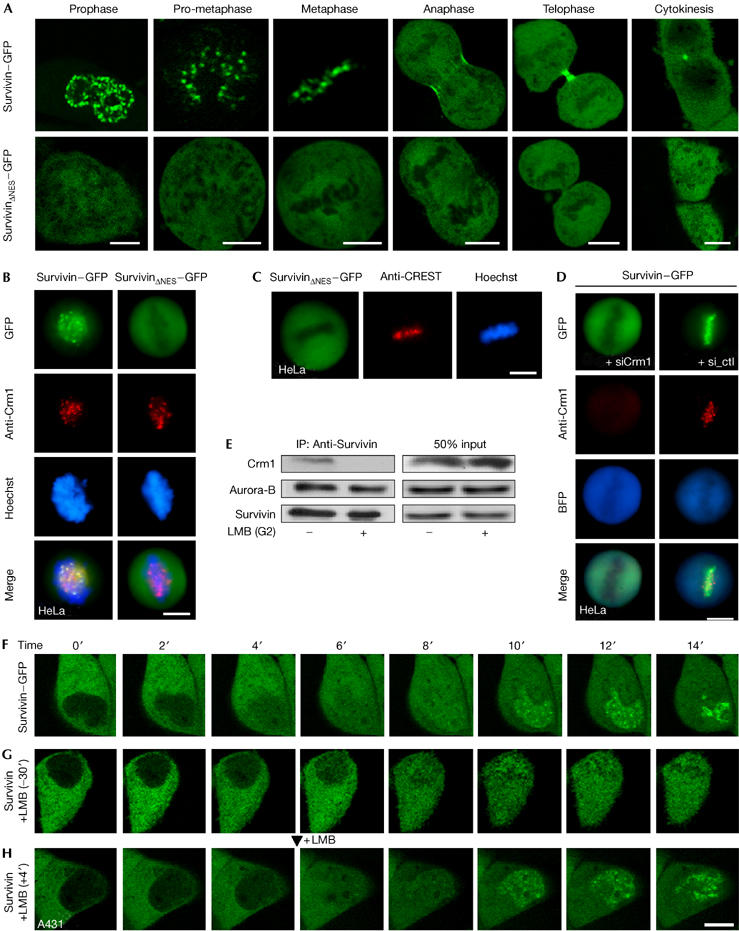
Figure 2
The Survivin–Crm1 interaction is required to tether Survivin to the centromere. (A) The localization of Survivin–GFP and SurvivinΔNES–GFP during mitosis was followed in live A431 cells. (B) Survivin–GFP but not SurvivinΔNES–GFP localizes with Crm1 at the centromere. (C) Staining of centromeres in cells expressing SurvivinΔNES–GFP using a CREST antiserum. (D) RNA-interference-mediated ablation of Crm1 impairs targeting of Survivin–GFP to the centromere. Cells were transfected with a Crm1 or a control (ctl) short interfering RNA together with a BFP expression plasmid as the transfection control. Crm1 was detected by immunostaining (red). (E) Survivin–Crm1 complex formation is abolished by leptomycin B (LMB). Immunoprecipitation of mitotic HeLa cell extracts was performed using Survivin antibody. Crm1, Survivin and Aurora-B were detected by immunoblot. (F–H) Time-lapse imaging of Survivin–GFP during G2/M transition. (G) Pretreatment of late G2 cells with LMB interfered with the (F) centromeric localization of Survivin–GFP, whereas (H) assembled chromosomal passenger complexes at the centromeres were not affected. The arrowhead indicates addition of LMB. Scale bars, 10 μm. GFP, green fluorescent protein; ΔNES, mutant nuclear export signal.
Figure 3
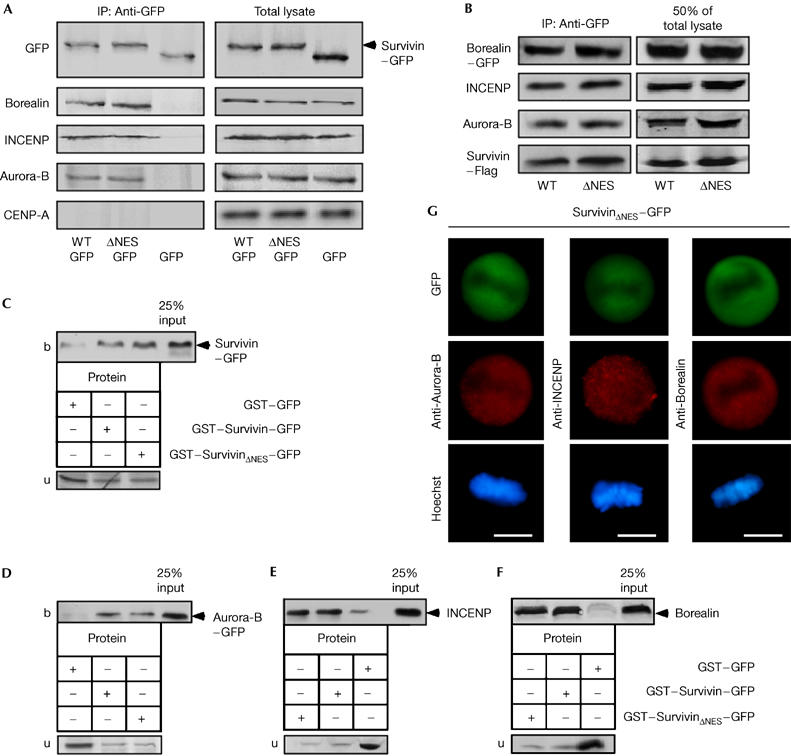
Figure 3
Survivin and SurvivinΔNES interact with subunits of the chromosomal passenger complex in vivo and in vitro. (A) Immunoprecipitations (IPs) of mitotic HeLa cell extracts were carried out with green fluorescent protein (GFP) antibody, and immunoblots were probed with the indicated antibodies. (B) IPs of chromosomal passenger complexes (CPCs) from G2 cells expressing the indicated proteins. CPCs were recovered using immobilized GFP antibody, and precipitated proteins were identified by immunoblot. (C–F) Survivin and SurvivinΔNES bind to CPC proteins in vitro. In vitro-translated, labelled (C) Survivin–GFP, (D) Aurora-B–GFP, (E) INCENP or (F) Borealin was incubated with 4 μg of recombinant GST–Survivin–GFP or GST–SurvivinΔNES–GFP prebound to glutathione Sepharose beads. GST–GFP controlled non-specific binding. Bound (b) and unbound (u) fractions were separated by SDS–polyacrylamide gel electrophoresis, and the proteins were visualized by phosphorimaging. Input: Total amount of in vitro-translated protein added to the immobilized GST–GFP proteins. (G) Expression of SurvivinΔNES–GFP interferes with the centromeric localization of CPC subunits. In SurvivinΔNES–GFP-expressing HeLa transfectants, Aurora-B, INCENP and Borealin were detected by immunostaining (red). DNA was stained with Hoechst. Scale bars, 10 μm. GST, glutathione S-transferase; LMB, leptomycin B; ΔNES, mutant nuclear export signal; WT, wild type.
Figure 4
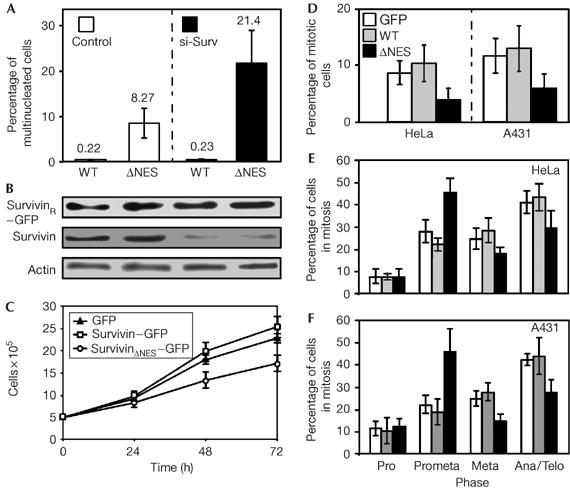
Figure 4
The Survivin–Crm1 interaction is important for correct mitotic progression. (A) HeLa cells stably expressing short interfering RNA (siRNA)-resistant Survivin–GFP fusions (SurvivinR-WT–GFP or SurvivinR-ΔNES–GFP) were transfected with Survivin siRNA (si-Surv) or a control siRNA together with an RFP expression plasmid. The number of cells with two or more nuclei was examined in 200 GFP- and RFP-double-positive cells, and the percentages of multinucleated cells were determined (mean±s.d., n=3). (B) Depletion of endogenous Survivin and similar expression levels were controlled by immunoblot using Survivin antibody. Actin was used as the loading control. (C) Proliferation of A431 cell lines expressing the indicated GFP fusions (mean±s.d., n=2). SurvivinΔNES–GFP-expressing cells show reduced proliferation and (D) less mitotic cells. Mitotic stages were analysed in (E) HeLa or (F) A431 cell lines expressing the indicated GFP proteins (mean±s.d., n=3). At least 80 GFP-positive cells were evaluated for each group. SurvivinΔNES–GFP expression increased the number of cells in pro-metaphase and decreased the number of metaphase and anaphase/telophase cells. GFP, green fluorescent protein; ΔNES, mutant nuclear export signal; WT, wild type.

References

    1. Arnaoutov A, Azuma Y, Ribbeck K, Joseph J, Boyarchuk Y, Karpova T, McNally J, Dasso M (2005) Crm1 is a mitotic effector of Ran–GTP in somatic cells. Nat Cell Biol 7: 626–632 - PubMed
    1. Dasso M (2005) Cell biology: new cog for a familiar machine. Nature 435: 899–900 - PubMed
    1. Earnshaw WC (2005) Cell biology. Keeping Survivin nimble at centromeres in mitosis. Science 310: 1443–1444 - PubMed
    1. Gassmann R, Carvalho A, Henzing AJ, Ruchaud S, Hudson DF, Honda R, Nigg EA, Gerloff DL, Earnshaw WC (2004) Borealin: a novel chromosomal passenger required for stability of the bipolar mitotic spindle. J Cell Biol 166: 179–191 - PMC - PubMed
    1. Heger P, Lohmaier J, Schneider G, Schweimer K, Stauber RH (2001) Qualitative highly divergent nuclear export signals can regulate export by the competition for transport cofactors in vivo. Traffic 2: 544–555 - PubMed

Publication types

MeSH terms