. 2006 Dec;38(12):1446-51.
doi: 10.1038/ng1917. Epub 2006 Nov 12.

A chromatin-mediated mechanism for specification of conditional transcription factor targets

Affiliations

A chromatin-mediated mechanism for specification of conditional transcription factor targets

Michael J Buck et al. Nat Genet. 2006 Dec.

Abstract

Organisms respond to changes in their environment, and many such responses are initiated at the level of gene transcription. Here, we provide evidence for a previously undiscovered mechanism for directing transcriptional regulators to new binding targets in response to an environmental change. We show that repressor-activator protein 1 (Rap1), a master regulator of yeast metabolism, binds to an expanded target set after glucose depletion despite decreasing protein levels and no evidence of posttranslational modification. Computational analysis predicts that proteins capable of recruiting the chromatin regulator Tup1 act to restrict the binding distribution of Rap1 in the presence of glucose. Deletion of the gene(s) encoding Tup1, recruiters of Tup1 or chromatin regulators recruited by Tup1 cause Rap1 to bind specifically and inappropriately to low-glucose targets. These data, combined with whole-genome measurements of nucleosome occupancy and Tup1 distribution, provide evidence for a mechanism of dynamic target specification that coordinates the genome-wide distribution of intermediate-affinity DNA sequence motifs with chromatin-mediated regulation of accessibility to those sites.


Figures
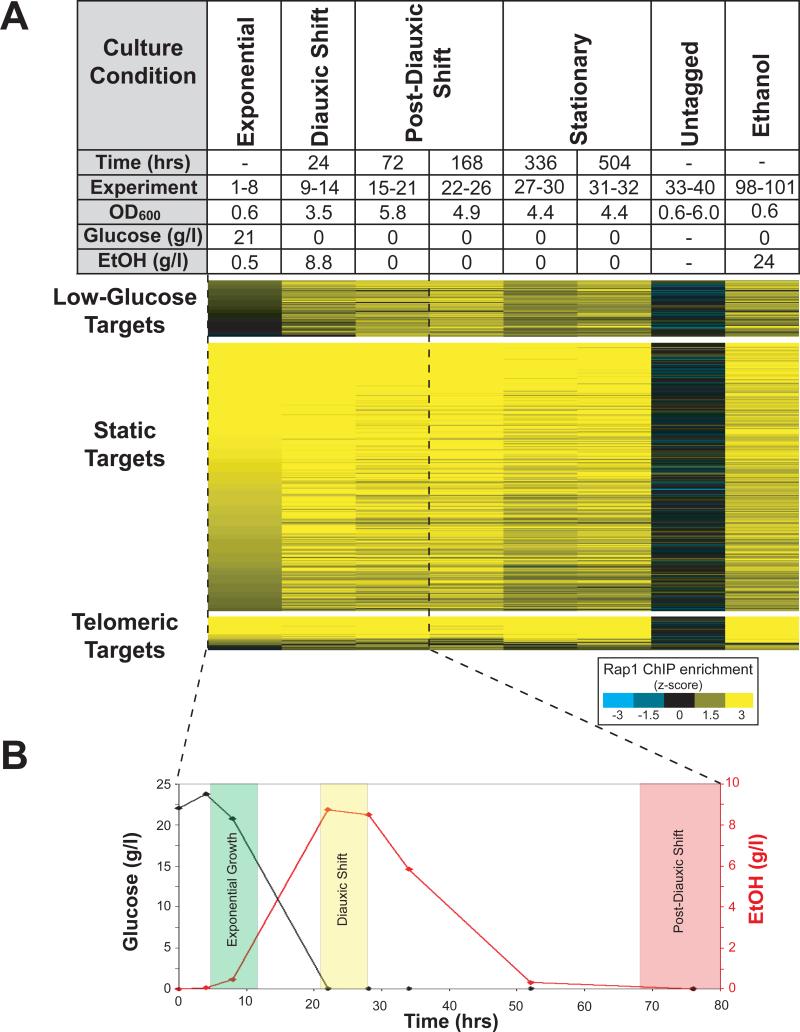
Figure 1
Figure 1. Rap1 binds to new targets in the absence of glucose
A) Rap1 ChIPs (Methods) were performed at the time points shown. For each time point, elapsed time, microarray experiment number (Table S1), optical density at 600 nm, concentration of glucose in the media, and concentration of ethanol in the media is indicated. In experiments 1-40, media initially contained 2% glucose as the sole carbon source. The enrichment, by z-score, of genomic regions by Rap1 ChIP is indicated by color (scalebar, lower right). Enriched loci were grouped into three categories: telomeric targets, static targets, and low-glucose targets (Methods). The 262 static targets were bound at all time points. Telomeric targets are located within 10 kb of a telomere. The 52 low-glucose targets were bound by Rap1 only after depletion of glucose, and include the promoters of genes involved in alternative carbon source utilization, stationary-phase survival, and other nutrient utilization pathways (Figure S5). To show that carbon source controls the observed redistribution of Rap1, we performed Rap1 ChIPs from cells that were grown in media identical to that used in experiments 1-40, except that 2.4% ethanol was provided as a carbon source (experiments 98-101, rightmost column). B) After 24 hours in culture, glucose was depleted completely and ethanol levels peaked at 8.8 g/l. After 72 hours, all ethanol in the media had been consumed. The shaded regions show when samples were ChIPed.
Figure 2
Figure 2. In the absence of Tup1 or proteins that recruit Tup1, Rap1 binds specifically and inappropriately to low-nutrient targets
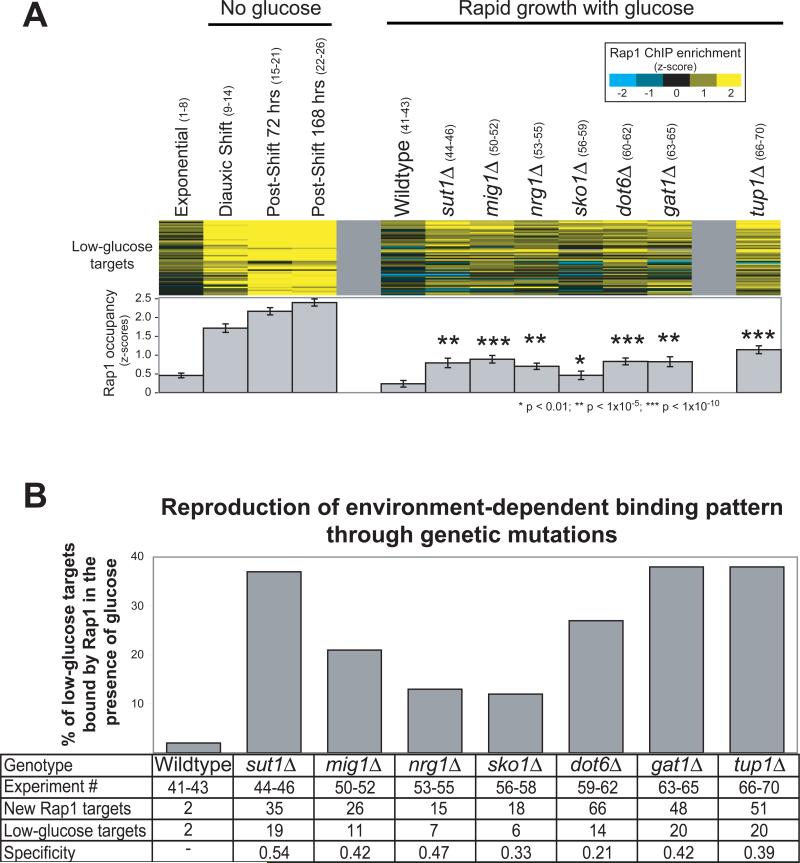
A) Rap1 occupancy determined by ChIP is shown at the 52 low-glucose targets in the indicated mutant strains (z-scores for enrichment, scalebar upper right). Experiments 1-26 (shown in parentheses, detailed in Table S1) measure Rap1 occupancy over a timecourse as glucose is depleted from the media. Experiments 41-46 and 50-70 measure Rap1 occupancy at a single timepoint in the indicated strain during exponential growth in the presence of glucose. Enrichment in each deletion strain was compared to wildtype by t-test. B) For each strain the targets bound by Rap1 were determined by ChIPOTle (Methods). The percentage of low-glucose targets bound inappropriately by Rap1 is plotted. Error bars are not appropriate here because the percentage of targets bound is determined using all experimental replicates and takes measurement variability into account. Indicated at the bottom is the experiment number, the total number of new Rap1 targets observed relative to wild-type, the number of those new targets that were also low-glucose targets, and a statistic termed “specificity”, calculated as: (low-glucose targets / total new targets).
Figure 3
Figure 3. Tup1 restricts Rap1 binding through chromatin-modifying co-factors
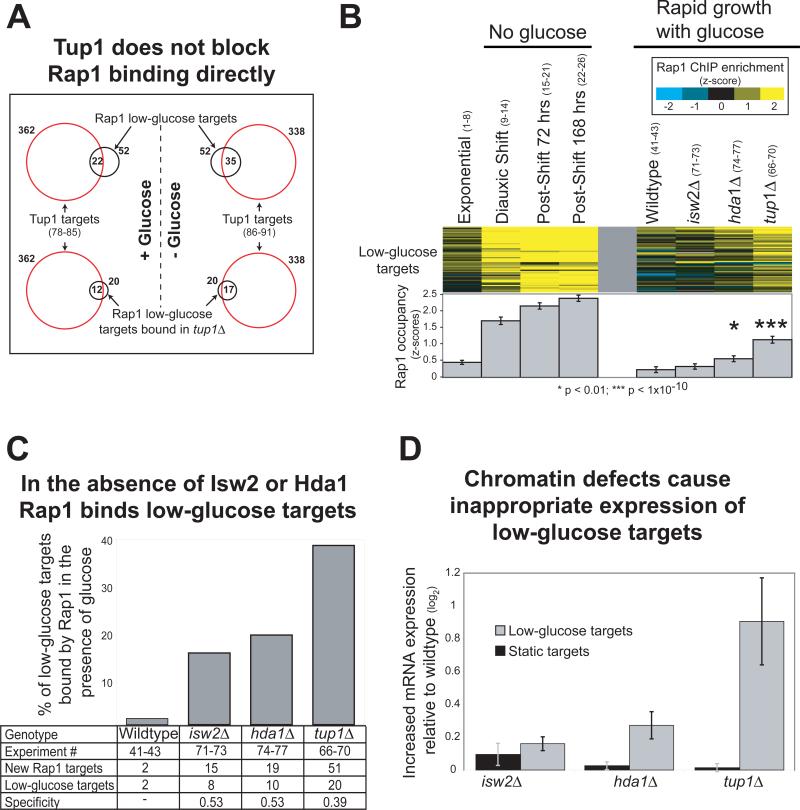
A) Genomic loci bound by Tup1 in wildtype cells (red circles) as determined by ChIP-chip (p<0.005, Methods) during growth in the presence of glucose (left) and after glucose had been depleted from the media (right). Rap1 low-glucose targets are indicated by black circles (upper) and the subset of those targets also bound inappropriately in a tup1Δ strain is shown in the lower panel. Tup1 targets indicated in the lower panel are identical to those in the upper panels, and are reproduced for comparison to the respective Rap1 targets. B) Rap1 occupancy in strains lacking the Tup1-associated chromatin modifying proteins Isw2 and Hda1, as determined by ChIP-chip during exponential growth in the presence of glucose (see Figure 2A for details). C) Same as Figure 2B, but for the strains indicated. D) The average mRNA expression change, (deletion over wildtype) of the genes downstream of 23 low-glucose Rap1 targets and 223 static targets. To avoid ambiguity regarding which gene might be regulated by Rap1, only genes downstream of unidirectional promoters are plotted.
Figure 4
Figure 4. Low-glucose Rap1 targets contain Sko1, Sut1, or Mig1 binding sites and a weak Rap1 consensus motif
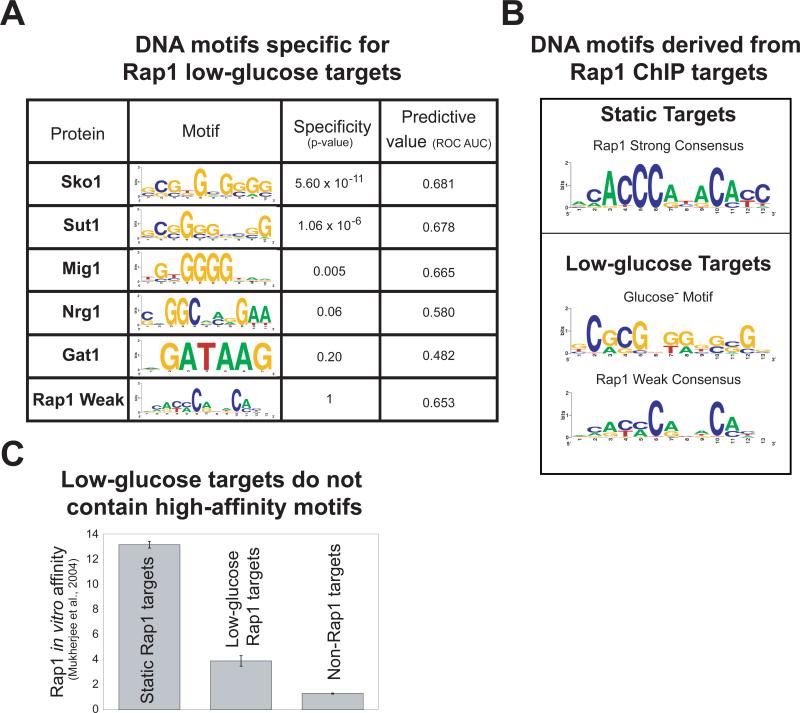
A) The specificity of sequence motifs for low-glucose versus static targets was determined using ROVER with a site p-value cutoff of 0.001. The value of each motif in predicting Rap1 binding was determined using the area under (AUC) the receiver operator characteristic (ROC) plot, with each promoter represented by the motif score generated by the MatrixScan module of BioProspector. Motif scores encapsulate the similarity of DNA sequences at each locus to the specified position weight matrix (PWM). ROC plots show how low-glucose targets (true positives) were captured in relation to non-low-glucose targets (false positives) for a given motif score. A motif that had no predictive value would have an AUC of about 0.5; higher values are better (maximum = 1). B) Overrepresented DNA sequence motifs for static and low-glucose Rap1 targets were determined using MDscan and BioProspector,. The motif found for the static targets is the archetypical Rap1 binding motif. The most significant motif discovered for the low-glucose targets is very similar to the Sut1 binding motif. We identified the Rap1-weak motif through a directed search using a degenerate Rap1-Strong PWM (methods). All PWMs are displayed as sequence logos. C) Rap1 in vitro binding affinity for low-glucose-, static-, and non-Rap1 targets was enumerated using published protein binding microarray data. “Protein binding microarray” is a technique that determines a protein's in vitro DNA-binding specificity for a set of arrayed loci or DNA sequences.
Figure 5
Figure 5. Loss of nucleosomes allows Rap1 to bind to intermediate-affinity targets
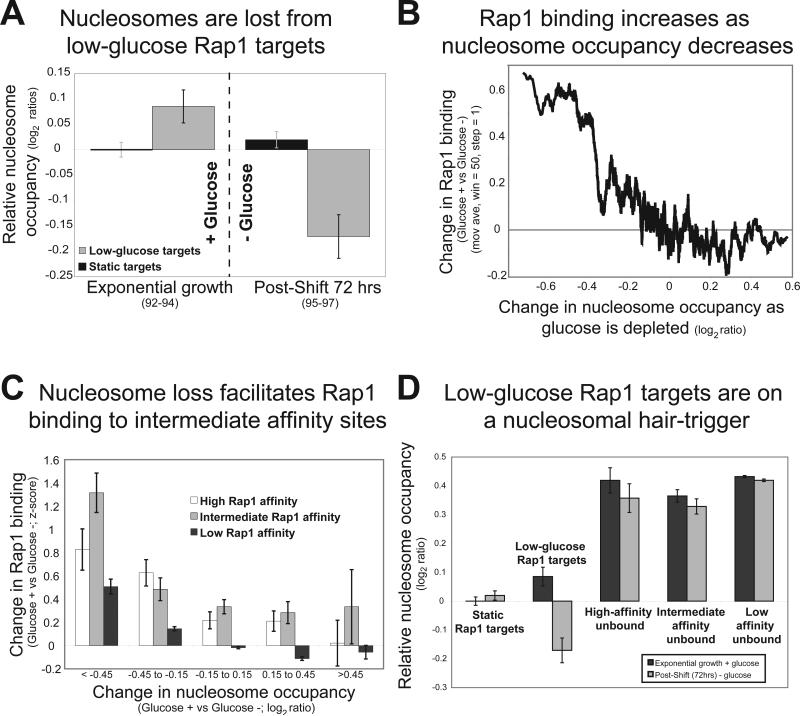
A) Nucleosome occupancy was determined by ChIP-chip with an anti-Histone H3 antibody during exponential growth in the presence of glucose (left) and after glucose had been depleted from the media (right). Nucleosome occupancy is plotted relative to static targets during exponential growth. Error bars indicate the standard error. During growth in the presence of glucose, unbound low-glucose targets have a higher nucleosome occupancy then bound-static targets (p = 0.073). In the absence of glucose, both groups of targets are bound by Rap1, but low-glucose sites have significantly lower (p < 5 × 10⁻⁵) nucleosome occupancy than static targets. Experiment numbers are indicated in parentheses. B) Loci were sorted by their change in nucleosome occupancy upon glucose depletion. A moving average of the change in Rap1 occupancy upon glucose depletion is plotted on the y-axis. C) Intergenic regions were grouped into three categories based on their Rap1 binding affinity (high, intermediate, or low affinity) as measured by PBM. The 306 high-affinity regions had PBM p-values less than 1 × 10⁻⁶, the 288 intermediate affinity regions had PBM p-values between 0.01 and 1 × 10⁻⁶, and the remaining 4945 sites were classified as low-affinity. The average change in Rap1 occupancy (x axis) was determined for each group as a function of the change in nucleosome occupancy (y axis). D) Low-glucose Rap1 targets are on a nucleosomal hair-trigger. Nucleosome occupancy in the presence (black) and absence (gray) of glucose is plotted for all yeast intergenic regions. Values are relative to static Rap1 targets in the presence of glucose. Intergenic regions were separated into five groups: static Rap1 targets, low-glucose Rap1 targets, unbound loci containing high-affinity Rap1 sites, unbound loci containing intermediate-affinity Rap1 sites and unbound loci containing low-affinity Rap1 sites.
Figure 6
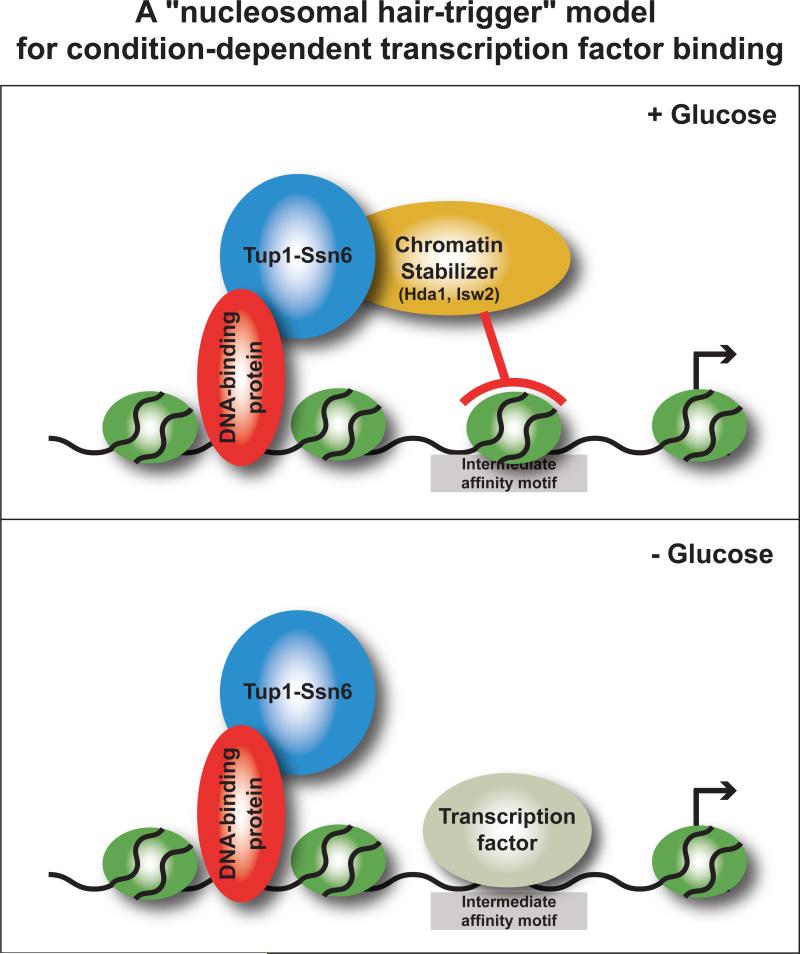
Figure 6. A “nucleosomal hair-trigger” model for condition-dependent transcription factor binding through coordinated interplay between local chromatin structure and DNA-binding affinity
See text for details. Note that rather than the typical case of chromatin remodeling proteins acting to remove a nucleosome to effect activation, in this mechanism the enzymes act to position nucleosomes into a repressive configuration. Therefore, the default state of this system is factor binding and gene activation.

References

    1. Jacob F, Monod J. Genetic regulatory mechanisms in the synthesis of proteins. J Mol Biol. 1961;3:318–56. - PubMed
    1. Harbison CT, et al. Transcriptional regulatory code of a eukaryotic genome. Nature. 2004;431:99–104. - PMC - PubMed
    1. O'Neill EM, Kaffman A, Jolly ER, O'Shea EK. Regulation of PHO4 nuclear localization by the PHO80-PHO85 cyclin-CDK complex. Science. 1996;271:209–12. - PubMed
    1. Gu W, Roeder RG. Activation of p53 sequence-specific DNA binding by acetylation of the p53 C-terminal domain. Cell. 1997;90:595–606. - PubMed
    1. Zubay G, Schwartz D, Beckwith J. Mechanism of activation of catabolite-sensitive genes: a positive control system. Proc Natl Acad Sci U S A. 1970;66:104–10. - PMC - PubMed

Publication types

MeSH terms

Associated data