. 2007 Feb;75(2):723-35.
doi: 10.1128/IAI.00956-06. Epub 2006 Nov 13.

Environmental mimics and the Lvh type IVA secretion system contribute to virulence-related phenotypes of Legionella pneumophila

Affiliations

Environmental mimics and the Lvh type IVA secretion system contribute to virulence-related phenotypes of Legionella pneumophila

Purnima Bandyopadhyay et al. Infect Immun. 2007 Feb.

Abstract

Legionella pneumophila, the causative organism of Legionnaires' disease, is a fresh-water bacterium and intracellular parasite of amoebae. This study examined the effects of incubation in water and amoeba encystment on L. pneumophila strain JR32 and null mutants in dot/icm genes encoding a type IVB secretion system required for entry, delayed acidification of L. pneumophila-containing phagosomes, and intracellular multiplication when stationary-phase bacteria infect amoebae and macrophages. Following incubation of stationary-phase cultures in water, mutants in dotA and dotB, essential for function of the type IVB secretion system, exhibited entry and delay of phagosome acidification comparable to that of strain JR32. Following encystment in Acanthamoeba castellanii and reversion of cysts to amoeba trophozoites, dotA and dotB mutants exhibited intracellular multiplication in amoebae. The L. pneumophila Lvh locus, encoding a type IVA secretion system homologous to that in Agrobacterium tumefaciens, was required for restoration of entry and intracellular multiplication in dot/icm mutants following incubation in water and amoeba encystment and was required for delay of phagosome acidification in strain JR32. These data support a model in which the Dot/Icm type IVB secretion system is conditionally rather than absolutely required for L. pneumophila virulence-related phenotypes. The data suggest that the Lvh type IVA secretion system, previously thought to be dispensable, is involved in virulence-related phenotypes under conditions mimicking the spread of Legionnaires' disease from environmental niches. Since environmental amoebae are implicated as reservoirs for an increasing number of environmental pathogens and for drug-resistant bacteria, the environmental mimics developed here may be useful in virulence studies of other pathogens.


Figures

FIG. 1.
FIG. 1.
Reversal of defective entry into amoebae and macrophages by WS treatment. Stationary phase (Stat) or WS-treated (WS) cultures of the indicated L. pneumophila strains were used to infect A. castellanii trophozoites (A), J774 mouse macrophages (B), or primary cultures of bone marrow macrophages from A/J mice (C) at an MOI of 2 at 28°C (A) or 100 at 37°C (B and C). At 30 min (A and C) or 60 min (B) postinfection, samples were fixed and stained, and entry of GFP-expressing Legionella was quantified by epifluorescence microscopy. Means and standard deviations are shown. The number of independent experiments, i.e., experiments performed on separate days in addition to the replicates performed on a given day, in which the effect of WS treatment on entry was shown is three for dotA and five for dotB in panel A; seven for dotA, six for dotB, and two for all other dot/icm mutants in panel B, and three for dotA and three for dotB in panel C.
FIG. 2.
FIG. 2.
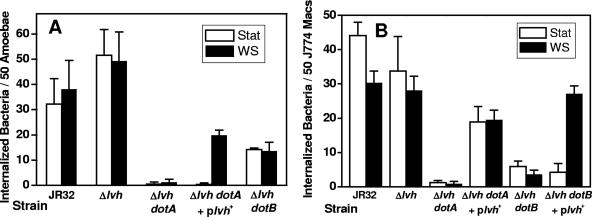
Reversal of defective entry by WS treatment requires the lvh locus. Entry into A. castellanii trophozoites (A) or J774 macrophages (B) was quantified as described in the legend of Fig. 1. Strains are the Δlvh deletion mutant, the Δlvh dotA dotB double mutants, or double mutants complemented with the lvh locus on a plasmid, plvh+. In panel A reference values for the dotA and dotB single mutants are 1.5 (stationary phase) and 50 (WS) and 11.2 (stationary phase) and 66 (WS), respectively, internalized bacteria/50 amoebae. Reference values in panel B for the dotA and dotB single mutants are, respectively, 7.9 (stationary phase) and 48 (WS) and 5.6 (stationary phase) and 34 (WS), respectively, internalized bacteria/50 J774 macrophages. The number of independent experiments in which the effect of the Δlvh mutation on entry and complementation of this effect were shown is two for Δlvh dotA, two for Δlvh dotA plvh+, and three for Δlvh dotB in panel A and one for Δlvh dotA and Δlvh dotA plvh+, three for Δlvh dotB, and one for Δlvh dotB plvh+ in panel B. Stat, stationary phase.
FIG. 3.
FIG. 3.
Effect of WS treatment and the lvh locus on delay of phagosome acidification. Cultured J774 macrophages (A and C) or primary cultures of bone marrow mouse macrophages (B) were incubated with LysoTracker Red then infected with stationary phase (Stat) or WS-treated (WS) cultures of the indicated L. pneumophila strain at an MOI of 10 or 50 (A and C) or 100 (B) at 37°C. After 1 h, the samples were fixed and stained, and colocalization of GFP-expressing Legionella with LysoTracker was quantified by epifluorescence microscopy. (A and B) The colocalization of stationary-phase cultures was significantly different from that of the respective WS culture (P < 0.001) for dotA, dotB, icmE, and icmF mutants of strain JR32. For these four strains colocalization of WS cultures was not significantly different from that of WS-treated strain JR32 (P values of 0.12 to 0.84). Colocalization of the Δlvh dotB double mutant was significantly different from that of the Δlvh mutant for WS cultures (P = 0.02) and showed a trend to be different for Δlvh dotB and Δlvh Stat cultures (P = 0.12). (C) Colocalization with LysoTracker in J774 macrophages for strain JR32 or the Δlvh mutant containing no vector, vector pMMB207, or the complementing pMMB207 plasmid (plvh+) was determined as in panel A. Following complementation, colocalization of stationary-phase Δlvh mutant was significantly different from Δlvh mutant strains without vector or with pMMB207 (P < 0.006). Colocalization for the WS-complemented Δlvh mutant showed a trend to be different from Δlvh strains with no vector or with pMMB207 (P values of 0.1 to 0.2). Colocalization of the JR32 strain with plvh+ was not significantly different from JR32 strains with no vector or with pMMB207 for stationary-phase or WS cultures (P > 0.6). The number of independent experiments in which the effect of WS on colocalization was as shown in panel A is nine for dotA, six for dotB, five for Δlvh, three for icmG, two for icmE and icmF, and one for the Δlvh dotB mutant. Reversal of defective colocalization in BMMs as in panel B was shown in two independent experiments for dotA and dotB. Complementation of the defective colocalization of stationary-phase or WS-treated Δlvh mutant (C) was shown in two independent experiments.
FIG. 4.
FIG. 4.
Stationary-phase and WS-treated cultures of dotA and dotB mutants are nonreplicative in amoeba trophozoites and macrophages. A. castellanii trophozoites (A) or cultured J774 mouse macrophages (B) were infected with stationary-phase (filled symbols) or WS treated cultures (open symbols) of the indicated L. pneumophila strain at an MOI of 1, and intracellular multiplication was quantified by titer of the infection medium during incubation at 28°C (A) or 37°C (B). The number of independent experiments in which stationary-phase or WS-treated cultures were unable to replicate is two for dotA and two for dotB in A. castellanii trophozoites and one for dotA and two for dotB in J774 macrophages. t0, time zero.
FIG. 5.
FIG. 5.
Intracellular multiplication of internalized dotA and dotB mutants in amoebae following reversion of cysts to trophozoites. A. castellanii trophozoites were infected with WS-treated cultures of the indicated L. pneumophila strain at an MOI of 10 at 28°C. After 30 min external bacteria were removed by washing, and trophozoites containing internalized bacteria were converted to cysts at 4°C. After 19 h at 4°C, cysts were reverted to trophozoites at 28°C, and intracellular multiplication was quantified by titer of the infection medium at the indicated times after addition to microtiter dishes. The number of independent experiments in which intracellular multiplication comparable to that in panel A was observed is 10 for strain JR32 and seven for the Δlvh mutant. For panel B the number of independent experiments in which an increase in titer comparable to or greater than that shown was observed is five for dotA and seven for dotB. Decreased intracellular multiplication in the Δlvh dotB mutant was observed in three independent experiments. t0, time zero.
FIG. 6.
FIG. 6.
Microscopic assay of intracellular growth after reversion of amoeba cysts to trophozoites. A. castellanii trophozoites were infected with the indicated WS-treated Legionella strain containing plasmid GFP, converted to amoeba cysts, then reverted to trophozoites as described in the legend of Fig. 5, and then adhered to glass coverslips. At the indicated times after adherence to coverslips, infected amoebae were fixed and stained for visualization of internal bacteria. In panel A values at 22 h are significantly different from respective values at 1 h for JR32, Δlvh, dotA, and dotB strains (P ≤ 0.02). For Δlvh dotA and Δlvh dotB strains, values at 22 and 47 h are not significantly different from respective values at 1 h (P > 0.3). For dotA and dotB strains, values at 47 h are not significantly different from respective values at 1 h (P > 0.3). Intracellular replication was shown in three independent experiments for the dotA and dotB mutants, and a decrease in replication for the Δlvh dotA and Δlvh dotB mutants was shown in two independent experiments. In panel B at 4.5 h, P values for single versus Δlvh double mutants are 0.064 and 0.029 for dotA and dotB mutants, respectively. At 21 h, P values for the corresponding comparisons are 0.11 and 0.001. The P values for the Δlvh double mutants versus the corresponding strains complemented with plvh+ are 0.16 and 0.19 for dotA and dotB mutants, respectively, at 4.5 h and 0.35 and 0.013, respectively, at 21 h. The experiment with the plvh+-complemented strains in panel B was performed once.

References

    1. Abd, H., T. Johansson, I. Golovliov, G. Sandstrom, and M. Forsman. 2003. Survival and growth of Francisella tularensis in Acanthamoeba castellanii. Appl. Environ. Microbiol. 69:600-606. - PMC - PubMed
    1. Abd, H., A. Weintraub, and G. Sandstrom. 2005. Intracellular survival and replication of Vibrio cholerae O139 in aquatic free-living amoebae. Environ. Microbiol. 7:1003-1008. - PubMed
    1. Bandyopadhyay, P., B. Byrne, Y. Chan, M. S. Swanson, and H. M. Steinman. 2003. Legionella pneumophila catalase-peroxidases are required for proper trafficking and growth in primary macrophages. Infect. Immun. 71:4526-4535. - PMC - PubMed
    1. Bandyopadhyay, P., and H. M. Steinman. 2000. Catalase-peroxidases of Legionella pneumophila: cloning of the katA gene and studies of KatA function. J. Bacteriol. 182:6679-6686. - PMC - PubMed
    1. Bandyopadhyay, P., and H. M. Steinman. 1998. Legionella pneumophila catalase-peroxidases: cloning of the katB gene and studies of KatB function. J. Bacteriol. 180:5369-5374. - PMC - PubMed

Substances

LinkOut - more resources