Why yeast cells can undergo apoptosis: death in times of peace, love, and war
- PMID: 17101700
- PMCID: PMC2064587
- DOI: 10.1083/jcb.200608098
Why yeast cells can undergo apoptosis: death in times of peace, love, and war
Abstract
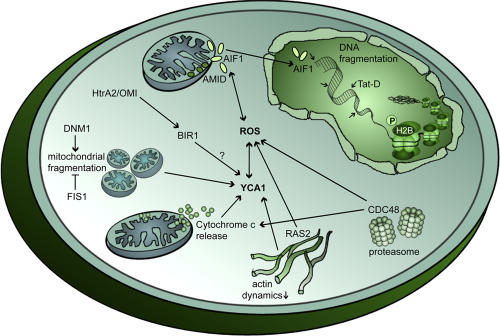
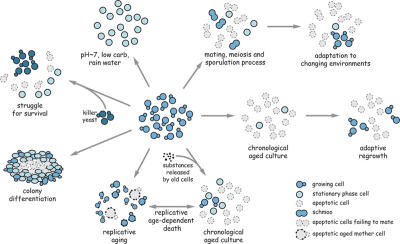
The purpose of apoptosis in multicellular organisms is obvious: single cells die for the benefit of the whole organism (for example, during tissue development or embryogenesis). Although apoptosis has also been shown in various microorganisms, the reason for this cell death program has remained unexplained. Recently published studies have now described yeast apoptosis during aging, mating, or exposure to killer toxins (Fabrizio, P., L. Battistella, R. Vardavas, C. Gattazzo, L.L. Liou, A. Diaspro, J.W. Dossen, E.B. Gralla, and V.D. Longo. 2004. J. Cell Biol. 166:1055-1067; Herker, E., H. Jungwirth, K.A. Lehmann, C. Maldener, K.U. Frohlich, S. Wissing, S. Buttner, M. Fehr, S. Sigrist, and F. Madeo. 2004. J. Cell Biol. 164:501-507, underscoring the evolutionary benefit of a cell suicide program in yeast and, thus, giving a unicellular organism causes to die for.
Figures
References
-
- Ahn, S.H., W.L. Cheung, J.Y. Hsu, R.L. Diaz, M.M. Smith, and C.D. Allis. 2005. a. Sterile 20 kinase phosphorylates histone H2B at serine 10 during hydrogen peroxide-induced apoptosis in S. cerevisiae. Cell. 120:25–36. - PubMed
-
- Ahn, S.H., K.A. Henderson, S. Keeney, and C.D. Allis. 2005. b. H2B (Ser10) phosphorylation is induced during apoptosis and meiosis in S. cerevisiae. Cell Cycle. 4:780–783. - PubMed
Publication types
MeSH terms
Substances
LinkOut - more resources
Full Text Sources
Molecular Biology Databases