. 2006 Nov-Dec;13(6):809-19.
doi: 10.1101/lm.334306. Epub 2006 Nov 13.

Spatial and nonspatial escape strategies in the Barnes maze

Affiliations

Spatial and nonspatial escape strategies in the Barnes maze

Fiona E Harrison et al. Learn Mem. 2006 Nov-Dec.

Abstract

The Barnes maze is a spatial memory task that requires subjects to learn the position of a hole that can be used to escape the brightly lit, open surface of the maze. Two experiments assessed the relative importance of spatial (extra-maze) versus proximal visible cues in solving the maze. In Experiment 1, four groups of mice were trained either with or without a discrete visible cue marking the location of the escape hole, which was either in a fixed or variable location across trials. In Experiment 2, all mice were trained with the discrete visible cue marking the target hole location. Two groups were identical to the cued-target groups from Experiment 1, with either fixed or variable escape locations. For these mice, the discrete cue either was the sole predictor of the target location or was perfectly confounded with the spatial extra-maze cues. The third group also used a cued variable target, but a curtain was drawn around the maze to prevent the use of spatial cues to guide navigation. Probe trials with all escape holes blocked were conducted to dissociate the use of spatial and discrete proximal cues. We conclude that the Barnes maze can be solved efficiently using spatial, visual cue, or serial-search strategies. However, mice showed a strong preference for using the distal room cues, even when a discrete visible cue clearly marked the escape location. Importantly, these data show that the cued-target control version of the Barnes maze as typically conducted does not dissociate spatial from nonspatial abilities.


Figures
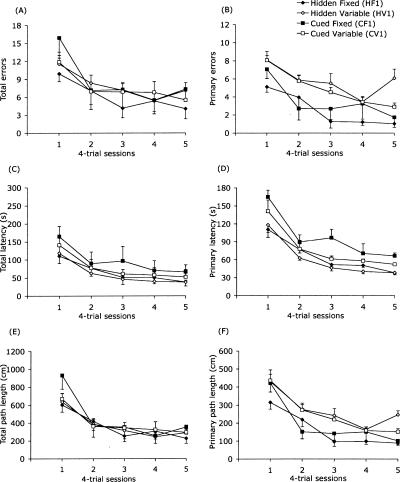
Figure 1.
Figure 1.
Barnes maze acquisition in Experiment 1 (mean ± SEM of four trials per day). Performance improved significantly in all groups over the course of training. There were no significant group differences on the measures of total errors (A). In contrast, mice trained with a fixed target location (HF1 and CF1 groups) made significantly fewer primary errors (B) and had shorter primary path lengths (F) than did mice trained with a variable target location (HV1 and CV1 groups) during training trials. Experimental groups did not differ on total latency, primary latency, or total path length (C, D, E, respectively).
Figure 2.
Figure 2.
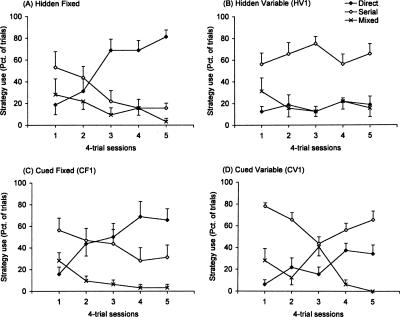
Search strategies used during Barnes maze training in Experiment 1. Mice in all groups started training with a preference for using a serial search; direct searches on the first day of training were at chance levels. Over the course of training, mice trained with a fixed target location (HF1 and VF1 groups) completed more trials with direct than serial-search strategies (A, C). Inversely, mice trained with a variable target location (HV1 and CV1 groups) showed a clear preference for serial over direct search strategies (B, D). Data represent the mean (±SEM) percentage of trials on which each strategy type was used.
Figure 3.
Figure 3.
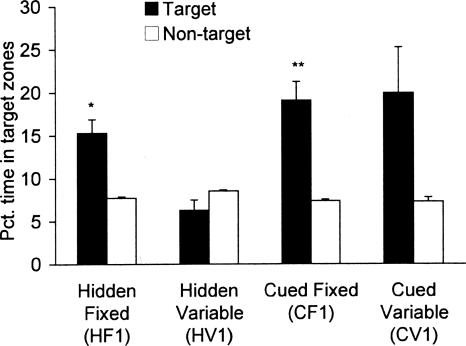
Mean (±SEM) percentage of time spent in target and nontarget zones on the 5-min probe trial in Experiment 1. All groups except HV1 spent a greater proportion of time at the target location compared with the average time spent at other hole locations, demonstrating good memory for the location of the former escape hole. For the HV1 group, the escape hole was unmarked and varied randomly from trial to trial during training. Thus for this group, the target from the final training trial was assigned as the target hole for the probe trial and compared with the other 11 holes. Predictably, this group did not show a preference for any of the holes. Asterisks represent significant difference from mean of time spent at nontarget locations: *P < 0.05, **P < 0.01.
Figure 4.
Figure 4.
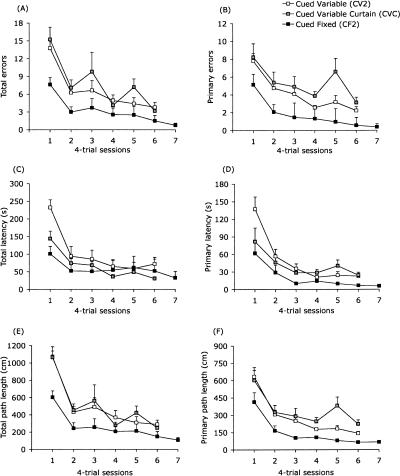
Acquisition curves from Experiment 2. Consistent with the results of Experiment 1, the fixed-target group (CF2) performed better than did the variable-target groups. Mice in the CF2 group made significantly fewer primary errors (B) and had shorter primary path lengths (F) than did CV2 and CVC groups. There were no significant group differences in total errors (A), total path length (E), total latency (C), or primary latency (D). Data represent mean (±SEM) of four trials per day.
Figure 5.
Figure 5.
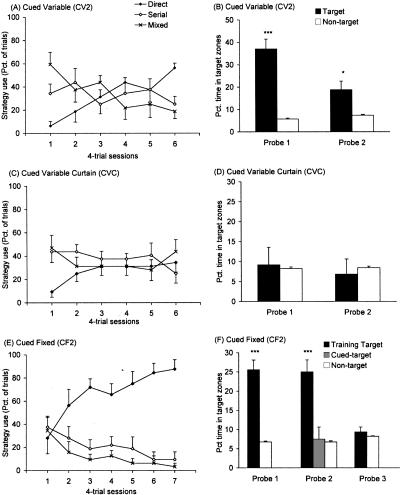
Strategy use and time spent at target locations during probe trials in Experiment 2. Neither CV2 nor CVC groups showed a preference for any particular search strategy (A, C). Mice in the CF2 group had a strong preference for direct- over serial- or mixed/random-search strategies (E). The CF2 group continued to use direct searches on day 7, when training trials were conducted in the absence of the discrete cue. During the probe trials, mice in the CV2 group showed a distinct preference for the target location marked with a discrete visible cue (B). Mice run under identical conditions but with a curtain drawn around the maze (CVC) failed to show a preference for the cued location over nontarget locations during probe trials (D). The CF2 group, for which spatial and discrete cues were confounded and always marked the location of the escape hole during training, spent more time near the target during the first probe trial (F). On the second probe trial, when the discrete cue was moved to the opposite side of the maze, mice in the CF2 group ignored the cue and lingered near the target zone associated with the spatial room cues. On the third probe trial, a white curtain was drawn around the maze to obscure the room cues. Under these conditions, the CF2 group did not show a preference for the target location over the other 11 locations. Asterisks represent significant difference from mean time spent at nontarget locations: *P < 0.05, ***P < 0.001.

References

    1. Barnes C.A. Memory deficits associated with senescence: A neurophysiological and behavioral study in the rat. J. Comp. Physiol. Psychol. 1979;93:74–104. - PubMed
    1. Bernardo A., McCord M., Troen A.M., Allison J.D., McDonald M.P. Impaired spatial memory in APP-overexpressing mice on a homocysteinemia-inducing diet. Neurobiol. Aging. 2006 (in press) - PubMed
    1. Biegler R., Morris R.G. Landmark stability is a prerequisite for spatial but not discrimination learning. Nature. 1993;361:631–633. - PubMed
    1. Biegler R., Morris R.G. Landmark stability: Further studies pointing to a role in spatial learning. Q. J. Exp. Psychol. B. 1996;49:307–345. - PubMed
    1. Biegler R., Morris R.G. Blocking in the spatial domain with arrays of discrete landmarks. J. Exp. Psychol. Anim. Behav. Process. 1999;25:334–351. - PubMed

Publication types

LinkOut - more resources