


Parental determinants of neonatal body composition
- PMID: 17105847
- PMCID: PMC2080689
- DOI: 10.1210/jc.2006-0456
Parental determinants of neonatal body composition
Abstract
Background: The prevalence of both childhood and adult obesity is rising in the developed world, and there is increasing interest in its underlying causes. A number of studies suggest a positive relationship between birth weight and childhood body mass index, but less is known about specific prenatal environmental influences on more direct measures of obesity. We used data from the Southampton Women's Survey to investigate parental influences on neonatal body composition ascertained by dual x-ray absorptiometry.
Methods: Participating mothers were characterized in detail (anthropometry, lifestyle, diet) before and during pregnancy; information was also obtained on their partners. The offspring underwent assessment of fat and lean body mass by dual x-ray absorptiometry within 2 wk of birth. Linear regression methods were used to explore the parental determinants of neonatal body composition.
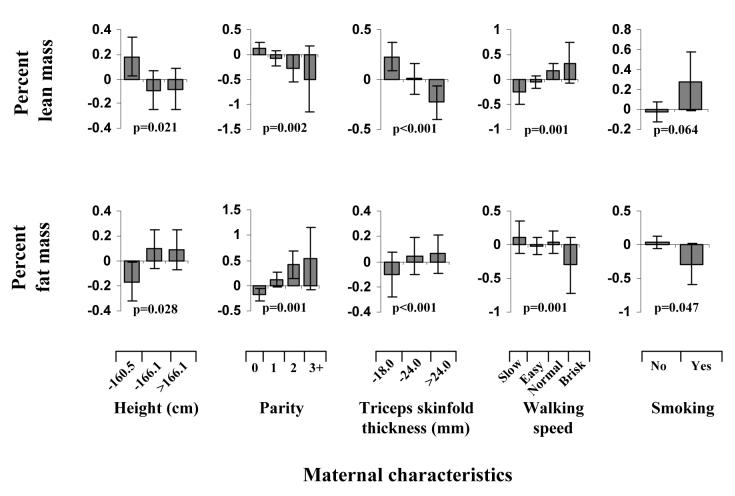
Results: Complete data were available for 448 mother-offspring pairs. Taller women and those with higher parity had offspring with increased birth weight, fat, and lean mass (P < 0.05). Mothers who were taller, of greater parity, had greater fat stores, or walked more slowly also had offspring with greater proportionate body fat at birth (all P < 0.05). There was a weaker trend toward lower percentage fat and greater percentage lean in the offspring of mothers who smoked during pregnancy.
Conclusion: Maternal size, parity, smoking history, walking speed, and fat stores are independent determinants of neonatal body composition. If these influences are shown to have persisting effects on body composition through to adulthood, they point to novel public health interventions early in life to prevent later obesity.
Figures
References
-
- Sayer AA, Syddall HE, Dennison EM, Gilbody HJ, Duggleby SL, Cooper C, et al. Birth weight, weight at one year and body composition in older men: findings from the Hertfordshire Cohort Study. Am J Clin Nut. 2004;80:199–203. - PubMed
-
- Fall CH, Stein CE, Kumaran K, Cox F, Osmond C, Barker DJ, Hales CN. Size at birth, maternal weight, and type 2 diabetes in South India. Diabet Med. 1998;15:220–227. - PubMed
Publication types
MeSH terms
Grants and funding
- MC_U147574237/MRC_/Medical Research Council/United Kingdom
- MC_U147585827/MRC_/Medical Research Council/United Kingdom
- U.1475.00.004.00002.01(74240)/MRC_/Medical Research Council/United Kingdom
- MC_U147574240/MRC_/Medical Research Council/United Kingdom
- MC_UP_A620_1014/MRC_/Medical Research Council/United Kingdom
LinkOut - more resources
Full Text Sources
Medical
