


Intracranial adeno-associated virus-mediated delivery of anti-pan amyloid beta, amyloid beta40, and amyloid beta42 single-chain variable fragments attenuates plaque pathology in amyloid precursor protein mice
- PMID: 17108166
- PMCID: PMC6674861
- DOI: 10.1523/JNEUROSCI.2795-06.2006
Intracranial adeno-associated virus-mediated delivery of anti-pan amyloid beta, amyloid beta40, and amyloid beta42 single-chain variable fragments attenuates plaque pathology in amyloid precursor protein mice
Erratum in
- J Neurosci. 2006 Dec 6;26(49):preceding 12847
Abstract
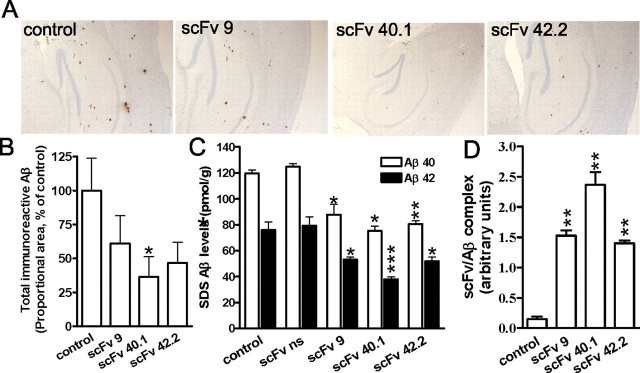
Accumulation of amyloid beta protein (Abeta) aggregates is hypothesized to trigger a pathological cascade that causes Alzheimer's disease (AD). Active or passive immunizations targeting Abeta are therefore of great interest as potential therapeutic strategies. We have evaluated the use of recombinant anti-Abeta single-chain variable fragments (scFvs) as a potentially safer form of anti-Abeta immunotherapy. We have generated and characterized three anti-Abeta scFvs that recognize Abeta 1-16, Abeta x-40, or Abeta x-42. To achieve widespread brain delivery, constructs expressing these anti-Abeta scFvs were packaged into adeno-associated virus (AAV) vectors and injected into the ventricles of postnatal day 0 (P0) amyloid precursor protein CRND8-transgenic mice. Intracranial delivery of AAV to neonatal mice resulted in widespread neuronal delivery. In situ expression of each of the anti-Abeta scFvs after intracerebroventricular AAV serotype 1 delivery to P0 pups decreased Abeta deposition by 25-50%. These data suggest that intracranial anti-Abeta scFv expression is an effective strategy to attenuate amyloid deposition. As opposed to transgenic approaches, these studies also establish a "somatic brain transgenic" paradigm to rapidly and cost-effectively evaluate potential modifiers of AD-like pathology in AD mouse models.
Figures


References
-
- Banks WA, Pagliari P, Nakaoke R, Morley JE. Effects of a behaviorally active antibody on the brain uptake and clearance of amyloid beta proteins. Peptides. 2005;26:287–294. - PubMed
-
- Bard F, Cannon C, Barbour R, Burke RL, Games D, Grajeda H, Guido T, Hu K, Huang J, Johnson-Wood K, Khan K, Kholodenko D, Lee M, Lieberburg I, Motter R, Nguyen M, Soriano F, Vasquez N, Weiss K, Welch B, et al. Peripherally administered antibodies against amyloid beta-peptide enter the central nervous system and reduce pathology in a mouse model of Alzheimer disease. Nat Med. 2000;6:916–919. - PubMed
-
- Bennett DA, Holtzman DM. Immunization therapy for Alzheimer disease? Neurology. 2005;64:10–12. - PubMed
-
- Borchelt DR, Thinakaran G, Eckman CB, Lee MK, Davenport F, Ratovitsky T, Prada CM, Kim G, Seekins S, Yager D, Slunt HH, Wang R, Seeger M, Levey AI, Gandy SE, Copeland NG, Jenkins NA, Price DL, Younkin SG, Sisodia SS. Familial Alzheimer's disease-linked presenilin 1 variants elevate Abeta1–42/1–40 ratio in vitro and in vivo. Neuron. 1996;17:1005–1013. - PubMed
Publication types
MeSH terms
Substances
Grants and funding
LinkOut - more resources
Full Text Sources
Other Literature Sources
Medical
Research Materials
