. 2007 Feb 1;73(3):331-40.
doi: 10.1016/j.bcp.2006.10.005. Epub 2006 Oct 13.

Data mining of NCI's anticancer screening database reveals mitochondrial complex I inhibitors cytotoxic to leukemia cell lines

Affiliations

Data mining of NCI's anticancer screening database reveals mitochondrial complex I inhibitors cytotoxic to leukemia cell lines

Constance J Glover et al. Biochem Pharmacol. .

Abstract

Mitochondria are principal mediators of apoptosis and thus can be considered molecular targets for new chemotherapeutic agents in the treatment of cancer. Inhibitors of mitochondrial complex I of the electron transport chain have been shown to induce apoptosis and exhibit antitumor activity. In an effort to find novel complex I inhibitors which exhibited anticancer activity in the NCI's tumor cell line screen, we examined organized tumor cytotoxicity screening data available as SOM (self-organized maps) (http://www.spheroid.ncifcrf.gov) at the developmental therapeutics program (DTP) of the National Cancer Institute (NCI). Our analysis focused on an SOM cluster comprised of compounds which included a number of known mitochondrial complex I (NADH:CoQ oxidoreductase) inhibitors. From these clusters 10 compounds whose mechanism of action was unknown were tested for inhibition of complex I activity in bovine heart sub-mitochondrial particles (SMP) resulting in the discovery that 5 of the 10 compounds demonstrated significant inhibition with IC50's in the nM range for three of the five. Examination of screening profiles of the five inhibitors toward the NCI's tumor cell lines revealed that they were cytotoxic to the leukemia subpanel (particularly K562 cells). Oxygen consumption experiments with permeabilized K562 cells revealed that the five most active compounds inhibited complex I activity in these cells in the same rank order and similar potency as determined with bovine heart SMP. Our findings thus fortify the appeal of mitochondrial complex I as a possible anticancer molecular target and provide a data mining strategy for selecting candidate inhibitors for further testing.


Figures
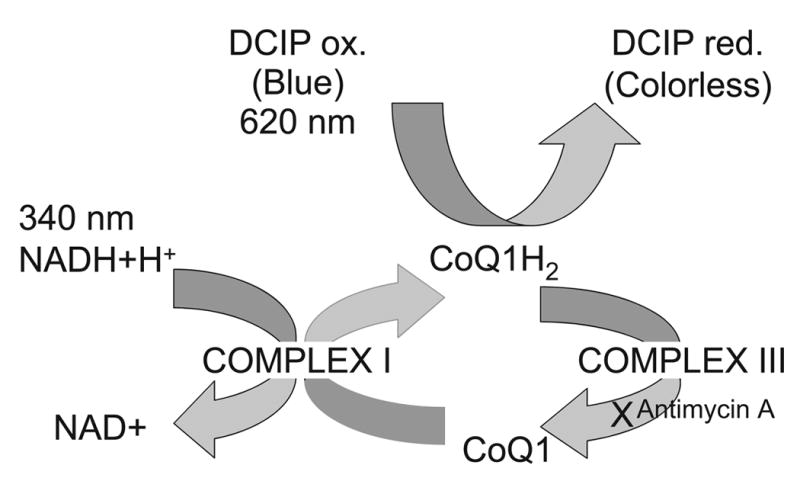
Figure 1
Figure 1
The electron transport mechanism in the bovine sub-mitochondrial particles (SMP) complex I assay (as in Jewess et al [49]). In a buffer enriched with excess NADH, Coenzyme Q1 and DCIP, SMP containing bovine complex I enzyme oxidize NADH to NAD+ and reduce Coenzyme Q1 to Coenzyme Q1H2, resulting in a decline of NADH absorbance at 340nm. Coenzyme Q1H2 reduces DCIP, resulting in a decrease in absorbance at 620nm. The decrease in absorbance at 340nm, and also at 620nm continues until all exogenously added NADH is oxidized. Antimycin A (an inhibitor of complex III) prevents Coenzyme Q1H2 from passing reducing components to complex III, and KCN (an inhibitor of complex IV) prevents cytochrome oxidase activity of complex IV.
Figure 2
Figure 2
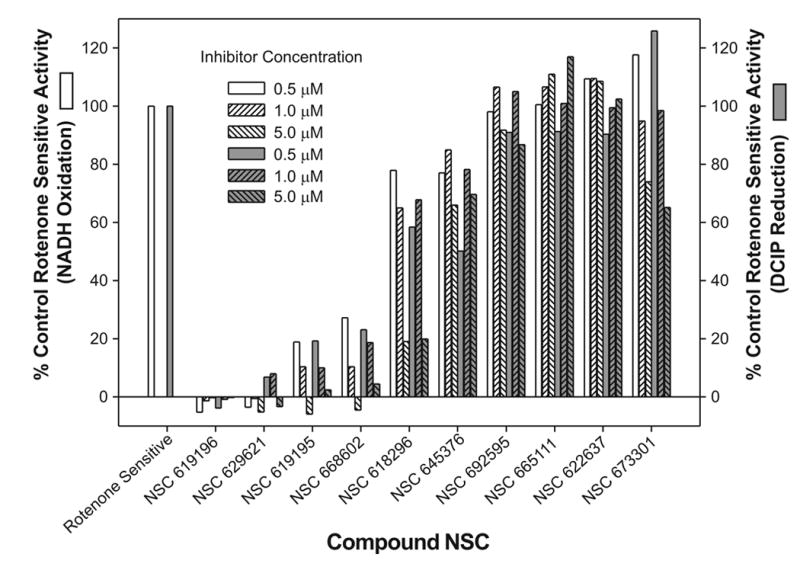
The % Control complex I activity as monitored by NADH oxidation (white columns) and DCIP reduction (grey columns) for each of the ten compounds tested at concentrations of 0.5, 1.0 and 5.0μM. Each compound was incubated with the SMP for at least two minutes before the addition of NADH. The specific activity of the complex I enzyme in the presence of the three concentrations of compounds was compared to total rotenone sensitive activity (DMSO control-Rotenone control).
Figure 3
Figure 3
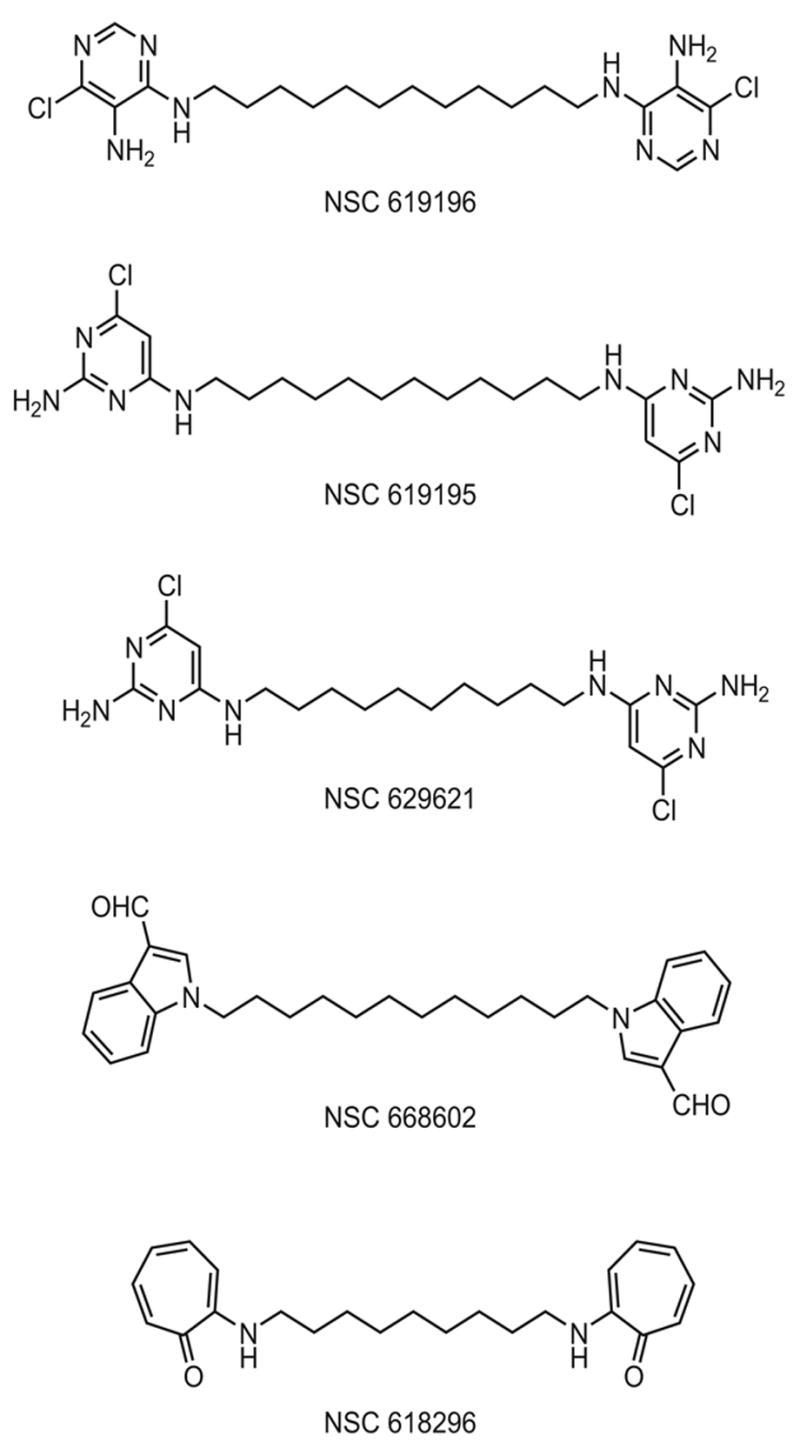
Structures of the five most potent inhibitors. NSC 619196, N4-(12-((5-amino-6-chloro-4-pyrimidinyl)amino)dodecyl)-6-chloro-4,5-pyrimidinediamine; NSC 619195,N4-(12-((2-amino-6-chloro-4-pyrimidinyl)amino)dodecyl)-6-chloro-2,4-pyrimidinediamine; NSC 629621, N4-(10-((2-amino-6-chloro-4-pyrimidinyl)amino)decyl)-6-chloro-2,4-pyrimidinediamine; NSC 668602, 1-(12-(3-formyl-1H-indol-1-yl)dodecyl)-1H-indole-3-carbaldehyde; and NSC 618296,2-((9-((7-oxo-1,3,5-cycloheptatrien-1-yl)amino)nonyl)amino)-2,4,6-cycloheptatrien-1-one.
Figure 4
Figure 4
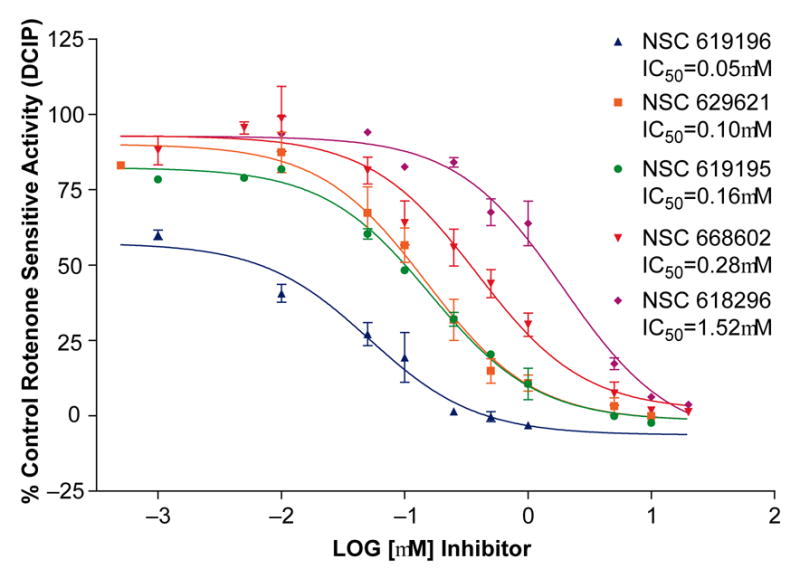
Dose response curves for the five strongest inhibitors discovered by the survey in Figure 1. Inhibitor concentrations for NSC 619196, 629621, 619195 and 668602, and 618296 ranged from an initial concentration of 20μM to 1nM final concentration in the complex I assay. Inhibitors were incubated with the SMP for at least two minutes prior to addition of NADH to initiate the assay , then NADH oxidation and DCIP reduction was monitored for several minutes and slopes at each concentration of inhibitor were used to calculate specific activities. The IC50's obtained by the dose -response curves for each compound were obtained by non-linear regression analysis, one-site competition, using GraphPad Prizm. The specific activity of complex I enzyme in the presence of the serial dilutions of the compounds was divided by maximal (total) rotenone sensitive specific activity (DMSO control DCIP activity-Rotenone control DCIP activity) to obtain calculations for % Control (n=3).
Figure 5
Figure 5
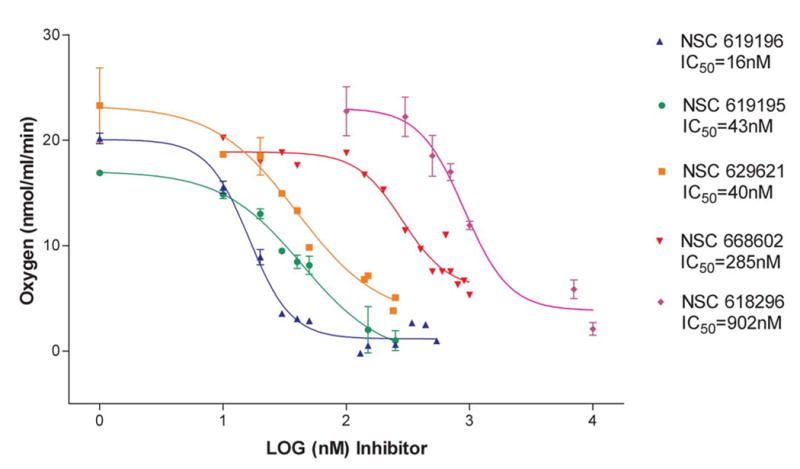
Dose response curves for Complex I inhibition of K562 Cells by the five strongest inhibitors confirmed by Table I. Dose response curves are based upon the change in rate of oxygen consumption when increasing concentrations (range=1nM to 1mM) of inhibitors of Complex I are added, after 1x10⁷ cells have been permeabilized with digitonin and energized with Complex I substrates. The IC50's obtained by the dose -response curves for each compound were obtained by non-linear regression analysis, one-site competition, using GraphPad Prizm. n=2–4 separate experiments for each concentration.

References

    1. Ferreira CG, Epping M, Kruyt FAE, Giaccone G. Apoptosis: Target of cancer therapy. Clin Cancer Res. 2002;8:2024–2034. - PubMed
    1. Makin G. Targeting apoptosis in cancer chemotherapy. Expert Opin Ther Targets. 2002;6:73–84. - PubMed
    1. Kaufman SH, Earnshaw WC. Induction of apoptosis by cancer chemotherapy. Exp Cell Res. 2000;256:42–49. - PubMed
    1. Green DR, Kroemer G. The pathophysiology of mitochondrial cell death. Science. 2004;305:626–629. - PubMed
    1. Yano T. The energy-transducing NADH: quinone oxidoreductase, complex I. Mol Aspects Med. 2002;23:345–368. - PubMed

MeSH terms