


Paradoxical hyperalgesia induced by mu-opioid receptor agonist endomorphin-2, but not endomorphin-1, microinjected into the centromedial amygdala of the rat
- PMID: 17112504
- PMCID: PMC3732481
- DOI: 10.1016/j.ejphar.2006.10.014
Paradoxical hyperalgesia induced by mu-opioid receptor agonist endomorphin-2, but not endomorphin-1, microinjected into the centromedial amygdala of the rat
Abstract
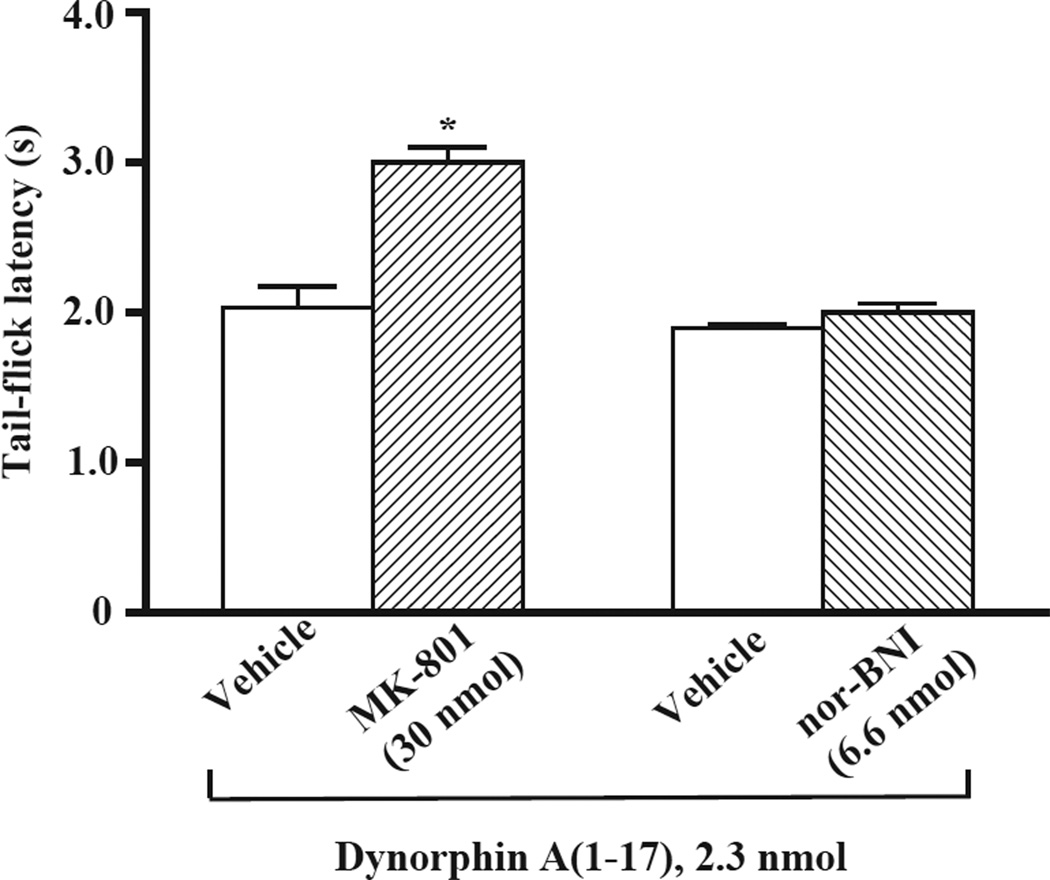
The effects of endomorphin-2 or endomorphin-1 microinjected into the centromedial amygdala on the thermally-induced tail-flick response were studied in male CD rats. Microinjection of endomorphin-2 (8.7-35.0 nmol) given into the centromedial amygdala time- and dose-dependently decreased the tail-flick latencies. On the other hand, endomorphin-1 (8-32.6 nmol) given into the same site did not cause any change of the tail-flick latency. However, endomorphin-1 (32.6 nmol) or endomorphin-2 (35.0 nmol) given into the basolateral site of amygdala did not affect the tail-flick latency. Pretreatment with the antiserum against dynorphin A(1-17) (200 microg) significantly reversed the decrease of the tail-flick latency induced by endomorphin-2. The decrease of the tail-flick latency induced by endomorphin-2 was also blocked by the endomorphin-2 selective micro-opioid receptor antagonist 3-methoxynaltrexone (6.4 pmol) and by the N-methyl-D-aspartate (NMDA) receptor antagonist MK-801 (30 nmol), but not by the kappa-opioid receptor antagonist nor-binaltorphimine (6.6 nmol). It is concluded that endomorphin-2, but not endomorphin-1, given into the centromedial amygdala stimulates a 3-methoxynaltrexone-sensitive mu-opioid receptor subtype to induce the release of dynorphin A(1-17), which then acts on the NMDA receptor, but not kappa-opioid receptor for producing hyperalgesia. This conclusion is further supported by the additional findings that dynorphin A(1-17) (2.3 nmol) given into the centromedial amygdala also caused the decrease of the tail-flick latency, which was similarly blocked by the NMDA receptor antagonist MK-801 (30 nmol), but not kappa-opioid receptor antagonist nor-binaltorphimine (6.6 nmol).
Figures


References
-
- Basbaum AI, Fields HL. Endogenous pain control systems: Brainstem spinal pathways and endorphin circuitry. Annu. Rev. Neurosci. 1984;7:309–338. - PubMed
-
- Bernard JF, Besson JM. The spino(trigemino)pontoamygdaloid pathway : electrophysiological evidence for an involvement in pain processes. J. Neurophysiol. 1990;63:473–490. - PubMed
-
- Bernard JF, Alden M, Besson JM. The organization of the efferent projection from the pontine parabrachial area to the amygdala complex: a phaseolus vulgaris leucoagglutinin (PHA-L) study in the rat. J. Comp. Neurol. 1993;329:201–229. - PubMed
-
- Bester H, Chapman V, Besson JM, Bernard JF. Physiological properties of the lamina I spinoparabrachial neurons in the rat. J. Physiology. 2000;83:2239–2259. - PubMed
-
- Burstein R, Potrebic S. Retrograde labeling of neurons in the spinal cord that project directly to the amygdala or the orbital cortex in the rat. J. Comp. Neurol. 1993;335:469–485. - PubMed
Publication types
MeSH terms
Substances
Grants and funding
LinkOut - more resources
Full Text Sources
Research Materials
