. 2007 Jan 15;15(2):663-77.
doi: 10.1016/j.bmc.2006.10.060. Epub 2006 Nov 1.

Synthesis and biological evaluation of gamma-aminophosphonates as potent, subtype-selective sphingosine 1-phosphate receptor agonists and antagonists

Affiliations

Synthesis and biological evaluation of gamma-aminophosphonates as potent, subtype-selective sphingosine 1-phosphate receptor agonists and antagonists

Frank W Foss Jr et al. Bioorg Med Chem. .

Abstract

The synthesis of N-arylamide phosphonates and related arylether and arylamine analogues provided potent, subtype-selective agonists and antagonists of the five known sphingosine 1-phosphate (S1P) receptors (S1P(1-5)). To this end, the syntheses of phosphoserine mimetics-selectively protected and optically active phosphonoserines-are described. In vitro binding assays showed that the implementation of phosphonates as phosphate mimetics provided compounds with similar receptor binding affinities as compared to their phosphate precursors. meta-substituted arylamide phosphonates were discovered to be antagonists of the S1P(1) and S1P(3) receptors. When administered to mice, an antagonist blocked the lymphopenia evoked by a S1P receptor agonist and caused capillary leakage in both lung and kidney.


Figures
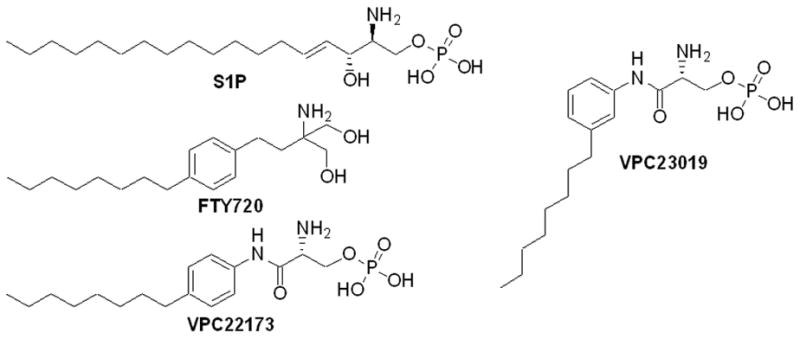
Figure 1
Figure 1
Structures of endogenous sphingosine 1-phosphate (S1P) and the S1P receptor ligands, FTY720, VPC22173 and VPC23019.
Figure 2
Figure 2
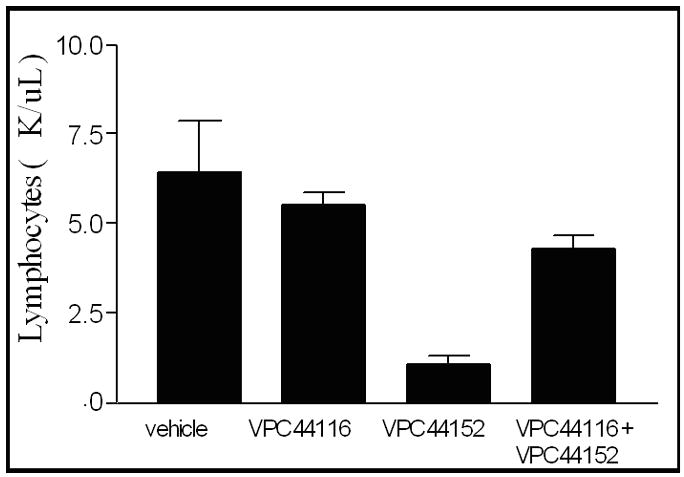
The lymphopenia evoked by the S1P agonist, 12b (VPC44152) is blocked by co-administration of the S1P receptor antagonist 12d (VPC44116). Groups of 3 C57BL/6 x sv129/J mice injected with vehicle (2% hydroxypropyl β-cyclodextrin), VPC44116 (22 mg/kg) and/or VPC44152 (18 mg/kg). After 16 hours, blood was drawn from the orbital sinuses and lymphocytes were measure with a Hemavet blood analyzer. Data are presented as mean ± S.E.
Figure 3
Figure 3
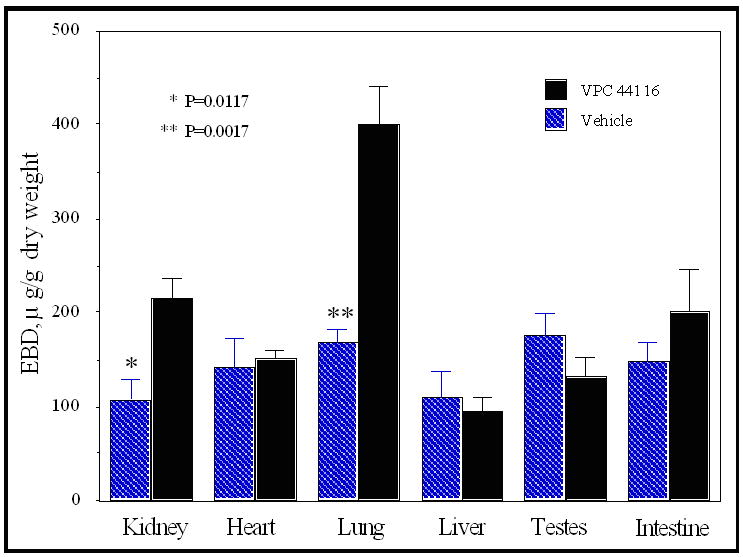
Effect of VPC44116 on vascular permeability. C57BL/6 mice were treated with vehicle (2% hydroxypropyl β-cyclodextrin) or VPC44116 (25 mg/kg) two hours prior to injection 2% Evans Blue dye (EBD) (20 mg/kg) into the jugular vein 30 min. before harvesting tissues. EBD was extracted into formamide, measured in a spectrometer and the amount of extravasated EBD in tissues was calculated from a standard curve. Values are means ± SE; n = 4 for each group. **P < 0.05, **P < 0.01 compared with vehicle treatment.
Scheme 1
Scheme 1
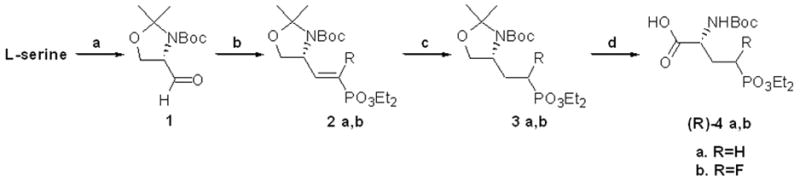
Synthesis of (3R)-4a,b – Method A: a.) i. SOCl2, MeOH, rt, 16h ii. Boc2O, Et3N, CH2Cl2, rt, 12h iii. 2,2-dimethoxypropane, p-TsOH, CH2Cl2, 0 °C to rt, 2h 62% (3 steps) iv. NaBH4, LiCl, 3:2 EtOH/THF, 0 °C to rt, 4h 89% v. DMSO, (COCl)2, CH2Cl2, −78 °C, then Et3N −78 °C to rt, 2–4 h, 97% b.) tetraethyl methylenebisphosphonate, n-BuLi, THF, −78 °C, rt, overnight, 75% (2a) or tetraethyl 2-fluoromethynebisphosphonate, n-BuLi, THF, -78 °C, rt, overnight, 31% (2b) c.) H2, Pd/C, rt., 12h, EtOH, 99% (3a) and 88% (3b) d.) Jones reagent, acetone, 0 °C to rt., 12h then, isopropyl alcohol, celite, rt, 15min., 59% (4a) and 48% (4b).
Scheme 2
Scheme 2
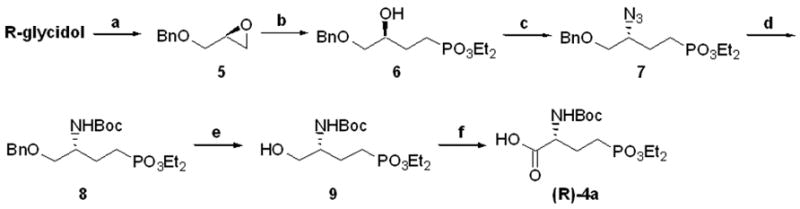
Synthesis of (3R)-[or (3S)-]4 – Method B: a.) BnBr, DMF, 60% NaH, 0 °C to rt, 3h, 78% b.) CH3PO3Et2, n-BuLi, BF3·OEt2, THF, −78 °C to rt, 3h then, NH4Cl, 1h, 96% c.) DPPA, DIAD, 3%-polymer-bound PhPPh2, CH2Cl2, 0 °C to rt, 20h, 96%, d.) Boc2O, H2 (balloon), 20%w/w Lindlar’s catalyst, MeOH, rt, 24h 77% e.) H2 (balloon), Pd/C, EtOH, rt, 24h, 94% f.) TEMPO, bis(acetoxy)iodosobenzene, NaHCO3, 1:1 CH3CN/H2O, rt, 3h., 38% or RuCl3·hydrate, NaIO4, 3:2:2 H2O/CH3CN/CCl4, rt, 3h, 76%.
Scheme 3
Scheme 3
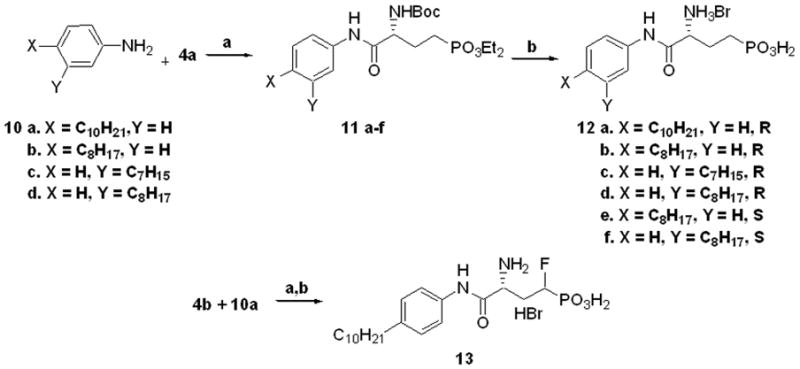
Synthesis of arylamide phosphonates 12 a–f & 13: a) PyBOP, 10 a–d, di-iso- propyl ethylamine (DIEA), CH2Cl2, 24–70% b.) TMSBr, CH2Cl2, rt, 4-6h then, 95:5 MeOH/H2O, rt, 1–4h, 45-100%.
Scheme 4
Scheme 4
Efficient synthesis of 4a from 2a: a.) H2, 10% Pd/C (20 w/w% followed by 10 w/w%), EtOH, rt, 3d, >95% b.) RuCl3·H2Ox, NaIO4, 2:2:3 CCl4/CH3CN/H2O, rt, 1–3h, 79%.
Scheme 5
Scheme 5
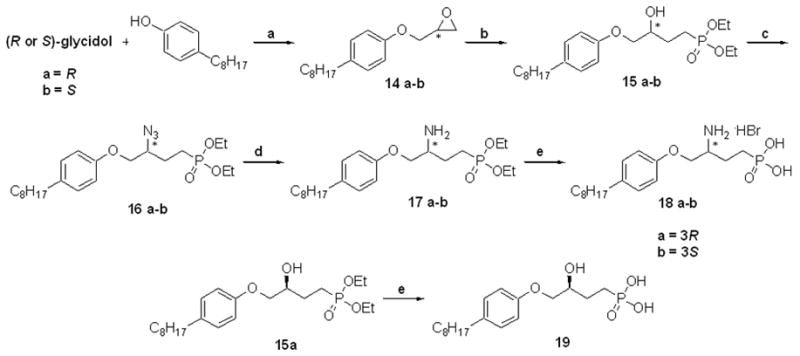
Synthesis of arylether phosphonate analogues 18 a–b and 19: a.) DIAD, PPh3, THF, 0 °C to rt, overnight, 80–84% b.) CH3PO3Et2, n-BuLi, BF3·OEt2, THF, −78 °C to rt, 3h then, NH4Cl, 1h, 72–87% c.) DPPA, DIAD, PPh3, CH2Cl2, 0 °C to rt, 20h, 67–98% d.) H2 (balloon), Pd/C, EtOH, formic acid cat., rt, 3.5h, quantitative e.) TMSBr, CH2Cl2, rt, 4–6h then, 95:5 MeOH/H2O, rt, 2–4h, 79–100%.
Scheme 6
Scheme 6
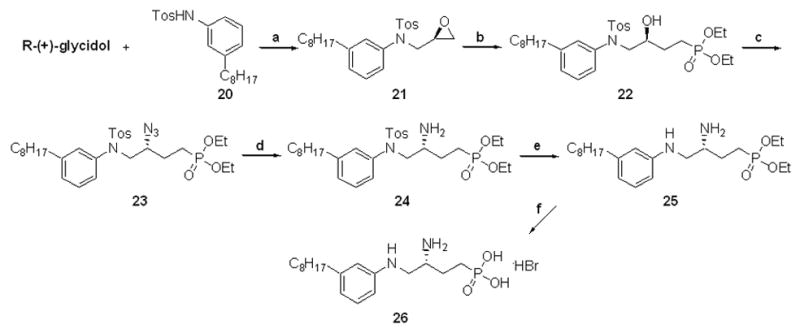
Synthesis of arylamine phosphonate analogue 26: a.) DIAD, PPh3, THF, 0 °C to rt, overnight, 69% b.) CH3PO3Et2, n-BuLi, BF3·OEt2, THF, –78 °C to rt, 2h then, NH4Cl, 2h, 97% c.) DPPA, DIAD, PPh3, CH2Cl2, 0 °C to rt, 20h, 85% (containing 5% OPPh3) d.) H2 (balloon), 20%w/w Pd(OH)2, 20:1 MeOH/conc. HCl, 1h, 100% e.)Na(s), NH3(l), –78 °C, 5 min.then EtOH, 25% (recovered 28% starting material) f.) TMSBr, CH2Cl2, rt, 4–6h then, 95:5 MeOH/H2O, 4h, rt, 95%.

References

    1. Lynch KR. Biochim et Biophys Acta. 2002;1582:70–71. - PubMed
    1. Hla T. Pharmacol Rev. 2003;47:401–407. - PubMed
    1. Watterson K, Sankala H, Milstien S, Spiegel S. Prog in Lipid Res. 2003;42:344–357. - PubMed
    1. Matloubian M, Lo CG, Cinamon G, Lesneski MJ, Xu Y, Brinkmann V, Allende ML, Proia RL, Cyster JG. Nature. 2004;427:355–360. - PubMed
    1. For a convenient review: Im D-S. TRENDS in Pharmacol Sci. 2003;24:12–4.

Publication types

MeSH terms