


The effect of two publicly funded insurance programs on use of dental services for young children
- PMID: 17116108
- PMCID: PMC1955315
- DOI: 10.1111/j.1475-6773.2006.00586.x
The effect of two publicly funded insurance programs on use of dental services for young children
Abstract
Objective: The purpose of this study is to compare the use of dental services for preschool aged children enrolled in North Carolina Medicaid, a traditional program based on a fee-for-service schedule, and North Carolina Health Choice (NCHC), an State Children's Health Insurance Program (S-CHIP) dental insurance program structured similarly to private insurance.
Study population: All children (165,858) 1-5 years of age enrolled in Medicaid and S-CHIP (NCHC) at some time during one study year (October 1, 1999-September 30, 2000). DATA SOURCES/EXTRACTION METHODS: Medicaid and NCHC enrollment and dental claims files were obtained for individual children.
Study design: An observational study with a retrospective cohort design. Use of dental services for each child was measured as having at least one dental claim during the outcome period (October 1, 1999-September 30, 2000). Multivariable logistic regression models were developed to compare the effect of two differently administered insurance programs on the use of dental services, controlling for demographic, enrollment, and county characteristics.
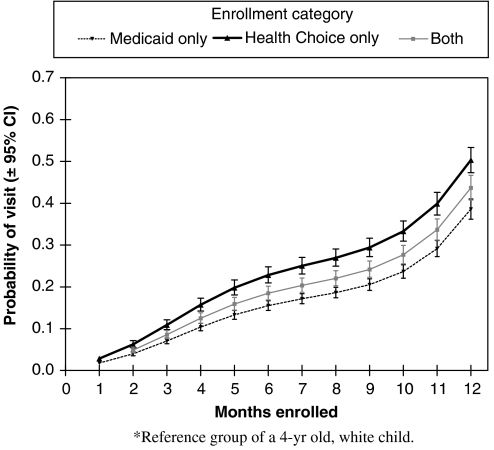
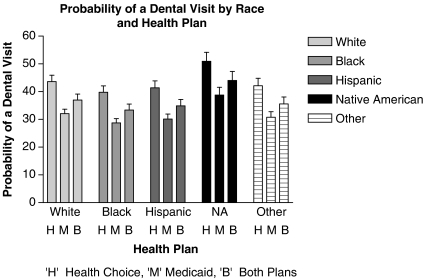
Principle findings: Children enrolled solely in S-CHIP (NCHC) were 1.6 times more likely (95 percent confidence intervals (CI)=1.50-1.79) to have a dental visit than those enrolled solely in Medicaid. Prediction models for children enrolled for 12 months indicated that those enrolled in S-CHIP (NCHC) had a significantly higher probability of having a dental visit (50 percent) than those enrolled in both plans (44 percent) or Medicaid only (39 percent), a trend found in all age groups.
Conclusions: The S-CHIP (NCHC) program appears to provide children with increased access to dental care compared to children in the Medicaid program.
Figures
References
-
- Almeida R, Hill I, Kenney G. Does SCHIP Spell Better Dental Care Access for Children? An Early Look at New Initiatives. Assessing the New Federalism. Washington, DC: The Urban Institute; 2000.
-
- Bailit HL, Newhouse J, Brook R. Dental Insurance and the Oral Health of Preschool Children. Journal of the American Dental Association. 1986;113(5):773–6. - PubMed
-
- Breslow N, Day N. Statistical Methods in Cancer Research: The Analysis of Case Control Data. Lyon: International Agency for Research on Cancer; 1980. - PubMed
-
- Brown JG. Children's Dental Services under Medicaid: Access and Utilization. Washington, DC: Department of Health and Human Services, Office of Inspector General; 1996.
-
- Chattopadhyay A, Slade GD, Shugars DA. Charges for Oral Health Care during a Period of Economic Growth in the U.S.: 1987–1996. Journal of Public Health Dentistry. 2003;63(2):104–11. - PubMed
Publication types
MeSH terms
Grants and funding
LinkOut - more resources
Full Text Sources
Medical
