


Two isoforms of tissue transglutaminase mediate opposing cellular fates
- PMID: 17116873
- PMCID: PMC1654133
- DOI: 10.1073/pnas.0604844103
Two isoforms of tissue transglutaminase mediate opposing cellular fates
Abstract
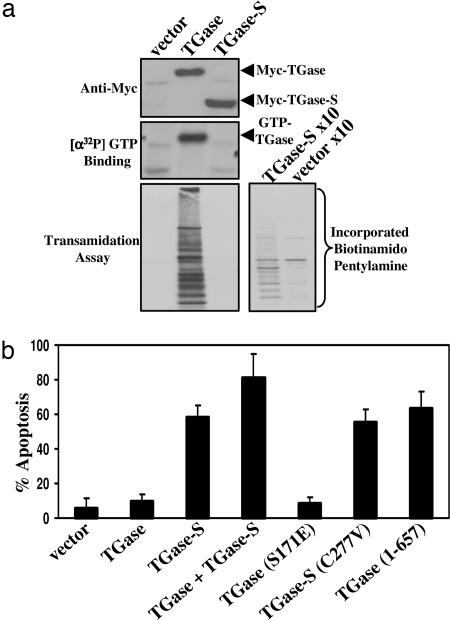
Opposing cellular responses are typically regulated by distinct sets of genes. However, tissue transglutaminase (TGase) provides an interesting example of a single gene product that has been implicated both in affording protection against cellular insults as well as in promoting cell death. Here, we shed some light on how these conflicting activities might be manifested by demonstrating that alternative transcripts of TGase differentially affect cell viability. We show that although the full-length TGase protein affords strong protection against cell death signals, a shorter version of TGase that is truncated at the 3' end, and thus called TGase-short (TGase-S), is cytotoxic. The apoptotic activity of TGase-S is not dependent on its transamidation activity because the mutation of a cysteine residue that is essential for catalyzing this reaction does not compromise the ability of TGase-S to induce cell death. Intriguingly, TGase-S undergoes inappropriate oligomer formation in cells before cell death, suggesting a novel mechanism for the apoptotic effects of this protein.
Conflict of interest statement
The authors declare no conflict of interest.
Figures




References
-
- Lorand L, Graham RM. Nat Rev Mol Cell Biol. 2003;4:140–156. - PubMed
-
- Fesus L, Szondy Z. FEBS Lett. 2005;579:3297–3302. - PubMed
-
- Antonyak MA, Miller AM, Jansen JM, Boehm JE, Balkman CE, Wakshlag JJ, Page RL, Cerione RA. J Biol Chem. 2004;279:41461–41467. - PubMed
-
- Lesort M, Chun W, Johnson GV, Ferrante RJ. J Neurochem. 1999;73:2018–2027. - PubMed
Publication types
MeSH terms
Substances
Grants and funding
LinkOut - more resources
Full Text Sources
Molecular Biology Databases
