Pharmacogenomics: challenges and opportunities
- PMID: 17116919
- PMCID: PMC5006954
- DOI: 10.7326/0003-4819-145-10-200611210-00007
Pharmacogenomics: challenges and opportunities
Abstract
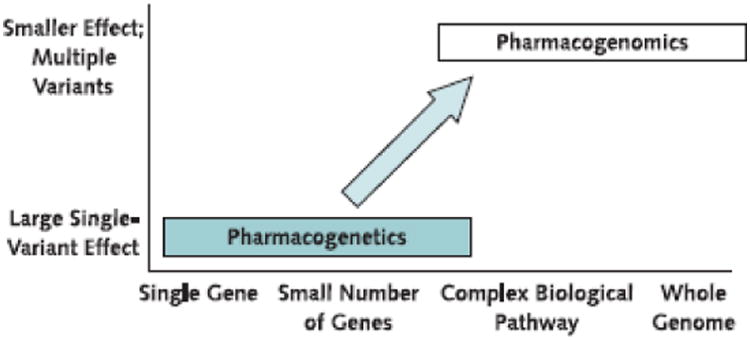
The outcome of drug therapy is often unpredictable, ranging from beneficial effects to lack of efficacy to serious adverse effects. Variations in single genes are 1 well-recognized cause of such unpredictability, defining the field of pharmacogenetics (see Glossary). Such variations may involve genes controlling drug metabolism, drug transport, disease susceptibility, or drug targets. The sequencing of the human genome and the cataloguing of variants across human genomes are the enabling resources for the nascent field of pharmacogenomics (see Glossary), which tests the idea that genomic variability underlies variability in drug responses. However, there are many challenges that must be overcome to apply rapidly accumulating genomic information to understand variable drug responses, including defining candidate genes and pathways; relating disease genes to drug response genes; precisely defining drug response phenotypes; and addressing analytic, ethical, and technological issues involved in generation and management of large drug response data sets. Overcoming these challenges holds the promise of improving new drug development and ultimately individualizing the selection of appropriate drugs and dosages for individual patients.
Figures
References
-
- Weinshilboum R. Inheritance and drug response. N Engl J Med. 2003;348:529–37. - PubMed
-
- Evans WE, McLeod HL. Pharmacogenomics—drug disposition, drug targets, and side effects. N Engl J Med. 2003;348:538–49. - PubMed
-
- Roses AD. Pharmacogenetics and drug development: the path to safer and more effective drugs. Nat Rev Genet. 2004;5:645–56. - PubMed
-
- Garrod AE. Inborn errors of metabolism. 2nd. London: Henry Frowde and Hodder Stroughton; 1923.
-
- Evans WE, Relling MV. Pharmacogenomics: translating functional genomics into rational therapeutics. Science. 1999;286:487–91. - PubMed
Publication types
MeSH terms
Grants and funding
- U19 GM061388/GM/NIGMS NIH HHS/United States
- U01 GM61373/GM/NIGMS NIH HHS/United States
- U01 HL65962/HL/NHLBI NIH HHS/United States
- U01 GM61390/GM/NIGMS NIH HHS/United States
- U01 HL65899/HL/NHLBI NIH HHS/United States
- U01 GM063340/GM/NIGMS NIH HHS/United States
- U01 GM61388/GM/NIGMS NIH HHS/United States
- U01 GM061393/GM/NIGMS NIH HHS/United States
- U01 GM74518/GM/NIGMS NIH HHS/United States
- U01 DA20830/DA/NIDA NIH HHS/United States
- U01 GM074492/GM/NIGMS NIH HHS/United States
- U19 HL065962/HL/NHLBI NIH HHS/United States
- U01 HL065899/HL/NHLBI NIH HHS/United States
- U01 HL065962/HL/NHLBI NIH HHS/United States
- U01 GM061388/GM/NIGMS NIH HHS/United States
- U01 GM63340/GM/NIGMS NIH HHS/United States
- U01 HL69757/HL/NHLBI NIH HHS/United States
- U01 GM61393/GM/NIGMS NIH HHS/United States
- U01 GM061390/GM/NIGMS NIH HHS/United States
- U01 GM061374/GM/NIGMS NIH HHS/United States
- U19 GM061390/GM/NIGMS NIH HHS/United States
- U01 GM74492/GM/NIGMS NIH HHS/United States
- U19 HL069757/HL/NHLBI NIH HHS/United States
- U01 GM061373/GM/NIGMS NIH HHS/United States
- Wellcome Trust/United Kingdom
- U01 GM61374/GM/NIGMS NIH HHS/United States
- U01 HL069757/HL/NHLBI NIH HHS/United States
- U01 GM074518/GM/NIGMS NIH HHS/United States
- U01 DA020830/DA/NIDA NIH HHS/United States
LinkOut - more resources
Full Text Sources