


Perception of sleep in recovering alcohol-dependent patients with insomnia: relationship with future drinking
- PMID: 17117964
- PMCID: PMC2935463
- DOI: 10.1111/j.1530-0277.2006.00245.x
Perception of sleep in recovering alcohol-dependent patients with insomnia: relationship with future drinking
Erratum in
- Alcohol Clin Exp Res. 2007 May;31(5):907
Abstract
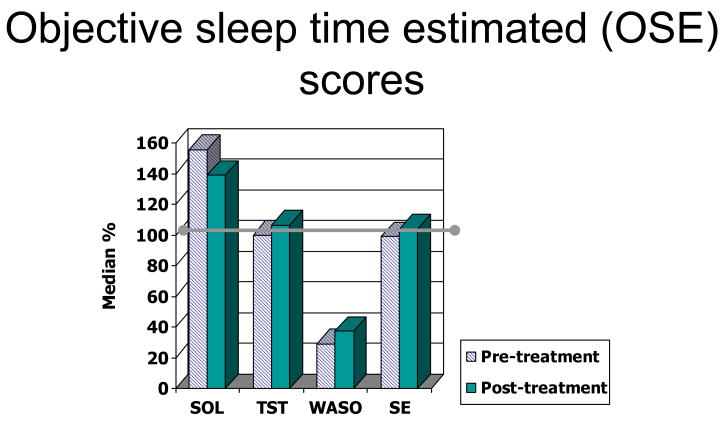
Background: Subjective and objective measures of poor sleep in alcoholic insomniacs predict relapse to drinking. Nonalcoholic insomniacs underestimate their total sleep time (TST) and overestimate their sleep onset latency (SOL) and wake time after sleep onset (WASO) compared with polysomnography (PSG). This study evaluated 3 hypotheses: (1) subjective SOL would predict frequency of future drinking; (2) participants would overestimate SOL and WASO and underestimate TST; and (3) higher amounts of over- and underestimates of sleep at baseline would predict worse drinking outcomes prospectively.
Methods: Participants (N=18), mean age 44.6 years (+/-13.2), underwent an adaptation night and then 2 nights of PSG 3 weeks apart. They also provided morning estimates of SOL, WASO, TST, and sleep efficiency (SE). Following the baseline PSG, participants were followed over 12 weeks. A 2-way ANOVA (night x method of measuring sleep) compared results and regression analyses predicted drinking. Drinking outcomes were defined as number of days drinking (DD) and number of heavy-drinking days (HDD) during 2 consecutive 6-week follow-up periods.
Results: Most participants (72%) overestimated SOL by a mean of 21.3 (+/-36) minutes compared with PSG [F(1, 14)=7.1, p<0.03]. Unexpectedly, 89% underestimated WASO by a mean difference of 48.7 (+/-49) minutes [F(1, 14)=15.6, p<0.01]. Drinking during the first 6-week study period was predicted by both subjective estimates of WASO and their accuracy, whereas drinking during the second 6-week period was predicted by both subjective estimations of sleep and rapid eye movement sleep latency.
Conclusion: Greater subjective accuracy of wakefulness at night provided by the patient predicted drinking during the study. Unlike nonalcoholic insomniacs, this alcoholic sample significantly underestimated WASO compared with PSG values. The predictive ability of sleep parameters depended on the selected measure of drinking outcomes and when outcomes were measured. Subjective sleep measures were better predictors of future drinking than corresponding PSG measures.
Figures
References
-
- Aldrich MS, Brower KJ, Hall JM. Sleep-disordered breathing in alcoholics. Alcohol Clin Exp Res. 1999;23:134–140. - PubMed
-
- Aldrich MS, O’Neal E, Eiser A, Kroll P, Brower KJ, Shipley J. Slow wave sleep decrement and relapse tendency in alcoholics in treatment. Sleep Research. 1994;23(185)
-
- Allen R, Wagman A. Do sleep patterns relate to the desire for alcohol? Adv Exp Med Biol. 1975;59:495–508. - PubMed
-
- Allen R, Wagman A, Funderburk F. Slow wave sleep changes: alcohol tolerance and treatment implications. Adv Exp Med Biol. 1977;85A:629–640. - PubMed
-
- Baekeland F, Hoy P. Reported vs recorded sleep characteristics. Arch Gen Psychiatry. 1971;24:548. - PubMed
Publication types
MeSH terms
Substances
Grants and funding
LinkOut - more resources
Full Text Sources
Other Literature Sources
Medical
