. 2005 Nov 11:5:32.
doi: 10.1093/jis/5.1.32.

The broadly insecticidal Photorhabdus luminescens toxin complex a (Tca): activity against the Colorado potato beetle, Leptinotarsa decemlineata, and sweet potato whitefly, Bemisia tabaci

Affiliations

The broadly insecticidal Photorhabdus luminescens toxin complex a (Tca): activity against the Colorado potato beetle, Leptinotarsa decemlineata, and sweet potato whitefly, Bemisia tabaci

Michael B Blackburn et al. J Insect Sci. .

Abstract

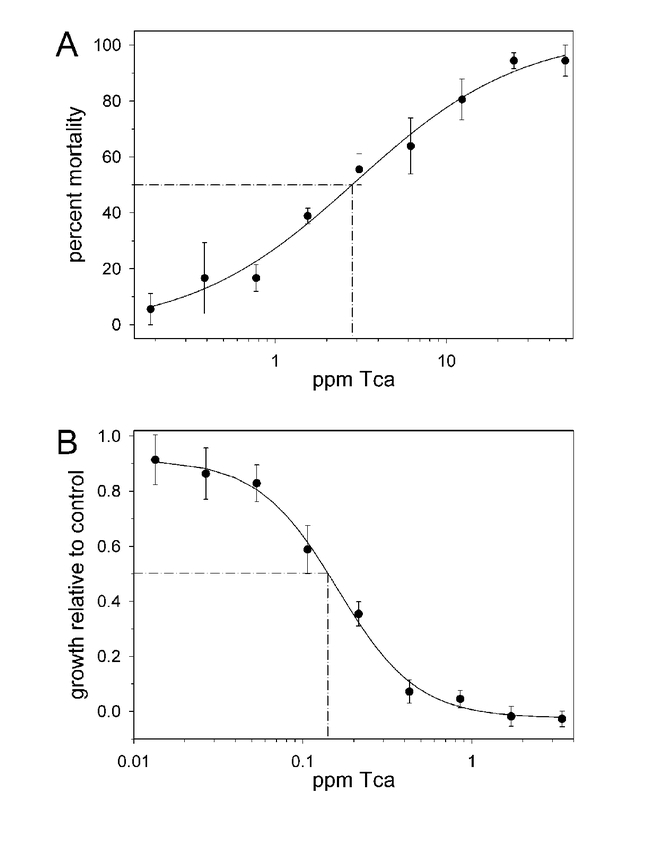
Toxin complex a (Tca), a high molecular weight insecticidal protein complex produced by the entomopathogenic bacterium Photorhabdus luminescens, has been found to be orally toxic to both the Colorado potato beetle, Leptinotarsa decemlineata, and the sweet potato whitefly, Bemisia tabaci biotype B. The 48 hour LC50 for Tca against neonate L. decemlineata was found to be 2.7 ppm, and the growth of 2nd instar L. decemlineata exposed to Tca for 72 hours was almost entirely inhibited at concentrations above 0.5 ppm. B. tabaci was highly susceptible to Tca as well; newly emerged nymphs that were artificially fed Tca developed poorly, or not at all. Tca concentrations between 0.1 and 0.2 ppm reduced the number of nymphs reaching the second instar by 50%. In addition, a preparation of Tca missing two prominent subunits, TcaAii and TcaAiii, was found to be at least as toxic to L. decemlineata and B. tabaci as Tca itself, indicating that the activity of Tca is not dependant on the presence of these subunits at the time of ingestion.


Figures

Figure 1.
Figure 1.
Schematic representation of the tca and tcd genetic loci with their respective products superimposed upon them. Similarly shaded areas indicate regions of similar amino acid sequences. Proteolytic cleavage sites are indicated by arrowheads. Peptides which have been determined to occur in the mature Tca and Tcd complexes are labeled in red italics (Bowen et al., 1998; Guo et al., 1999).
Figure 2.
Figure 2.
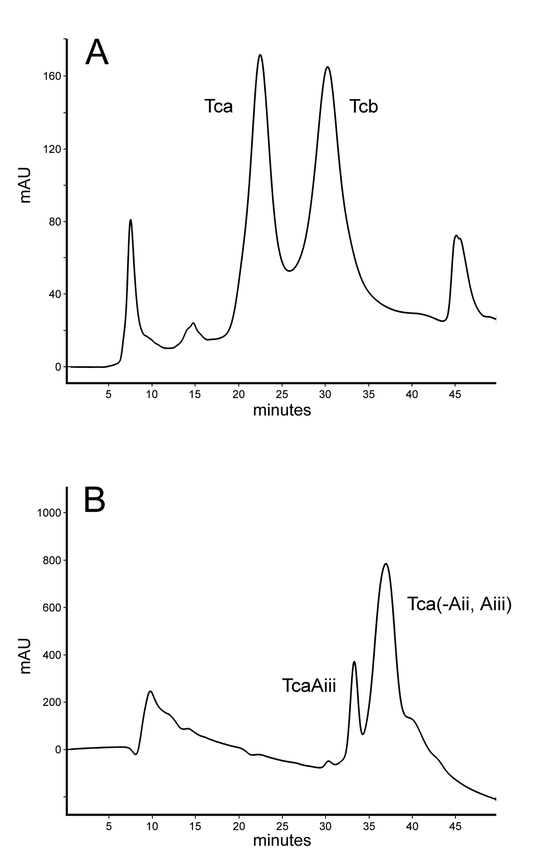
(A) Fractionation of the crude toxin preparation by anion exchange chromatography on a 1 × 7 cm Source 15Q column at pH 5.5. Tca and Tcb represent the major complexes in the crude fraction. Subsequent purifications were performed with the same column at pH 7.5. In one preparation, after prolonged storage at pH 5.5, TcaAiii was separated from the parent Tca (B).
Figure 3.
Figure 3.
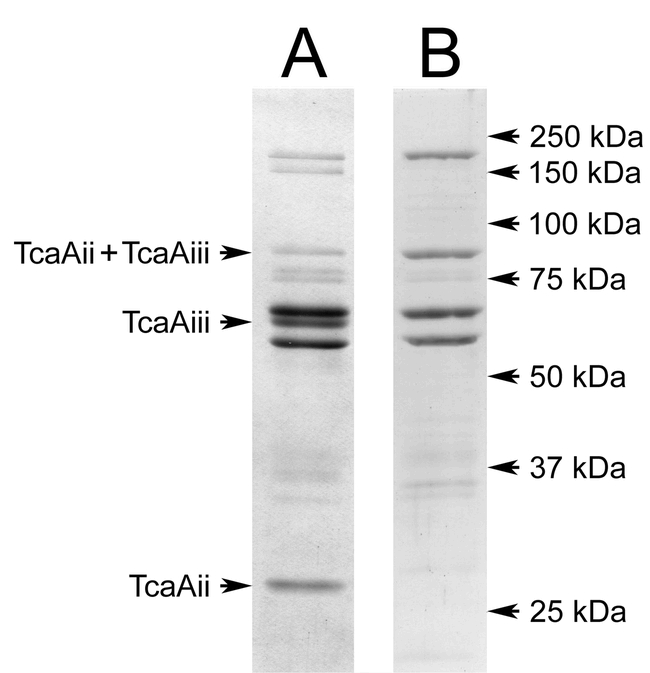
SDS-PAGE analysis of purified Tca. A typical preparation of Tca is shown in lane A, while the Tca(-Aii, Aiii) purified in Figure 2B is shown in lane B.
Figure 4.
Figure 4.
(A) Mortality of neonate Leptinotarsa decemlineata larvae exposed to Tca for 48 h. Each point represents the mean mortality (± SEM) in three separate assays of 12 larvae. (B) Growth of second instar L. decemlineata larvae exposed to Tca for 72 h. Each point represents the mean weight gain (± SEM) of larvae fed Tca relative to control larvae. For each point, 12 larvae were assayed on two separate occasions. At the highest concentrations, mortality was observed (ca. 50% at the highest dose).
Figure 5.
Figure 5.
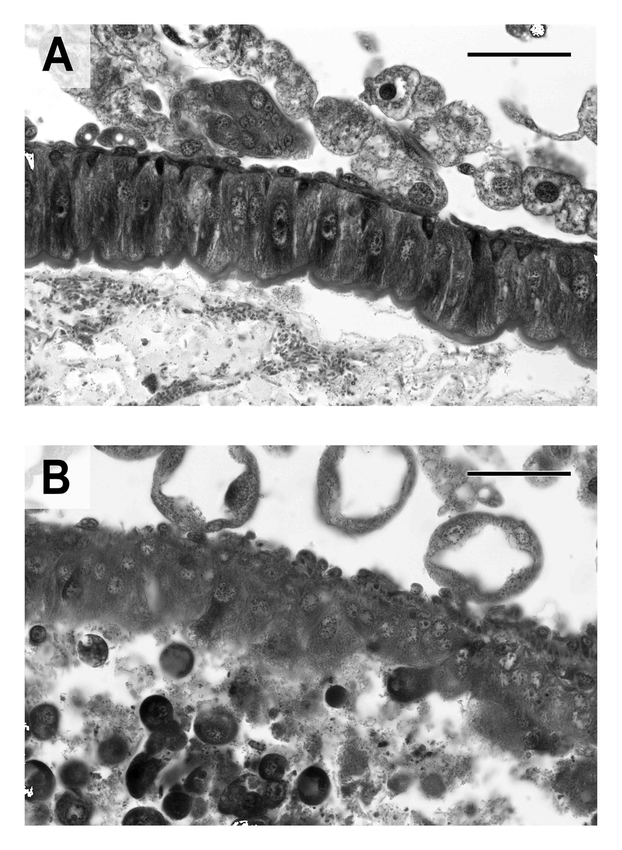
(A) Midgut epithelium of a second instar Leptinotarsa decemlineata larvae fed artificial diet alone. (B) Midgut epithelium of a second instar L. decemlineata larvae fed artificial diet containing 1.7 ppm Tca for 24 h. The gut epithelium is severely disrupted, and the gut lumen is packed with cellular debris (scale bars = 50 µm)
Figure 6.
Figure 6.
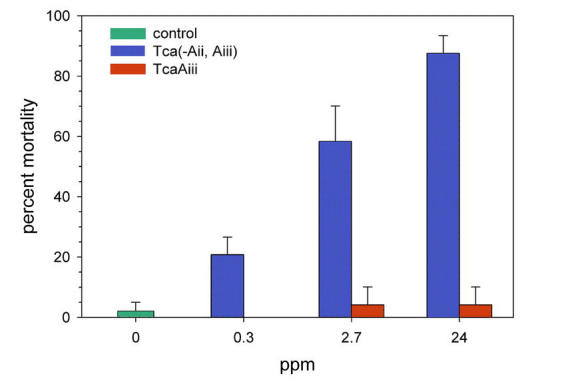
Mortality of neonate Leptinotarsa decemlineata larvae exposed to Tca (-Aii, Aiii) and TcaAiii for 48 h. Each point represents the mean (± SD) of two assays with 12 larvae each (controls had 24 larvae per assay).
Figure 7.
Figure 7.
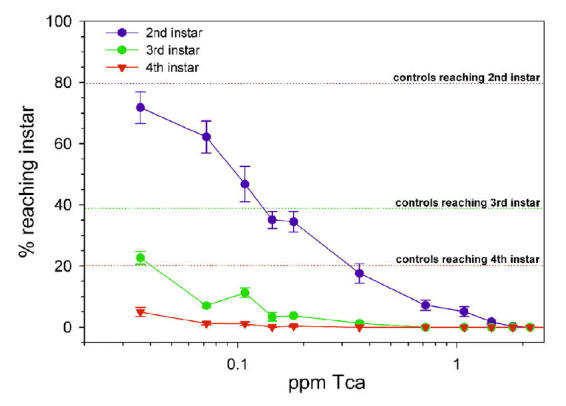
The percentage (± SEM) of first instar Bemesia tabaci nymphs successfully developing to the second, third, and fourth instars at different concentrations of Tca. Reference lines indicate the percentage of controls reaching the indicated instar.
Figure 8.
Figure 8.
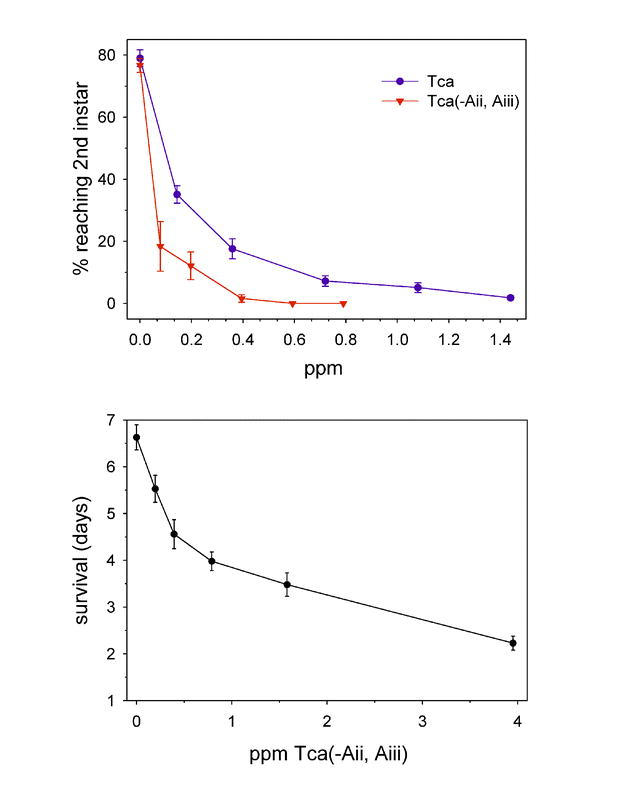
(A) Comparison of Tca and Tca(-Aii, Aiii) toxicity to first instar Bemisia tabaci . The data represent the mean percentage of first instar nymphs developing to the second instar (± SEM) at different concentrations of each complex. (B) The mean length of survival (± SEM), in days, of adult sweet potato whiteflies at varying concentrations of Tca(-Aii, Aiii).

References

    1. Blackburn M, Golubeva E, Bowen D, ffrench-Constant RH. A novel insecticidal toxin from Photorhabdus luminescens : histopathological effects of toxin complex A (Tca) on the midgut of Manduca sexta. Applied and Environmental Microbiology. 1998;64:3036–3041. - PMC - PubMed
    1. Bowen DJ, Ensign JC. Purification and characterization of a high-molecular-weight insecticidal protein complex produced by the entomopathogenic bacterium Photorhabdus luminescens. Applied and Environmental Microbiology. 1998;64:3029–3035. - PMC - PubMed
    1. Bowen D, Rocheleau TA, Blackburn M, Andreev O, Golubeva E, Bhartia R, ffrench-Constant RH. Insecticidal toxins from the bacterium Photorhabdus luminescens. Science. 1998;280:2129–2132. - PubMed
    1. Carazzi D. Eine neue Haematoxylinloesung. Zeitschrift fuer Wissenschaftliche Mikroskopie und fuer Mikroscopische Technik. 1911;28:273.
    1. Duchaud E, Rusniok C, Frangeul L, Buchrieser C, Givaudan A, Taourit S, Bocs S, Boursaux-Eude C, Chandler M, Charles JF, Dassa E, Derose R, Derzelle S, Freyssinet G, Gaudriault S, Medigue C, Lanois A, Powell K, Siguier P, Vincent R, Wingate V, Zouine M, Glaser P, Boemare N, Danchin A, Kunst F. The genome sequence of the entomopathogenic bacterium Photorhabdus luminescens. Nature Biotechnology. 2003;21:1307–13. - PubMed