. 2006 Dec 5;103(49):18727-32.
doi: 10.1073/pnas.0606298103. Epub 2006 Nov 22.

Hypoxia facilitates Alzheimer's disease pathogenesis by up-regulating BACE1 gene expression

Affiliations

Hypoxia facilitates Alzheimer's disease pathogenesis by up-regulating BACE1 gene expression

Xiulian Sun et al. Proc Natl Acad Sci U S A. .

Abstract

The molecular mechanism underlying the pathogenesis of the majority of cases of sporadic Alzheimer's disease (AD) is unknown. A history of stroke was found to be associated with development of some AD cases, especially in the presence of vascular risk factors. Reduced cerebral perfusion is a common vascular component among AD risk factors, and hypoxia is a direct consequence of hypoperfusion. Previously we showed that expression of the beta-site beta-amyloid precursor protein (APP) cleavage enzyme 1 (BACE1) gene BACE1 is tightly controlled at both the transcriptional and translational levels and that increased BACE1 maturation contributes to the AD pathogenesis in Down's syndrome. Here we have identified a functional hypoxia-responsive element in the BACE1 gene promoter. Hypoxia up-regulated beta-secretase cleavage of APP and amyloid-beta protein (Abeta) production by increasing BACE1 gene transcription and expression both in vitro and in vivo. Hypoxia treatment markedly increased Abeta deposition and neuritic plaque formation and potentiated the memory deficit in Swedish mutant APP transgenic mice. Taken together, our results clearly demonstrate that hypoxia can facilitate AD pathogenesis, and they provide a molecular mechanism linking vascular factors to AD. Our study suggests that interventions to improve cerebral perfusion may benefit AD patients.


Conflict of interest statement

The authors declare no conflict of interest.

Figures
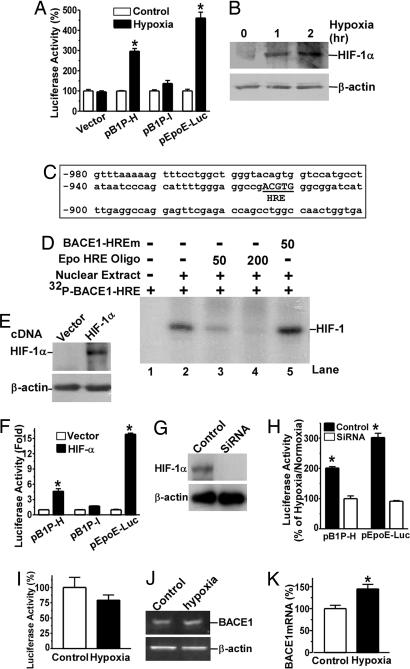
Fig. 1.
Fig. 1.
Up-regulation of BACE1 gene transcription by hypoxia. (A) Hypoxia increases human BACE1 promoter activity. BACE1 promoter constructs pB1P-H and pB1P-I were transfected into SH-SY5Y cells. Plasmid pGL3-Basic (vector) and pEpoE-Luc were used as negative and positive controls, respectively. Cells were exposed to 2% O2 (hypoxia) or 21% O2 (control) after transfection. Luciferase assay was performed 48 h after transfection to reflect promoter activity. ∗, P < 0.001 by ANOVA and Student's t test. (B) HIF-1α expression was rapidly induced by hypoxia in SH-SY5Y cells. Cells were treated with 2% O2 for 0, 1, and 2 h and then lysed in RIPA-Doc buffer (0.15 mM NaCl/0.05 mM Tris · HCl, pH 7.2/1% Triton X-100/1% sodium deoxycholate/0.1% SDS). HIF-1α was detected by rabbit polyclonal anti-HIF-1α antibody (H206). (C) Diagram shows base pairs −980 to −900 of the human BACE1 promoter sequence (relative to the transcription start site). A HRE consensus site 5′-RCGTG was located at base pairs −915 to −911 (capitalized and underlined). (D) The human BACE1 promoter contains a HRE site. Gel shift assay was performed as described in Methods. A 32P-labeled double-stranded oligonucleotide probe, [32P]BACE1-HRE, corresponding to BACE1 promoter base pairs −924 to −907 was used as a probe. (E) Robust HIF-1α expression in HEK293 cells after pHIF-1α expression plasmid transfection. (F) BACE1 promoter activity was increased by HIF-1α overexpression. BACE1 promoter constructs pB1P-H, pB1P-I, and positive control pEpoE-Luc were cotransfected with HIF-1α expression plasmid into HEK293 cells. Luciferase assay was performed 48 h after transfection. HIF-1α overexpression can significantly increase promoter activity in cells transfected with pB1P-H but not pB1P-I. HIF-1α overexpression also significantly increased pEpoE-Luc promoter activity. ∗, P < 0.001 by ANOVA. (G) HIF-1α siRNA transfection reduced HIF-1α expression in HEK293 cells. (H) HIF-1α siRNA inhibited hypoxia's up-regulatory effect on the human BACE1 promoter activity. BACE1 promoter construct pB1P-H or positive control pEpoE-Luc plasmid were cotransfected with control siRNA or HIF-1α siRNAs. The transfected cells were then exposed to 2% O2 (hypoxia) or 21% O2 (control) 12 h after transfection. Luciferase assay was performed 24 h after hypoxia treatment to reflect promoter activity. pCMV-Rluc was cotransfected to normalize transfection efficiency. The numbers represent mean ± SEM; n = 4; ∗, P < 0.0001 by Student's t test. (I) Mutation in the HRE site abolishes the effect of hypoxia on BACE1 promoter activity. The HRE site in the BACE1 promoter of pB1P-H was mutated by site-directed mutagenesis. The mutant construct was transfected into SH-SY5Y cells and exposed to 2% O2 (hypoxia) or 21% O2 (normoxia) for 48 h. (J) Swedish APP stable SH-SY5Y cells were exposed to 2% or 21% O2 for 24 h before RNA extraction. (K) Hypoxia increased BACE1 mRNA by ≈1.5 times. ∗, P < 0.05 by Student's t test.
Fig. 2.
Fig. 2.
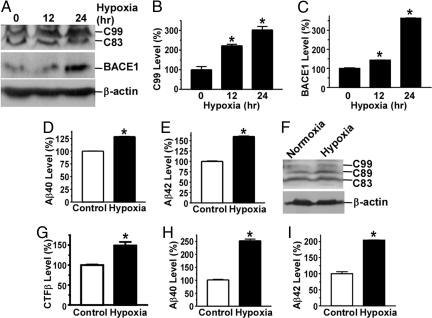
Hypoxia increases Aβ production by up-regulating BACE1 activity. (A) SH-SY5Y cells stably overexpressing Swedish mutant APP were exposed to 2% O2 for 0, 12, or 24 h. C20 antibody was used to detect APP CTFs; 208 antibody was used to detect BACE1. (B and C) Quantification of C99 (B) and BACE1 protein (C) levels. ∗, P < 0.001 by ANOVA. (D and E) ELISA was performed to measure Aβ40 (D) and Aβ42 (E) in culture media from SH-SY5Y cells stably overexpressing Swedish mutant APP exposed to 2% O2 (hypoxia) or 21% O2 (normoxia) for 24 h. ∗, P < 0.0001 by Student's t test. (F) WT APP695 cell HAW1 was cultured under 2% O2 for 12 h, and APP CTFs were detected with C20 antibody. (G) The levels of CTFβ including C99 and C89 were quantitated. ∗, P < 0.001 by Student's t test. (H and I) The conditioned media from the same hypoxia-treated cells were analyzed for Aβ40 (H) and Aβ42 (I) levels. The numbers represent mean ± SEM; n = 3; ∗, P < 0.0001 by Student's t test.
Fig. 3.
Fig. 3.
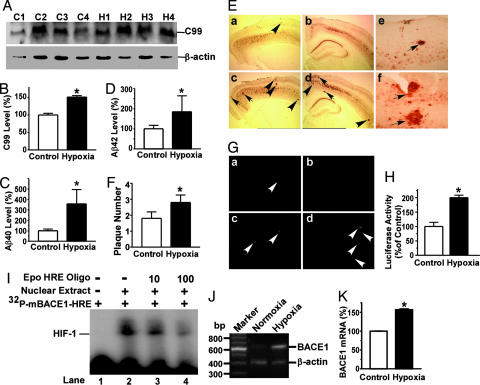
Hypoxia increases β-secretase cleavage of APP and Aβ deposition in APP23 transgenic mice. Eight-month-old APP23 mice were treated with 8% O2 (hypoxia) for 16 h/day for 1 month. Ten mice per group were used for hypoxia and normoxia treatment. (A) Half brains from hypoxic and age-matched normoxic control mice were lysed in RIPA-Doc lysis buffer and separated with 16% Tris-Tricine SDS/PAGE gel. C99 was detected by C20 polyclonal antibody. β-actin was detected by anti-β-actin antibody AC-15 as the internal control. (B) Quantification showed that C99 was significantly increased in hypoxia-treated mice. ∗, P < 0.01 by Student's t test. (C and D) ELISA was performed to measure Aβ40 (C) and Aβ42 (D) levels in mouse brain tissue lysates. ∗, P < 0.001 by Student's t test. (E) 4G8 immunostaining. The other half brains were dissected from hypoxic and age-matched normoxic control mice, fixed, and sectioned. Neuritic plaques were detected by Aβ-specific mAb 4G8 (Signet Laboratories) and the DAB method. The plaques were visualized under a microscope at ×40 magnification. More neuritic plaques were stained in hypoxic mice (c and d) compared with age-matched control mice (a and b). Arrows point to plaques. Magnification at ×200 reveals more and larger plaques in hypoxic mice (f) than in normoxic mice (e). (F) Quantification of neuritic plaques. ∗, P < 0.001 by ANOVA. (G) Thioflavin S staining. Neuritic plaques were further confirmed by using thioflavin S fluorescent staining and were visualized under a microscope at ×100 magnification. a and c are sections of frontal cortex; b and d are sections of hippocampus. More neuritic plaques were seen in hypoxia-treated mice (c and d) than in age-matched controls (a and b). Arrows point to green fluorescent neuritic plaques. (H) A mouse BACE1 promoter was cloned into the pGL3-Basic vector and transfected into cells. Hypoxia increased luciferase activity in pB1Pm-A transfected cells that contained two putative HRE consensus sites. ∗, P < 0.01 by Student's t test. (I) Gel shift assay demonstrated that the mouse BACE1 promoter also contains an HIF-1 transcription factor binding site. Gel shift assay was performed using a 32P-labeled [32P]mBACE1-HRE probe in which the two putative HRE consensus sites were juxtaposed. Lane 1, probe alone without nuclear extract; lane 2, incubation of HeLa nuclear extract with probe retarded the migration of free probes to form a new HIF-1-DNA complex; lanes 3 and 4, competition assays adding 10- and 100-fold molar excess of Epo-HRE consensus oligonucleotides. (J) Endogenous BACE1 mRNA level in the WT control mice. The control mice were subjected to the hypoxia treatment, and total RNA samples were extracted from the mouse brains for RT-PCR assay. β-actin was amplified as the internal control. (K) Hypoxia significantly increased endogenous BACE1 mRNA in WT mice by ≈1.5 times. ∗, P < 0.0001 relative to normoxia WT mice controls by Student's t test.
Fig. 4.
Fig. 4.
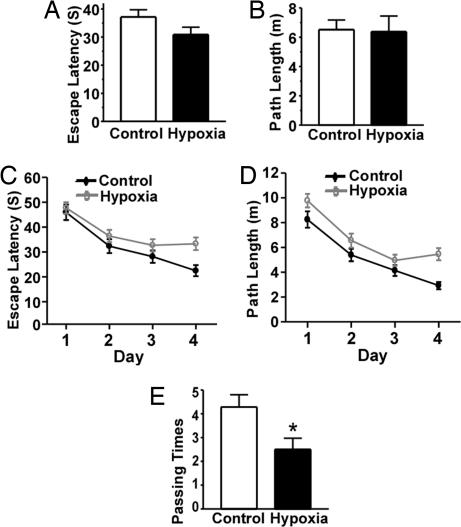
Hypoxia potentiates the memory deficit in Swedish mutant APP transgenic mice. A Morris water maze protocol with 1 day of visible platform tests and 4 days of hidden platform tests, plus a probe trial on day 6. Animal movement was tracked and recorded by an HVS 2020 Plus image analyzer (HVS Image, Hampton, UK). Ten mice per group were used for hypoxia and normoxia treatment. (A) During the first day of visible platform tests, mice were trained in five contiguous trials. The hypoxic and normoxic APP23 mice exhibited a similar latency to escape onto the visible platform. P > 0.05 by Student's t test. (B) Hypoxic and normoxic APP23 mice swam a similar distance before escaping onto the visible platform in the visible platform test. P > 0.05 by Student's t test. (C) In hidden platform tests, mice were trained with six trials per day for 4 days. Hypoxic APP23 mice showed a longer latency to escape onto the hidden platform. P < 0.005 by two-way ANOVA. (D) Hypoxic APP23 mice swam farther before escaping onto the hidden platform. P < 0.001 by two-way ANOVA. (E) In the probe trial on day 6, hypoxic APP23 mice crossed the target platform significantly fewer times than controls. ∗, P < 0.05 by Student's t test.

References

    1. Mattson MP. Nature. 2004;430:631–639. - PMC - PubMed
    1. White L, Petrovitch H, Hardman J, Nelson J, Davis DG, Ross GW, Masaki K, Launer L, Markesbery WR. Ann NY Acad Sci. 2002;977:9–23. - PubMed
    1. Snowdon DA, Greiner LH, Mortimer JA, Riley KP, Greiner PA, Markesbery WR. J Am Med Assoc. 1997;277:813–817. - PubMed
    1. Altieri M, Di Piero V, Pasquini M, Gasparini M, Vanacore N, Vicenzini E, Lenzi GL. Neurology. 2004;62:2193–2197. - PubMed
    1. Schneider JA, Wilson RS, Cochran EJ, Bienias JL, Arnold SE, Evans DA, Bennett DA. Neurology. 2003;60:1082–1088. - PubMed

Publication types

Substances