


Implication of MYH in colorectal polyposis
- PMID: 17122612
- PMCID: PMC1856630
- DOI: 10.1097/01.sla.0000246937.54435.50
Implication of MYH in colorectal polyposis
Abstract
Objective: The aim of this study was to determine the frequency of MYH mutations in one large population of polyposis patients without APC mutation identified.
Summary background data: Familial adenomatous polyposis (FAP) is the most known inherited colorectal cancer syndrome. In 70% to 80% of polyposis patients, an APC mutation is found. Patients with polyposis but no APC mutation are considered as APC-muted patients and followed as their relatives accordingly. Biallelic mutation of MYH has been found to responsible of colorectal polyposis and cancer in an autosomal recessive pattern of inheritance.
Methods: Between 1978 and 2004, 433 patients were operated for polyposis. A mutation on APC was identified in 322 patients. Among the remaining patients, 44 were identified as possible MYH-muted patients and contacted, and 31 signed informed consent. Clinical data were obtained from the patients' medical notes. Germline mutation of MYH was searched by sequencing the whole gene. To confirm the deleterious effects of biallelic MYH mutation, transversions on K-ras and APC were searched.
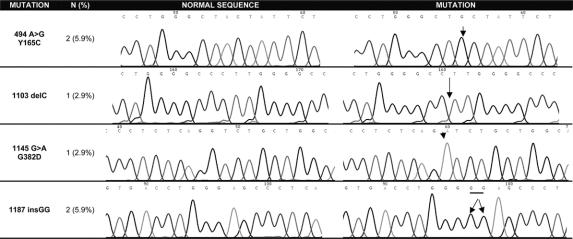
Results: There were 9 women and 22 men with a mean age of 53.9 years (range, 22-68 years) at the time of diagnosis. The mean number of polyps was 62.8 (range, 11-266). Eighteen patients (58.1%) had a colorectal cancer. We found biallelic MYH mutation in 6 patients (19.3%; 95% confidence interval, 5.2%-33.5%) and 5 (83.3%) had transversions in K-ras and/or APC.
Conclusion: MYH is a new gene responsible for about 1.4% of all adenomatous polyposis and about 20% of adenomatous polyposis without APC mutation identified. Search for MYH biallelic mutation in these patients should be systematic as it changes their and relatives'surveillance.
References
-
- Landis SH, Murray T, Bolden S, et al. Cancer statistics, 1999. CA Cancer J Clin. 1999;49:8–31. - PubMed
-
- Johns LE, Houslton RS. A systematic review and meta-analysis of familial colorectal cancer risk. Am J Gastroenterol. 2001;96:2292–2303. - PubMed
-
- Kinzler VW, Nilbert MC, Su LK, et al. Identification of FAP locus genes from chromosome 5q21. Science. 1991;253:661–665. - PubMed
-
- Kinzler KW, Vogelstein B. Lessons from hereditary colorectal cancer. Cell. 1996;87:159–170. - PubMed
MeSH terms
Substances
LinkOut - more resources
Full Text Sources
Research Materials
Miscellaneous
