Review
. 2007 Jan 1:12:2601-15.
doi: 10.2741/2258.

Neurolipidomics: challenges and developments

Affiliations
Review

Neurolipidomics: challenges and developments

Xianlin Han. Front Biosci. .

Abstract

The field of lipidomics is one of the most rapidly expanding areas of systems biology research. Considering the uniqueness and complexity of the lipidome in the nervous system (i.e., neurolipidome), neurolipidomics remains quite challenging but exciting. With the recent development of mass spectrometry (MS)-based lipidomics, particularly the rapid improvement of multi-dimensional MS-based shotgun lipidomics, much progress has been made in neurolipidomics. As the accelerated development of future technologies enables lipidomics penetrance into lower and lower abundance regions of mass contents of individual lipid molecular species, it can be anticipated that many biochemical mechanisms underlying lipid metabolism critical to neuronal disease states will be increasingly uncovered. Through exploiting the information content inherent in the complexity of neuronal lipid composition and kinetic turnover which can be revealed by neurolipidomics, substantial insights into neuronal plasticity and gene function can be gathered. Through neurolipidomics, the markers for these neuronal diseases which identify pathological alterations and are diagnostic of disease onset, progression or severity may potentially be discovered. Accordingly, with neurolipidomics, our understanding of the complexities of the nervous system will be undoubtedly accelerated, as many mysteries are resolved.


Figures
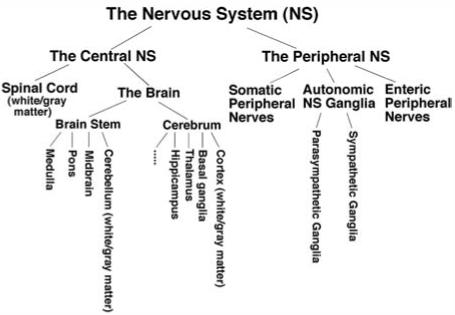
Figure 1
Figure 1
Schematic classification of the nervous system.
Figure 2
Figure 2
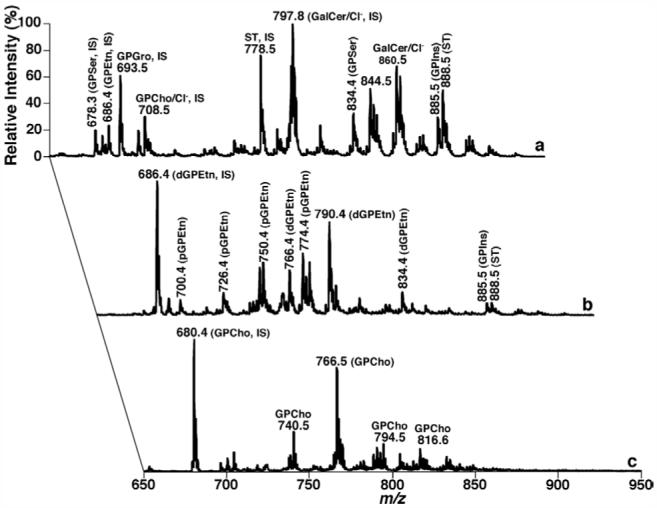
Electrospray ionization mass spectrometric analyses of the mouse cortex lipidome after intrasource separation and selective ionization. Spectrum a was acquired in the negative-ion mode directly from a lipid extract that was diluted to less than 50 pmol of total lipids per microliter. Spectrum b was acquired again in the negative-ion mode from the diluted lipid solution as used for spectrum a after addition of approximately 25 pmol LiOH per microliter to the lipid solution. Spectrum c was acquired in the positive-ion mode from the identical diluted lipid solution as used in spectrum b after direct infusion. “IS” denotes internal standard. GPCho is choline glycerophospholipid; GPEtn stands for ethanolamine glycerophospholipid; pGPEtn represents plasmalogen GPEtn; GPSer represents phosphatidylserine; GPIns indicates phosphatidylinositol; GalCer denotes galactosylceramide; and ST is sulfatide. All mass spectral traces are displayed after normalization to the base peak in each individual spectrum.
Figure 3
Figure 3
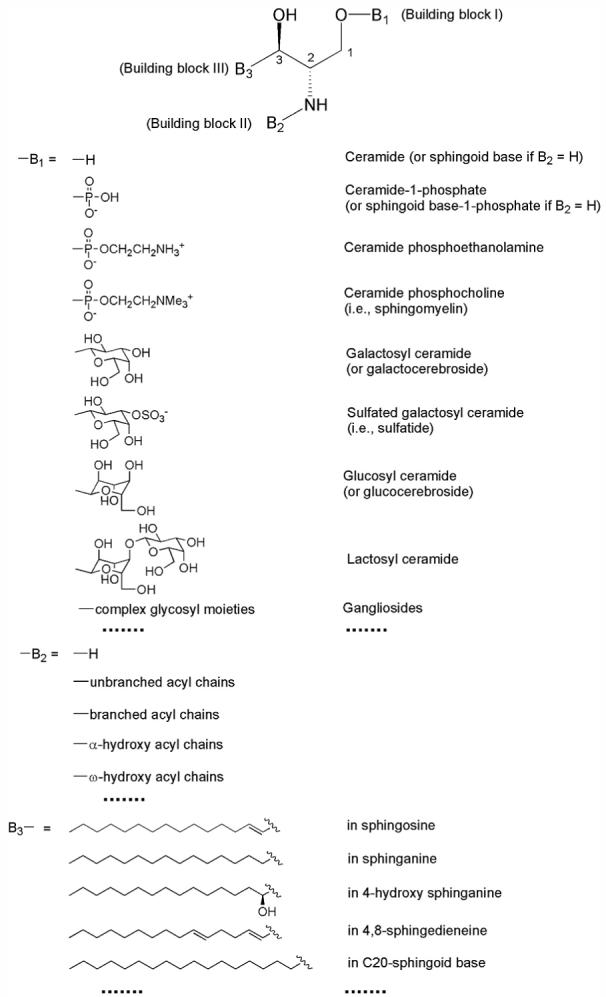
A simplified structural list of sphingolipidome with three building blocks. The building block I (B1) represents a different polar moiety (linked to the oxygen at the C1 position of sphingoid base). The building block II (B2) represents fatty acyl chains (acylated to the primary amine at the C2 position of sphingoid base) with or without the presence of a hydroxyl group which is usually located at the alpha or omega position. The building block III (B3) represents the aliphatic chains in all of possible sphingoid bases, which are carbon-carbon linked to the C3 position of sphingoid bases and vary with the aliphatic chain length, degree of unsaturation, the presence of branch, and the presence of an additional hydroxyl group.
Figure 4
Figure 4
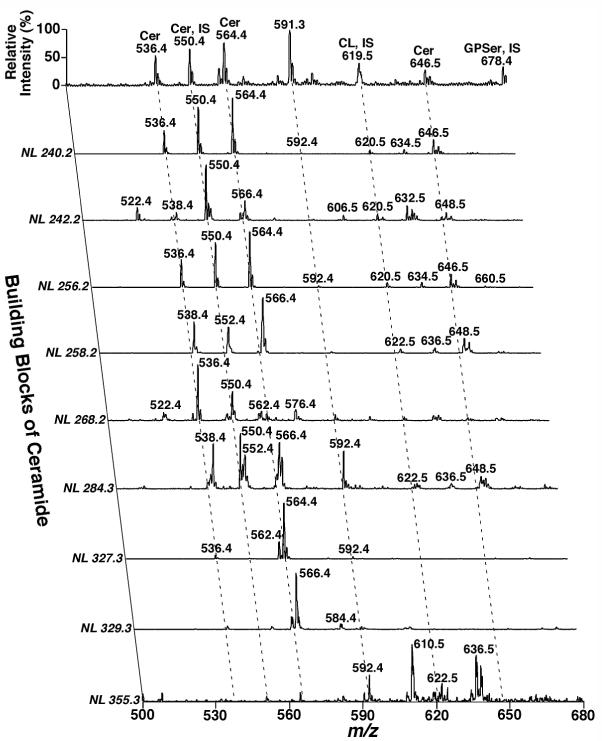
Analysis of ceramide molecular species in a lipid extract of post-mortem human occipital white matter by multi-dimensional mass spectrometry-based shotgun lipidomics. Lipids in human occipital white matter were extracted by a modified Bligh-Dyer procedure in the presence of 1 nmol C17:1 ceramide (used as an internal standard)/mg protein and 10 mM of LiCl. The lipid extract was directly infused into the ESI ion source using a Harvard syringe pump at a flow rate of 4 microliter per min after dilution of the extract to a concentration of approximately 100 pmol per microliter in 1:1 chloroform/methanol. A conventional ESI mass spectrum in the negative-ion mode was acquired prior to analysis of the building blocks of ceramide molecular species by neutral loss (NL) scanning. These building blocks of ceramide molecular species including sphingoid bases of sphingosine (NL 240.2, NL 256.2, and NL 327.3), sphinganine (NL 242.2, NL 258.2, and NL 329.3), and C20-sphingoid base (NL 268.2, NL 284.3, and NL 355.3) with or without presence of hydroxyl group in fatty amide chains as previously described (50). “IS” denotes internal standard; Cer stands for ceramide; CL represents doubly-charged cardiolipin; and GPSer represents phosphatidylserine. All mass spectral traces are displayed after normalization to the base peak in each individual spectrum. (Han, Unpublished data).
Figure 5
Figure 5
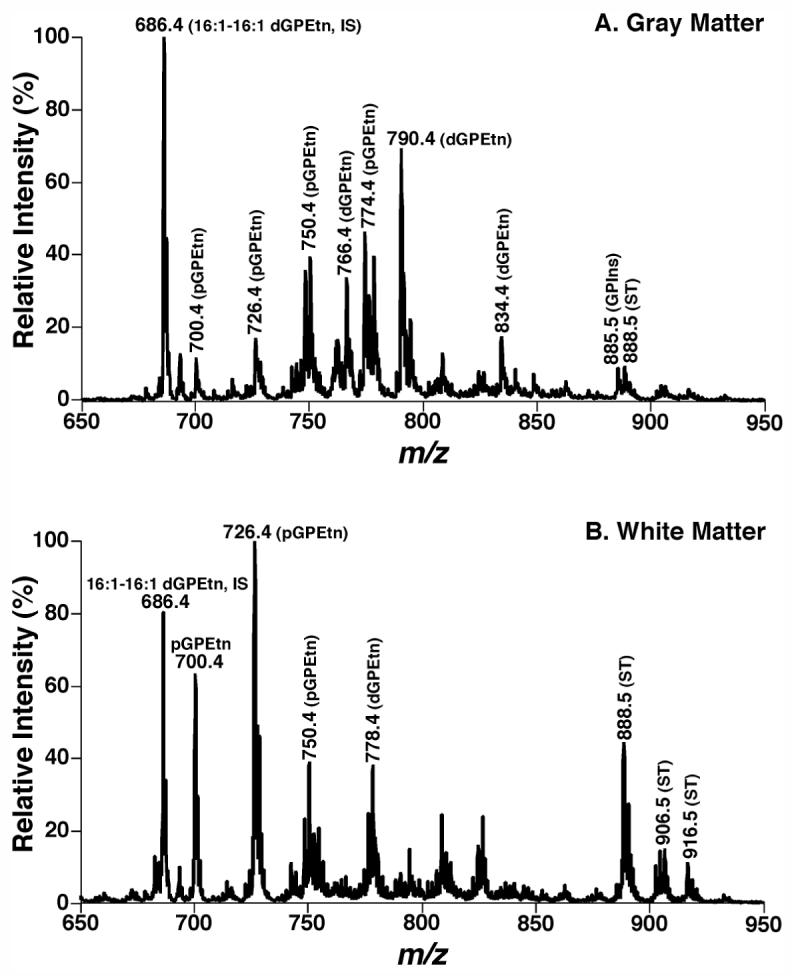
Distinct lipid profiles of ethanolamine glycerophospholipids in lipid extracts of cognitively normal human occipital gray and white matter. Brain lipids were extracted by a modified procedure of Bligh-Dye. Negative-ion ESI mass spectra of lipid extracts of occipital gray matter (Spectrum A of Panel A) and white matter (Spectrum B of Panel B) of cognitively normal human brain were acquired in the presence of LiOH. Individual molecular species were identified using multi-dimensional MS. Plasmenylethanolamine and phosphatidylethanolamine are abbreviated as “pGPEtn” and “dGPEtn”, respectively. GPSer represents phosphatidylserine; GPIns indicates phosphatidylinositol; and ST is sulfatide. “IS” denotes internal standard. (Han, Unpublished data).

References

    1. Han X, Gross RW. Global analyses of cellular lipidomes directly from crude extracts of biological samples by ESI mass spectrometry: a bridge to lipidomics. J Lipid Res. 2003;44:1071–1079. - PubMed
    1. Lagarde M, Geloen A, Record M, Vance D, Spener F. Lipidomics is emerging. Biochim Biophys Acta. 2003;1634:61. - PubMed
    1. Wenk MR. The emerging field of lipidomics. Nat Rev Drug Discov. 2005;4:594–610. - PubMed
    1. Kitano H. Systems biology: a brief overview. Science. 2002;295:1662–1664. - PubMed
    1. Kenchaiah S, Evans JC, Levy D, Wilson PW, Benjamin EJ, Larson MG, Kannel WB, Vasan RS. Obesity and the risk of heart failure. N Engl J Med. 2002;347:305–313. - PubMed

Publication types

LinkOut - more resources