. 2007 Apr 1;390(1-2):136-45.
doi: 10.1016/j.gene.2006.09.025. Epub 2006 Oct 5.

A deep-branching clade of retrovirus-like retrotransposons in bdelloid rotifers

Affiliations

A deep-branching clade of retrovirus-like retrotransposons in bdelloid rotifers

Eugene A Gladyshev et al. Gene. .

Abstract

Rotifers of class Bdelloidea, a group of aquatic invertebrates in which males and meiosis have never been documented, are also unusual in their lack of multicopy LINE-like and gypsy-like retrotransposons, groups inhabiting the genomes of nearly all other metazoans. Bdelloids do contain numerous DNA transposons, both intact and decayed, and domesticated Penelope-like retroelements Athena, concentrated at telomeric regions. Here we describe two LTR retrotransposons, each found at low copy number in a different bdelloid species, which define a clade different from previously known clades of LTR retrotransposons. Like bdelloid DNA transposons and Athena, these elements are found preferentially in telomeric regions. Unlike bdelloid DNA transposons, many of which are decayed, the newly described elements, named Vesta and Juno, inhabiting the genomes of Philodina roseola and Adineta vaga, respectively, appear to be intact and represent recent insertions, possibly from an exogenous source. We describe the retrovirus-like structure of the new elements, containing gag, pol, and env-like open reading frames, and discuss their possible origins, transmission, and behavior in bdelloid genomes.


Figures
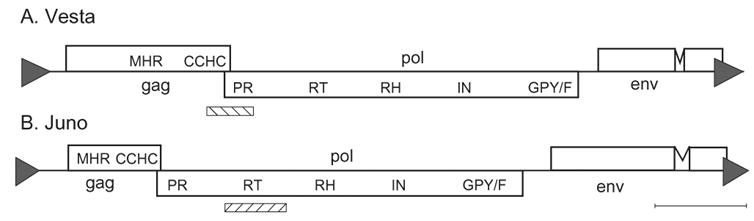
Figure 1
Figure 1
Structural organization of (A) Vesta and (B) Juno retrotransposons. Shaded triangles, LTRs; open boxes, ORFs. Functional domains within each ORF are discussed in the text. The predicted introns connect two putative exons in ORF3, although may not necessarily be functional in bdelloid hosts. Striped boxes denote the corresponding probes used in hybridization experiments.
Figure 2
Figure 2
Multiple sequence alignment of Vesta and Juno with known representatives of Metaviridae and Retroviridae. Shown are the most conserved regions in the gag-like ORF and in the PR, RT, RH, and IN domains of pol. Highly conserved residues are denoted by asterisks. Functionally important residues essential for binding or catalysis (listed in Xiong and Eickbush, 1990; Malik and Eickbush, 1999, 2001) are indicated on the top. The sequences from diverse clades, used in the alignment, including several uncharacterized retroelements, were retrieved as the top matches to the Vesta and Juno queries in a search of the CDD (conserved domain database, NCBI). The host species and GenBank identifier (gi) numbers of retroelements are as follows: DGLT-A1 from Dictyostelium discoideum (11527878); sushi from Fugu rubripes (6425167); Athila from Arabidopsis thaliana (4417306); Galadriel from Lycopersicon esculentum (4235644); Ty3 from Saccharomyces cerevisiae (173086); Woot from Tribolium castaneum (1213461); blastopia from Drosophila melanogaster (415797); Cer1 from Caenorhabditis elegans (557717); MuLV from Mus musculus (535517); uncharacterized retroelements from C. elegans (K03D3.8, 3878215) Oryza sativa (13486715), Glomerella cingulata (10946131), Zea mays (2832244), and Danio rerio (68394879). The Gag alignment, in its CC-HC part, is a continuation of the sequences on the left, except for two cases: line 3 shows the second Zn knuckle of Juno, 7 aa downstream from the first one, and line 7 shows the retroviral Zn knuckle from MuLV.
Figure 3
Figure 3
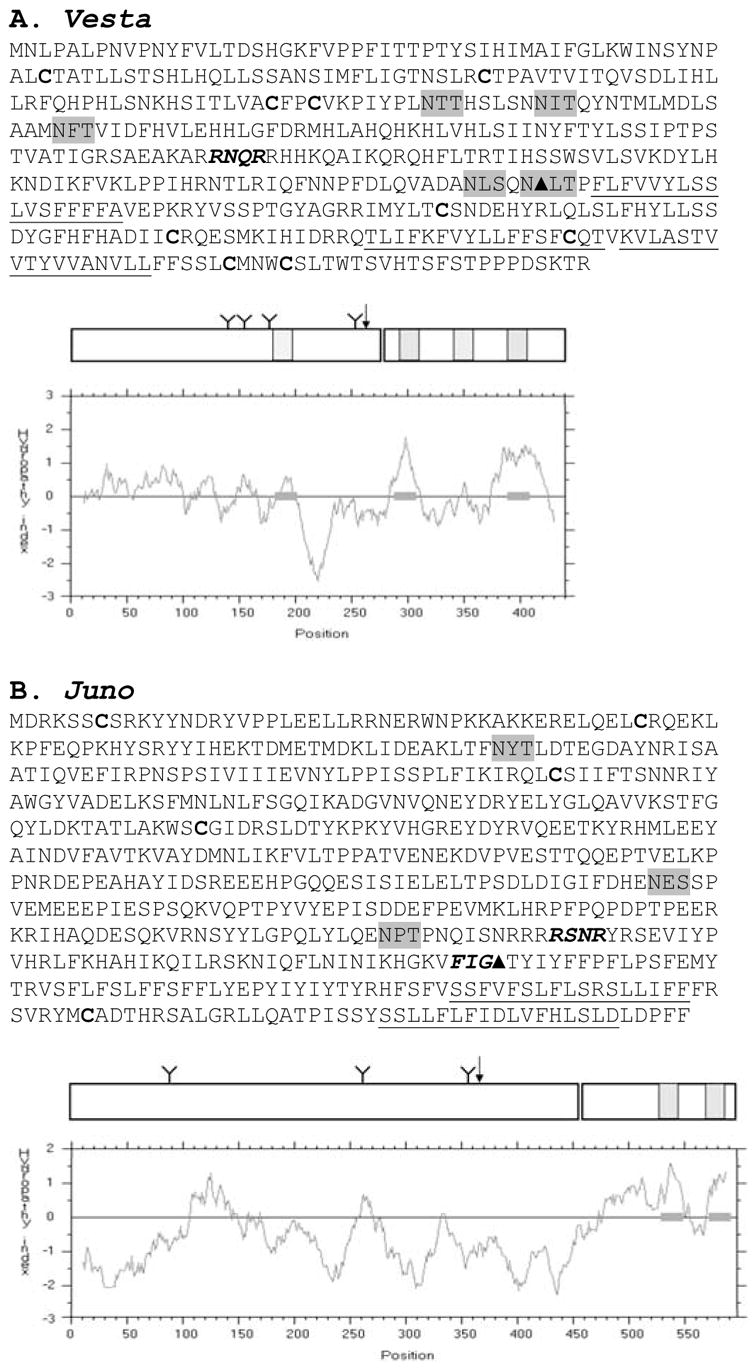
Characterization of the putative env-like proteins encoded by (A) Vesta and (B) Juno. The putative N-linked glycosylation sites (NxS/T) are shaded; the potential furin-like protease cleavage sites (RxxR) and the canonical fusion tripeptide (FxG) motifs (Misseri et al., 2003) are in bold italics. The transmembrane (TM) regions predicted by PSORT are underlined. Two TM regions are found in Juno2 (shown in the figure); only one region appears in Juno3, 5, and 4; the most divergent Juno1 lacks detectable TM regions. Cysteine residues are in boldface. Predicted intron locations are shown by triangles. We have not determined the exact structure of subgenomic RNAs used for expression of the env regions, thus the first methionine in these ORFs does not necessarily correspond to the actual N-terminus of env-like proteins, normally expected to have a signal peptide. Below the amino acid sequence of each ORF is its graphical representation (shaded boxes, putative transmembrane domains; vertical arrows, potential host protease cleavage sites; Y, putative N-glycosylation sites) and the corresponding Kyte-Doolittle hydrophobicity plot generated by ConPred2, with predicted TM segments shown as shaded boxes (http://bioinfo.si.hirosaki-u.ac.jp/~ConPred2/).
Figure 4
Figure 4
Southern blot hybridization estimates of copy numbers of Vesta (A) and Juno (B) in genomic DNA. Hybridization probes are indicated in Fig. 1. (A) P. roseola genomic DNA digested with (1) EcoR1, (2) HindIII and (3) PvuII. EcoR1 has a single recognition site within Vesta and yields no internal Vesta fragments; HindIII yields a ca. 5-kb internal fragment, in addition to fragments extending into flanking DNA; and PvuII has no internal recognition sites. (B) PvuII digests of genomic DNA from A. vaga (1) and a related species A. ricciae (2), which yields weak hybridization. A ca. 4-kb internal Juno fragment is generated upon PvuII digestion, in addition to fragments extending into flanking DNA.
Figure 5
Figure 5
Phylogenetic placement of Vesta and Juno. The phylogram shows the results of the neighbor-joining analysis, with the clade support values from 1000 bootstrap replications indicated below the branches, and with the clade credibility values obtained from Bayesian analysis indicated above the branches, if any of the values exceeds 50%. Previously known clades of Metaviridae (Malik and Eickbush, 1999; Bae et al., 2001; Kordis, 2005) are indicated on the right. The Gmr clade, with the inverse IN-RT order (Goodwin and Poulter, 2002), was not included in the alignment. All clades are significantly supported, but in most cases the branching order of the clades, as in previous studies, cannot be resolved. The elements Woot and Cigr1 apparently do not belong to known clades, and their placement differs in neighbor-joining and Bayesian analyses. Amino acid sequences are from the datasets in the above references, which were used to define these clades; also shown are several sequences listed in the legend to Fig. 2.

References

    1. Arkhipova IR, Mazo AM, Cherkasova VA, Gorelova TV, Schuppe NG, Ilyin YV. The steps of reverse transcription of Drosophila mobile dispersed genetic elements and U3-R-U5 structure of their LTRs. Cell. 1986;44:555–563. - PubMed
    1. Arkhipova IR, Lyubomirskaya NV, Ilyin YV. Drosophila retrotransposons. Austin, TX: RG Landes Co; 1995.
    1. Arkhipova IR. Promoter elements in Drosophila melanogaster revealed by sequence analysis. Genetics. 1995;139:1359–1369. - PMC - PubMed
    1. Arkhipova I, Meselson M. Transposable elements in sexual and ancient asexual taxa. Proc Natl Acad Sci USA. 2000;97:14473–14477. - PMC - PubMed
    1. Arkhipova I, Meselson M. Deleterious transposable elements and the extinction of asexuals. Bioessays. 2005a;27:76–85. - PubMed

Publication types

LinkOut - more resources