. 2007 Jun;56(6):927-38.
doi: 10.1007/s00262-006-0237-4. Epub 2006 Nov 28.

In the FVB/N HER-2/neu transgenic mouse both peripheral and central tolerance limit the immune response targeting HER-2/neu induced by Listeria monocytogenes-based vaccines

Affiliations

In the FVB/N HER-2/neu transgenic mouse both peripheral and central tolerance limit the immune response targeting HER-2/neu induced by Listeria monocytogenes-based vaccines

Reshma Singh et al. Cancer Immunol Immunother. 2007 Jun.

Abstract

Listeria monocytogenes-based vaccines for HER-2/neu are capable of breaking tolerance in FVB/N rat HER-2/neu transgenic mice. The growth of implanted NT-2 tumors, derived from a spontaneously occurring tumor in the FVB/N HER-2/neu transgenic mouse, was significantly slower in these mice following vaccination with a series of L. monocytogenes-based vaccines for HER-2/neu. Mechanisms of T cell tolerance that exist in these transgenic mice include the absence of functional high avidity anti-HER-2/neu CD8(+) T cells and the presence of CD4(+)CD25(+) regulatory T cells. The in vivo depletion of these regulatory T cells resulted in the slowing in growth of tumors even without the treatment of mice with an anti-HER-2/neu vaccine. The average avidities of responsive CD8(+) T cells to six of the nine epitopes in HER-2/neu we examined, four of which were identified in this study, are shown here to be of a lower average avidity in the transgenic mice versus wild type FVB/N mice. In contrast, the average avidity of CD8(+) T cells to three epitopes that showed the lowest avidity in the wild-type mice did not differ between wild type and transgenic mice. This study demonstrates the ability of L. monocytogenes-based vaccines to impact upon tolerance to HER-2/neu in FVB/N HER-2/neu transgenic mice and further defines some of the aspects of tolerance in these mice.


Figures

Fig. 1
Fig. 1
NT-2 tumor growth is significantly slower after Lm-LLO-HER-2/neu vaccination. NT-2 tumor cells were implanted s.c. on the flank of female HER-2/neu transgenic mice. The tumors in control mice when vaccinated with PBS or Lm-LLO-NYESO-1 rapidly grew out by day 45. The tumors in all of the HER-2/neu vaccinated mice grow much more slowly and on average do not grow beyond 10 mm. There were no tumor measurements after day 50 because each of the HER-2/neu vaccinated mice scratched away her tumor. All of the Lm-LLO-HER-2/neu vaccines are significantly different (P < 0.0001) from the control vaccines (PBS and the Lm-LLO-NYESO-1 vaccines) on day 42 based on the Student’s t test
Fig. 2
Fig. 2
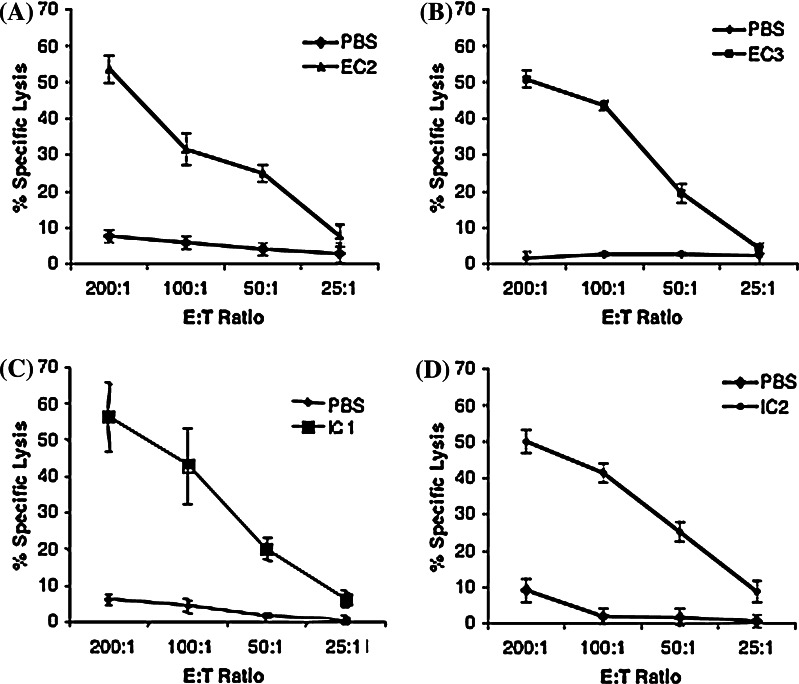
Identification of novel CD8+ T cell epitopes in the FVB/N HER-2/neu transgenic mouse. Novel epitopes in each of the Listeria monocytogenes vaccines have been identified through CTL analyses. Peptides were used at a concentration of 1 μg/ml each pulsed onto 3T3-wt target cells. The E:T ratios used were 200:1, 100:1, 50:1, and 25:1, with splenocytes from PBS or Lm-LLO-HER-2/neu vaccinated mice. The epitopes are as follows: a the EC2 epitope LFRNPHQALL, b the EC3 epitope PGPTQCVNCS, c the IC1 epitope PNQAQMRIL, d the IC2 epitope LQRYSEDPTL
Fig. 3
Fig. 3
Some of the CD8+ T cells in the FVB/N HER-2/neu transgenic mouse are of lower avidity than the cells from wild type FVB/N mice. CTL analysis of each of the epitopes using decreasing concentrations of the peptide pulsed onto 3T3-wt target cells. The concentrations used were 10−6, 10−7, 10−8, 10−9, 10−10 M. Wild type and transgenic mice are directly compared at a 200:1 E:T ratio. a PDSLRDLSVF, b PYNYLSTEV, c LFRNPHQALL, d PGPTQCVNCS, e PNQAQMRIL, f GSGAFGTVYK, g AFGTVYKGI, h PYVSRLLGI, and i LQRYSEDPTL
Fig. 4
Fig. 4
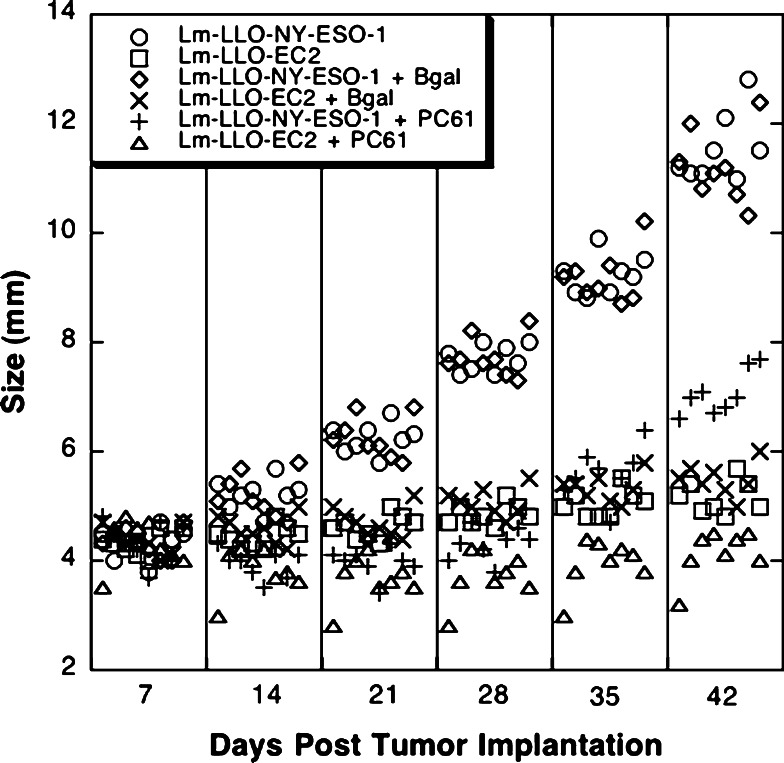
Regression of NT-2 tumor cells in FVB/N HER-2/neu transgenic mice following depletion of CD4+CD25+ regulatory T cells. Mice were given tumors and then injected with no antibody, a control antibody, or a CD25 depletion antibody and then observed for the ability to induce the regression of tumors following depletion of regulatory T cells. Both the Lm-LLO-NYESO-1 + PC61 and the Lm-LLO-EC2 + PC61 groups are significantly different (P < 0.0001) from the Lm-LLO-NYESO-1 + β-gal and the Lm-LLO-EC2 + β-gal group on day 42 based on the Student’s t test
Fig. 5
Fig. 5
An anti-HER-2/neu specific monoclonal antibody is capable of controlling NT-2 tumor growth in FVB/N HER-2/neu transgenic mice. Mice were given tumors and injected with both the Listeria-based vaccines and either a control (a) or the 7.21.2 anti-HER-2/neu antibody (b) on days 7, 14, 21, 28, and 35. Groups are shown as an average tumor size at each time point. Both the PBS and Lm-LLO-NYESO-1, anti-HER-2/neu antibody groups are significantly better at day 42 than the PBS and Lm-LLO-NYESO-1 control antibody groups (P < 0.0001). Each of the Lm-LLO-HER-2/neu vaccine groups co-administered with the anti-HER-2/neu specific antibody is also significantly better at day 42 than the vaccine groups with the control antibody (P < 0.01)

References

    1. Schwartz RH. T cell anergy. Annu Rev Immunol. 2003;21:305. doi: 10.1146/annurev.immunol.21.120601.141110. - DOI - PubMed
    1. Chattopadhyay S, Mehrotra S, Chhabra A, Hegde U, Mukherji B, Chakraborty NG. Effect of CD4+CD25+ and CD4+CD25- T regulatory cells on the generation of cytolytic T cell response to a self but human tumor-associated epitope in vitro. J Immunol. 2006;176:984. - PubMed
    1. Wang RF, Peng G, Wang HY. Regulatory T cells and Toll-like receptors in tumor immunity. Semin Immunol. 2006;18:136. doi: 10.1016/j.smim.2006.01.008. - DOI - PubMed
    1. Lauritzsen GF, Hofgaard PO, Schenck K, Bogen B. Clonal deletion of thymocytes as a tumor escape mechanism. Int J Cancer. 1998;78:216. doi: 10.1002/(SICI)1097-0215(19981005)78:2<216::AID-IJC16>3.0.CO;2-8. - DOI - PubMed
    1. De Visser KE, Schumacher TN, Kruisbeek AM. CD8+ T cell tolerance and cancer immunotherapy. J Immunother. 2003;26:1. doi: 10.1097/00002371-200301000-00001. - DOI - PubMed

Publication types