


Implementation of Advanced Access in general practice: postal survey of practices
- PMID: 17132379
- PMCID: PMC1934051
Implementation of Advanced Access in general practice: postal survey of practices
Abstract
Background: Advanced Access has been strongly promoted as a means of improving access to general practice. Key principles include measuring demand, matching capacity to demand, managing demand in different ways and having contingency plans. Although not advocated by Advanced Access, some practices have also restricted availability of pre-booked appointments.
Aim: This study compares the strategies used to improve access by practices which do or do not operate Advanced Access.
Design of study: Postal survey of practices.
Setting: Three hundred and ninety-one practices in 12 primary care trusts.
Method: Questionnaires were posted to practice managers to collect data on practice characteristics, supply and demand of appointments, strategies employed to manage demand, and use of Advanced Access.
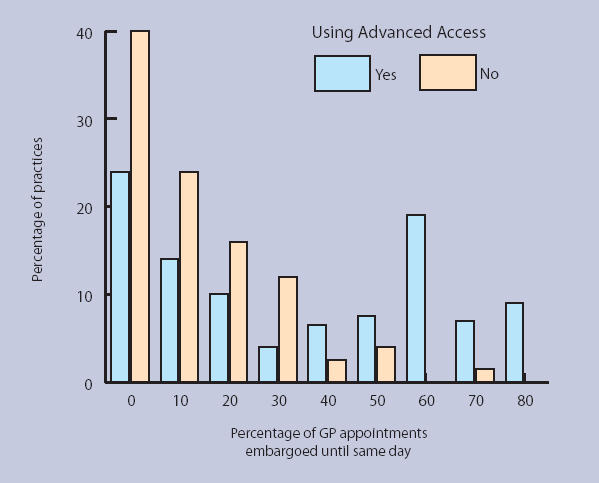
Results: Two hundred and forty-five from 391 (63%) practices returned a questionnaire and 162/241(67%) claimed to be using Advanced Access. There were few differences between characteristics of practices operating Advanced Access or not. Both types of practice had introduced a wide range of measures to improve access. The proportion of doctors' appointments only available for booking on the same day was higher in Advanced Access practices (40 versus 16%, difference = 24%, 95% CI = 16% to 32%). Less than half the practices claiming to operate Advanced Access ((63/140; 45%) used all four of this model's key principles.
Conclusion: The majority of practices in this sample claim to have introduced Advanced Access, but the degree of implementation is very variable. Advanced Access practices use more initiatives to measure and improve access than non-Advanced Access practices.
Figures
References
-
- Department of Health. Achieving and sustaining improved access to Primary Care. London: Department of Health; 2002. http://www.dh.gov.uk/PolicyAndGuidance/OrganisationPolicy/PrimaryCare/Pr... (accessed 26 October 2006)
-
- Oldham J. Advanced Access in primary care. Glossop: National Primary Care Development Team; 2001. http://www.npdt.org/AccesstoPrimaryCare/advancedaccess.pdf (accessed 10 Nov 2006)
-
- Murray M, Berwick DM. Advanced Access. Reducing waiting and delays in primary care. JAMA. 2003;289(8):1035–1040. - PubMed
-
- Knight AW, Padgett J, George B, Datoo MR. Reduced waiting times for the GP: two examples of ‘advanced access’ in Australia. Med J Aust. 2005;183(2):101–103. - PubMed
-
- Solberg LI, Hroscikoski MC, Sperl-Hillen JM, et al. Key issues in transforming health care organizations for quality: the case of advanced access. Jt Comm J Qual Safety. 2004;30(1):15–24. - PubMed
Publication types
MeSH terms
LinkOut - more resources
Full Text Sources
