. 2007 Jan;35(Database issue):D219-23.
doi: 10.1093/nar/gkl897. Epub 2006 Nov 28.

FireDB--a database of functionally important residues from proteins of known structure

Affiliations

FireDB--a database of functionally important residues from proteins of known structure

Gonzalo Lopez et al. Nucleic Acids Res. 2007 Jan.

Abstract

The FireDB database is a databank for functional information relating to proteins with known structures. It contains the most comprehensive and detailed repository of known functionally important residues, bringing together both ligand binding and catalytic residues in one site. The platform integrates biologically relevant data filtered from the close atomic contacts in Protein Data Bank crystal structures and reliably annotated catalytic residues from the Catalytic Site Atlas. The interface allows users to make queries by protein, ligand or keyword. Relevant biologically important residues are displayed in a simple and easy to read manner that allows users to assess binding site similarity across homologous proteins. Binding site residue variations can also be viewed with molecular visualization tools. The database is available at http://firedb.bioinfo.cnio.es.


Figures
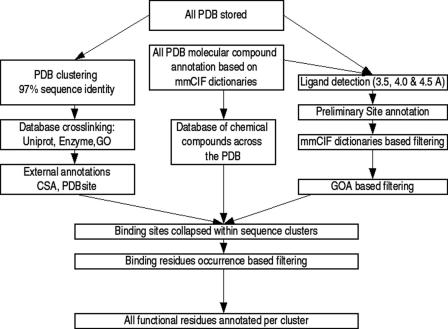
Figure 1
Figure 1
FireDB flowchart. The organization allows two search modes—molecular compounds and proteins.
Figure 2
Figure 2
Information retrieved for the family of sequence collapsed around 1tcoC. (a) a representation of the analogous sites collapsed into the master sequence for the FK506 bidning proteins. The sites are ordered by ligand occupancy and are annotated with information from the Catalytic Site Atlas. (b) an expanded view of the binding residues from the sequences that bind the ligand analog RAP from the sequences collapsed into the FK506 binding protein master sequence; the colour scheme of each residue depends on the percentage of occupancy of each residue. (c) Jmol representations of four cases from this family, representing (i) the FK506 binding site for 1tcoC, (ii) the FK506 binding site for 1bkf, (iii) the RAP (Rapamycin) binding site for 1bkf and (iv) the RAP binding site for 1fapA. The backbone and ball and stick for protein, Van der Waals representation for the ligands. The residue composition for all four binding sites is similar, but different.
Figure 3
Figure 3
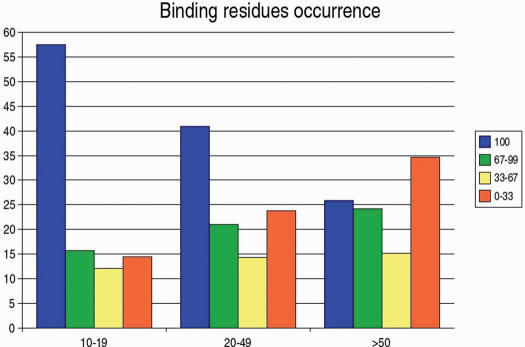
A breakdown of binding residue occupancy. Binding residues are grouped into three bins depending on the number of sequences with binding sites that are collapsed into each of the master sequences. These bins were for 10–19 sequences (a total of 14, 594 binding residues), 20–49 sequences (7536 residues) and greater than 49 sequences (1937 residues). The number of collapsed sequences used for the bins is shown in the x-axis. Residues were also clustered into bins depending on the occupancy in binding sites. Occupancy for each residue in a master sequence is defined as the percentage of collapsed sequences in which each equivalent residue is in contact with the ligand at 4A. Occupancy is shown in the legend and the percentage of residues at each of the occupancy bins is shown in the y-axis. Even for the group with 50 or more structures collapsed into the master sequence, 25% of binding residues bind the ligand in every single one of the collapsed sequences and another 25% fall in the 67–99% range of occupancy percentages.

References

    1. Westbrook J., Feng Z., Chen L., Yang H., Berman H.M. The Protein Data Bank and structural genomics. Nucleic Acids Res. 2003;31:489–491. - PMC - PubMed
    1. Berman H.M. The past and the future of structure databases. Curr. Opin. Biotech. 1999;10:76–80. - PubMed
    1. Rost B. Marrying structure and genomics. Structure. 1998;6:259–263. - PubMed
    1. Pazos F., Sternberg M.J.E. Automated prediction of protein function and detection of functional sites from structure. Proc. Natl Acad. Sci. USA. 2004;101:14754–14759. - PMC - PubMed
    1. Todd A.E., Orengo C.A., Thornton J.M. Evolution of function in protein superfamilies, from a structural perspective. J. Mol. Biol. 2001;307:1113–1143. - PubMed

Publication types