


The interaction between orthographic and phonological information in children: an fMRI study
- PMID: 17133384
- PMCID: PMC2692515
- DOI: 10.1002/hbm.20313
The interaction between orthographic and phonological information in children: an fMRI study
Abstract
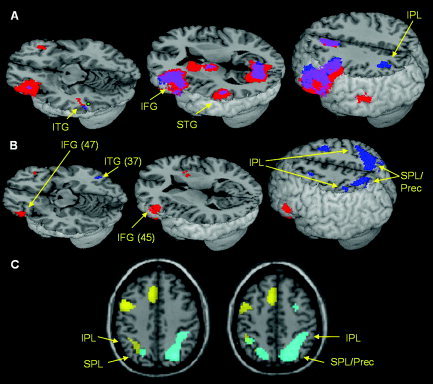
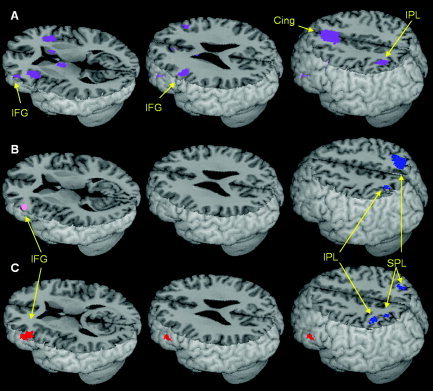
We examined the neural representations of orthographic and phonological processing in children, while manipulating the consistency between orthographic and phonological information. Participants, aged 9-15, were scanned while performing rhyming and spelling judgments on pairs of visually presented words. The orthographic and phonological similarity between words in the pair was independently manipulated, resulting in four conditions. In the nonconflicting conditions, both orthography and phonology of the words were either (1) similar (lime-dime) or (2) different (staff-gain); in conflicting conditions, words had (3) similar phonology and different orthography (jazz-has) or (4) different phonology and similar orthography (pint-mint). The comparison between tasks resulted in greater activation for the rhyming task in bilateral inferior frontal gyri (BA 45/47), and greater activation for the spelling task in bilateral inferior/superior parietal lobules (BA 40/7), suggesting greater involvement of phonological and semantic processing in the rhyming task, and nonlinguistic spatial processing in the spelling task. Conflicting conditions were more difficult in both tasks and resulted in greater activation in the above regions. The results suggest that when children encounter inconsistency between orthographic and phonological information they show greater engagement of both orthographic and phonological processing.
(c) 2006 Wiley-Liss, Inc.
Figures
References
-
- Alivisatos B, Petrides M 1997: Functional activation of the human brain during mental rotation. Neuropsychologia 35: 111–118. - PubMed
-
- Baayen RH, Piepenbrock R, Gulikers L 1995): The CELEX Lexical Database (Version Release 2) [CD‐ROM]. Philadelphia, PA: Linguistic Data Consortium, University of Pennsylvania.
-
- Booth JR, Burman DD, Meyer JR, Gitelman DR, Parrish TB, Mesulam MM 2002a: Functional anatomy of intra‐ and cross‐modal lexical tasks. Neuroimage 16: 7–22. - PubMed
Publication types
MeSH terms
Grants and funding
LinkOut - more resources
Full Text Sources
Research Materials
