


Predictors of onset of facial pain and temporomandibular disorders in early adolescence
- PMID: 17134830
- PMCID: PMC1979093
- DOI: 10.1016/j.pain.2006.10.012
Predictors of onset of facial pain and temporomandibular disorders in early adolescence
Abstract
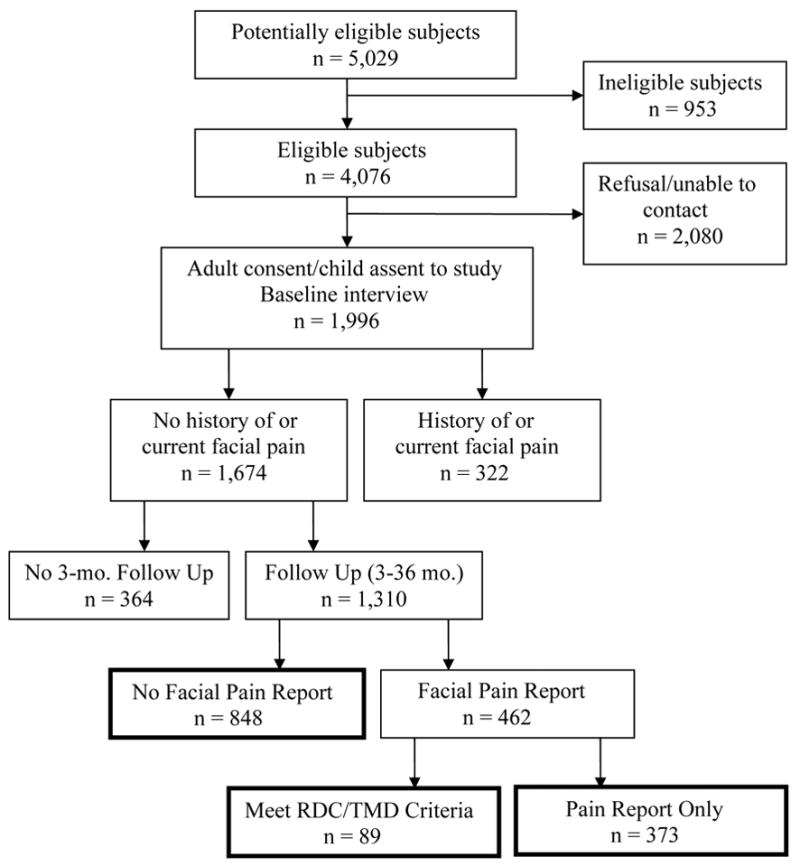
There are few prospective studies assessing risk factors for onset of temporomandibular (TMD) pain disorders in any age group. The aim of this prospective cohort study was to identify risk factors for onset of clinically significant TMD pain (i.e., pain meeting research diagnostic criteria for myofascial pain and/or arthralgia) during early adolescence. Subjects were 1,996 boys and girls, initially 11 years old, randomly selected from a large nonprofit health care system. Subjects completed a baseline telephone interview and were followed up with mailed questionnaires every 3 months for 3 years. At baseline and all follow ups, subjects were asked to report the presence of facial pain in the past 3 months. Subjects reporting a first onset of facial pain received a standardized clinical examination. In multivariate analyses, baseline predictors of clinically significant pain included female gender [Odds Ratio (OR)=2.0, 95% Confidence Interval (CI)=1.2-3.3] and negative somatic and psychological symptoms including somatization (OR=1.8, CI=1.1-2.8), number of other pain complaints (OR=3.2, CI=1.7-6.1) and life dissatisfaction (OR=4.1, CI=1.9-9.0). Many of the risk factors for onset of clinically significant TMD pain in adolescents are similar to risk factors for onset of TMD and other pain problems in adults, as well as risk factors for onset of other pain conditions in adolescents. These findings suggest that the development of TMD pain in adolescence may reflect an underlying vulnerability to musculoskeletal pain that is not unique to the orofacial region.
Figures
References
-
- Anttila P, Metsähonkala L, Aromaa M, Sourander A, Salminen J, Helenius H, Alanen P, Sillanpää M. Determinants of tension-type headache in children. Cephalalgia. 2002;22:401–408. - PubMed
-
- Bachman JG, Johnston LD, O’Malley PM. Monitoring the future: questionnaire responses from the nation’s high school seniors. Institute of Social Research, University of Michigan; Ann Arbor: 1986.
-
- Centers for Disease Control Growth Charts: United States. http://www.cdc.gov/growthcharts/
-
- Derogatis LR, Cleary PA. Confirmation of the dimensional structure of the SCL-90: A study in construct validation. J Clin Psychol. 1977;33:981–989.
-
- Diatchenko L, Slade GD, Nackley AG, Bhalang K, Sigurdsson A, Belfer I, Goldman D, Xu K, Shabalina SA, Shagin D, Max MB, Makarov SS, Maixner W. Genetic basis for individual variations in pain perception and the development of a chronic pain condition. Hum Mol Genet. 2005;14:135–143. - PubMed
Publication types
MeSH terms
Grants and funding
LinkOut - more resources
Full Text Sources
Other Literature Sources
Medical
Miscellaneous
