


The "bench-presser's shoulder": an overuse insertional tendinopathy of the pectoralis minor muscle
- PMID: 17138640
- PMCID: PMC2465431
- DOI: 10.1136/bjsm.2006.032383
The "bench-presser's shoulder": an overuse insertional tendinopathy of the pectoralis minor muscle
Abstract
Background: Tendinopathies of the rotator cuff muscles, biceps tendon and pectoralis major muscle are common causes of shoulder pain in athletes. Overuse insertional tendinopathy of pectoralis minor is a previously undescribed cause of shoulder pain in weightlifters/sportsmen.
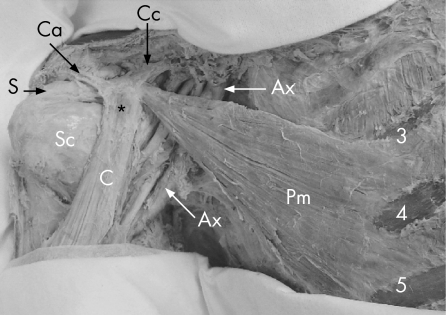
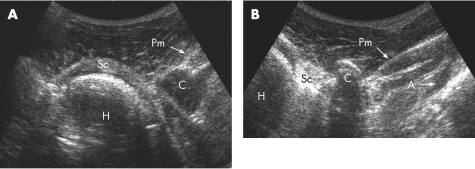
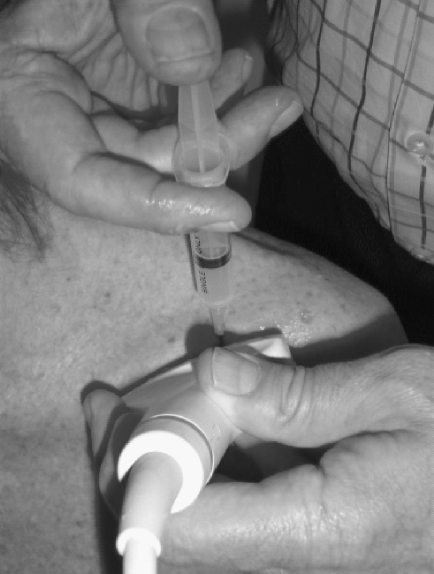
Objectives: To describe the clinical features, diagnostic tests and results of an overuse insertional tendinopathy of the pectoralis minor muscle. To also present a new technique of ultrasonographic evaluation and injection of the pectoralis minor muscle/tendon based on use of standard anatomical landmarks (subscapularis, coracoid process and axillary artery) as stepwise reference points for ultrasonographic orientation.
Methods: Between 2005 and 2006, seven sportsmen presenting with this condition were diagnosed and treated at the Cape Shoulder Institute, Cape Town, South Africa.
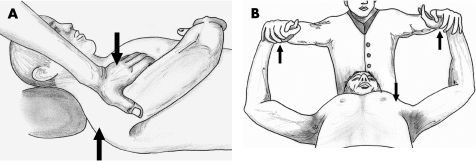
Results: In five patients, the initiating and aggravating factor was performance of the bench-press exercise (hence the term "bench-presser's shoulder"). Medial juxta-coracoid tenderness, a painful active-contraction test and bench-press manoeuvre, and decrease in pain after ultrasound-guided injection of a local anaesthetic agent into the enthesis, in the absence of any other clinically/radiologically apparent pathology, were diagnostic of pectoralis minor insertional tendinopathy. All seven patients were successfully treated with a single ultrasound-guided injection of a corticosteroid into the enthesis of pectoralis minor followed by a period of rest and stretching exercises.
Conclusions: This study describes the clinical features and management of pectoralis minor insertional tendinopathy, secondary to the bench-press type of weightlifting. A new pain site-based classification of shoulder pathology in weightlifters is suggested.
Conflict of interest statement
Competing interests: None.
References
-
- Maganaris C N, Narici M V, Almekinders L C.et al Biomechanics and pathophysiology of overuse tendon injuries: ideas on insertional tendinopathy. Sports Med 2004341005–1017. - PubMed
-
- Teitz C C, Garrett W E, Jr, Miniaci A.et al Instructional Course Lectures, The American Academy of Orthopaedic Surgeons–tendon problems in athletic individuals. J Bone Joint Surg Am 199779138–152. - PubMed
-
- Chadwick C J. Tendinitis of the pectoralis major insertion with humeral lesions: A report of two cases. J Bone Joint Surg Br 198971816–818. - PubMed
-
- Marone P J.Shoulder injuries in sports. London: Martin Dunitz, 199247–68.
-
- Kendall F P, McCreary E K.Muscles: testing and function. 3rd edn. Baltimore/London: Williams & Wilkins, 1983106
MeSH terms
Substances
LinkOut - more resources
Full Text Sources
Medical
