. 2007 Jan 5;100(1):96-104.
doi: 10.1161/01.RES.0000253904.53601.c9. Epub 2006 Nov 30.

Nitroxyl improves cellular heart function by directly enhancing cardiac sarcoplasmic reticulum Ca2+ cycling

Affiliations

Nitroxyl improves cellular heart function by directly enhancing cardiac sarcoplasmic reticulum Ca2+ cycling

Carlo G Tocchetti et al. Circ Res. .

Abstract

Heart failure remains a leading cause of morbidity and mortality worldwide. Although depressed pump function is common, development of effective therapies to stimulate contraction has proven difficult. This is thought to be attributable to their frequent reliance on cAMP stimulation to increase activator Ca(2+). A potential alternative is nitroxyl (HNO), the 1-electron reduction product of nitric oxide (NO) that improves contraction and relaxation in normal and failing hearts in vivo. The mechanism for myocyte effects remains unknown. Here, we show that this activity results from a direct interaction of HNO with the sarcoplasmic reticulum Ca(2+) pump and the ryanodine receptor 2, leading to increased Ca(2+) uptake and release from the sarcoplasmic reticulum. HNO increases the open probability of isolated ryanodine-sensitive Ca(2+)-release channels and accelerates Ca(2+) reuptake into isolated sarcoplasmic reticulum by stimulating ATP-dependent Ca(2+) transport. Contraction improves with no net rise in diastolic calcium. These changes are not induced by NO, are fully reversible by addition of reducing agents (redox sensitive), and independent of both cAMP/protein kinase A and cGMP/protein kinase G signaling. Rather, the data support HNO/thiolate interactions that enhance the activity of intracellular Ca(2+) cycling proteins. These findings suggest HNO donors are attractive candidates for the pharmacological treatment of heart failure.


Figures
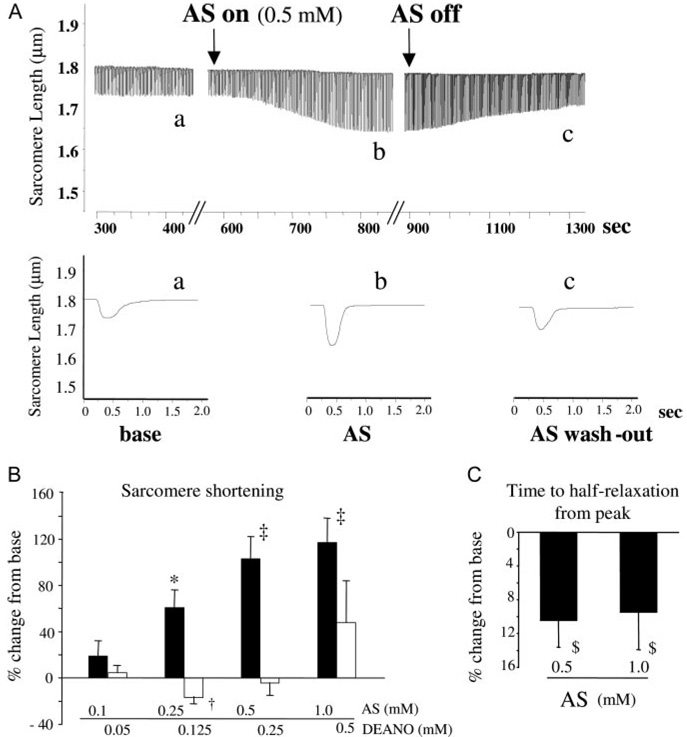
Figure 1
Figure 1
HNO increases contractility and relaxation in isolated ventricular myocytes. A, Effect of AS/HNO on sarcomere shortening in isolated mouse ventricular myocyte. B, Dose-response effect of AS/HNO and DEA/NO on cell shortening. *P<0.001 vs control, †P<0.01 vs control, ‡P<0.00005 vs control. C, AS/HNO effects on myocyte relaxation (time to 50% relengthening). $P<0.05 vs control.
Figure 2
Figure 2
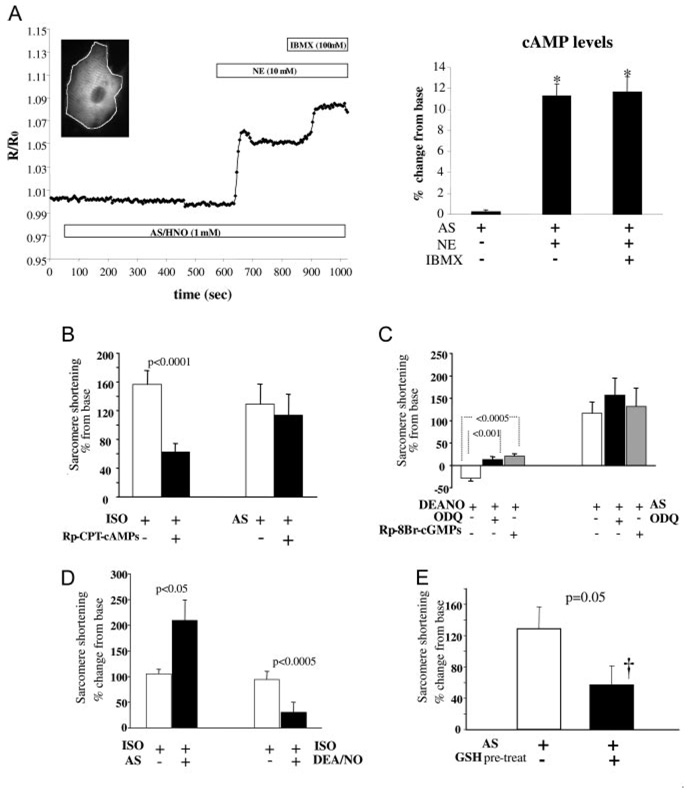
AS/HNO actions on myocyte function are cAMP and cGMP independent but modulated by the intracellular thiol content. A, left, Kinetics of cAM-PFRET recorded in a single living neonatal rat cardiomyocyte (inset) challenged with AS (1 mmol/L), followed by norepinephrine (NE) (10 µmol/L) and the broad-spectrum phosphodiesterase inhibitor 3-isobutyl-1-methylxanthine (IBMX) (100 µmol/L). Graph depicts FRET average over the entire cell. Summary data are to the right. *P<10−6 vs control. B, PKA inhibition with 100 µmol/L Rp-CPT-cAMPs blunts ISO but not HNO inotropy. C, sGC (soluble guanylyl cyclase [ODQ]) or PKG (Rp-8Br-cGMPs) inhibition blunts NO but not HNO effects. D, NO has negative impact on concomitant β-adrenergic– stimulated contractility, whereas HNO effects are additive. E, Pretreatment with cell-permeable GSH reduces sarcomere shortening enhancement by AS/HNO. †P<0.05 vs control.
Figure 3
Figure 3
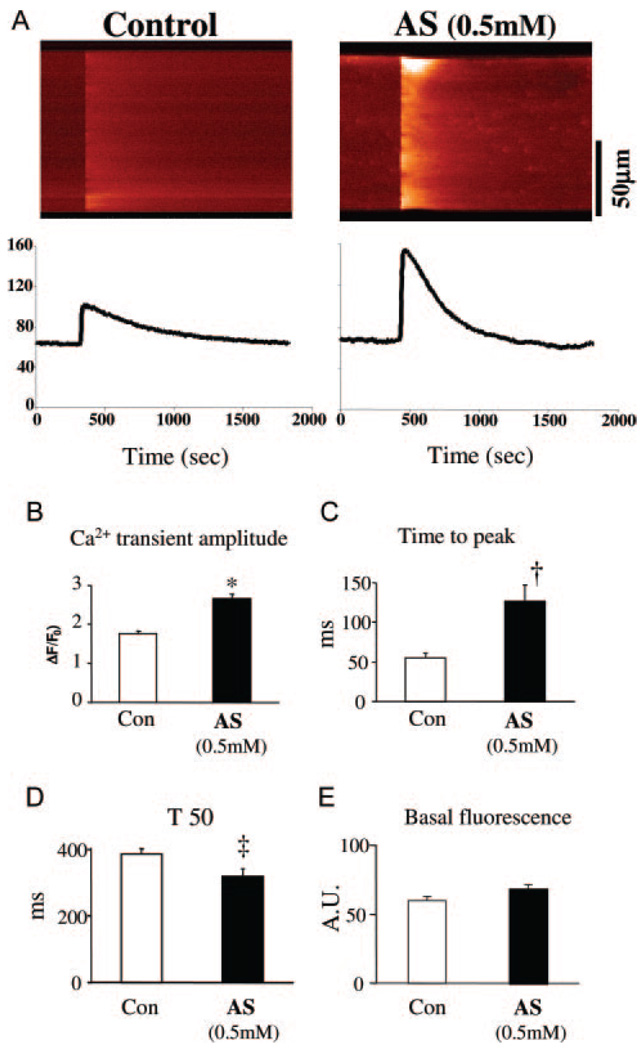
Increase of Ca2+ transients by HNO in isolated murine myocytes. A, Line-scan confocal images of Ca2+ transients in control and AS-treated (0.5 mmol/L) mice cardiomyocytes. Cells were loaded with Ca2+ indicator fluo-4 (20 µmol/L for 20 minutes). Mean results for Ca2+ transient amplitude (ΔF/F0) (B), rising time (Time to peak) (C), time from peak to 50% relaxation (T50) (D), and basal fluorescence (E) (arbitrary units, n=27 to 28 cells from 3 hearts for each data point). *P<0.001 vs control, †P<0.01 vs control, ‡P<0.05 vs control.
Figure 4
Figure 4
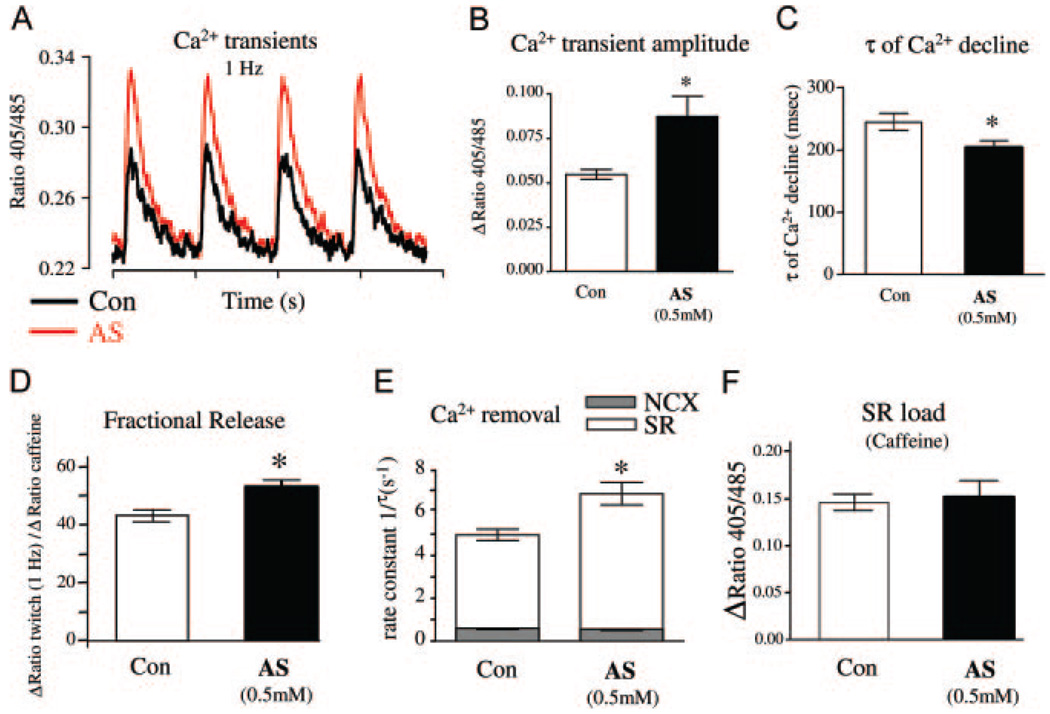
Increase of Ca2+ transients and Ca2+ fractional release from SR in rat cardiomyocytes. A, Representative original recordings and Ca2+ transients in untreated control (Ctr) and AS-pretreated (AS) rat myocytes. B and C, Mean results for Ca2+ transient amplitude and τ of Ca2+ decline (n=30 to 31 cells from 4 hearts). D through F, SR Ca2+ load measured via rapid application of 10 mmol/L caffeine (n=11 to 14 cells from 6 hearts). D, Twitch amplitude divided by the caffeine amplitude expressed in percentage (fractional SR Ca2+ release). E, Ca2+ removal fluxes according to the formula 1/τtwitch=1/τNCX+1/τSR; τNCX is the τ of Ca2+ decline in the presence of caffeine; relative contribution of the SR increased from 87.6% in Ctr to 91.3% in AS-pretreated cells and relative contribution of NCX decreased from 12.4% to 8.7%, respectively. Total SR load was unchanged (F). All data are means±SEM. *P<0.05 vs control.
Figure 5
Figure 5
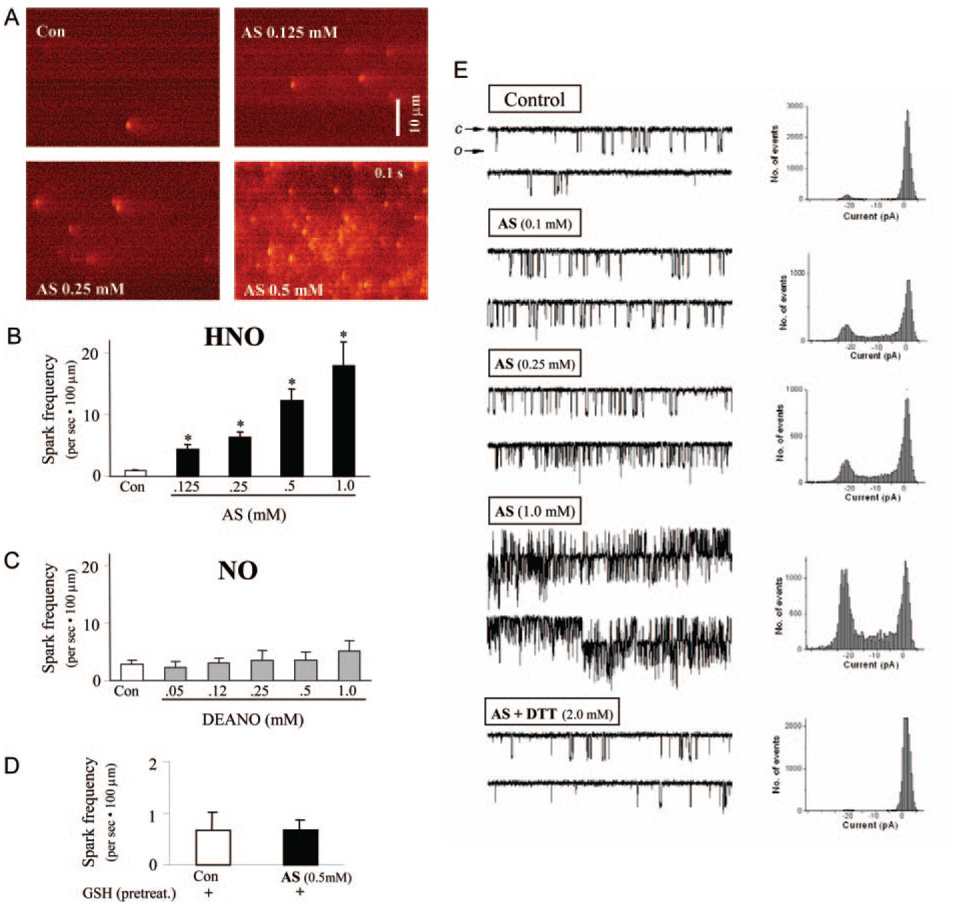
AS/HNO increase RyR2 function in a thiol-sensitive manner. A, Line-scan images of Ca2+ sparks in intact murine myocytes in control conditions and after increasing concentrations of AS/HNO. B, Dose-dependent effect of AS/HNO on Ca2+ spark frequency (*P<0.001 vs control). C, Neutral effect of DEA/NO on Ca2+ spark frequency. D, Pretreatment with GSH abolishes AS-induced increase in Ca2+ spark frequency. E, Representative original tracings of single-channel recordings in RyR2 from murine myocytes. Cardiac RyR2 channels were reconstituted into planar lipid bilayers and activated by 3 µmol/L (cis) cytosolic Ca2+. From the top to the bottom, RyR2 single recordings in control conditions and after the exposure to increasing concentration of AS/HNO, showing dose-dependent increase in Po with increasing doses of AS/HNO. In the lowest trace, the AS-induced increase in RyR2 open probability is almost fully reversed by the addition of the thiol-reducing agent dithiothreitol (DTT) to the cytosolic side.
Figure 6
Figure 6
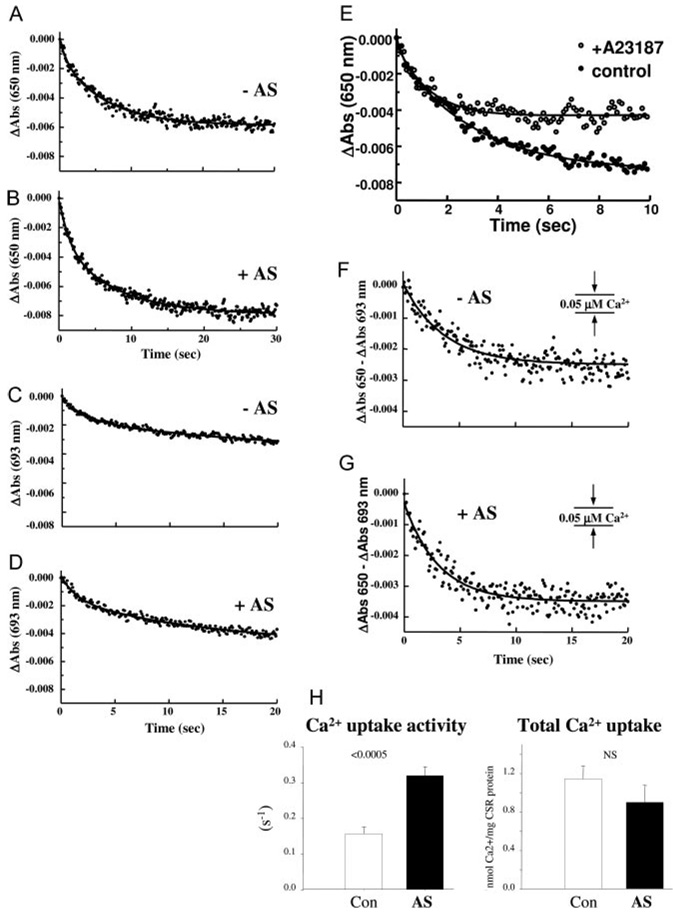
HNO increases ATP-dependent Ca2+ uptake in murine sarcoplasmic reticulum (SR) vesicles. A and B, Representative stopped-flow recordings of active Ca2+ accumulation monitored by arsenazo III at 650 nm in the absence (−AS) and presence (+AS) of 250 µmol/L AS. The downward deflection of the signal represents Ca2+ uptake from the extravesicular medium. The initial absorbance reading on the y-axis was normalized to 0 by subtracting the absorbance at t=0 from each of the absorbance readings. The solid curve through the data points represents the best fit of the data to a biexponential plus residual equation. C and D, Representative changes in light-scattering measured by stopped-flow mixing at the isosbestic wavelength of 693 nm in the absence (−AS) and presence (+AS) of 250 µmol/L AS. Reaction conditions were identical to those in A and B above. E, Representative stopped-flow recordings of active Ca2+ accumulation monitored at 650 nm in the absence (control) and presence of the Ca2+ ionophore (A23187). F and G, Representative time course of active Ca2+ uptake in SR vesicles determined by subtraction of a stopped-flow trace acquired at 693 nm from a trace acquired at 650 nm (ΔAbs 650 nm−ΔAbs 693 nm). The traces were normalized as described above before subtraction. H, Effect of AS/HNO on (left) Ca2+ uptake activity (sec−1) and (right) total Ca2+ uptake evaluated from the 650 to 693 nm signal.

References

    1. Houser SR, Margulies KB. Is depressed myocyte contractility centrally involved in heart failure? Circ Res. 2003;92:350–358. - PubMed
    1. Mann DL, Bristow MR. Mechanisms and models in heart failure: the biomechanical model and beyond. Circulation. 2005;111:2837–2849. - PubMed
    1. Fukuto JM, Bartberger MD, Dutton AS, Paolocci N, Wink DA, Houk KN. The physiological chemistry and biological activity of nitroxyl (HNO): the neglected, misunderstood, and enigmatic nitrogen oxide. Chem Res Toxicol. 2005;18:790–801. - PubMed
    1. Paolocci N, Saavedra WF, Miranda KM, Martignani C, Isoda T, Hare JM, Espey MG, Fukuto JM, Feelisch M, Wink DA, Kass DA. Nitroxyl anion exerts redox-sensitive positive cardiac inotropy in vivo by calcitonin gene-related peptide signaling. Proc Natl Acad Sci U S A. 2001;98:10463–10468. - PMC - PubMed
    1. Paolocci N, Katori T, Champion HC, St John ME, Miranda KM, Fukuto JM, Wink DA, Kass DA. Positive inotropic and lusitropic effects of HNO/NO- in failing hearts: independence from beta-adrenergic signaling. Proc Natl Acad Sci U S A. 2003;100:5537–5542. - PMC - PubMed

Publication types

MeSH terms