. 2006 Dec 13;25(24):5735-41.
doi: 10.1038/sj.emboj.7601454. Epub 2006 Nov 30.

NoRC-dependent nucleosome positioning silences rRNA genes

Affiliations

NoRC-dependent nucleosome positioning silences rRNA genes

Junwei Li et al. EMBO J. .

Abstract

Previous studies have established that the Snf2h-containing chromatin remodeling complex NoRC mediates epigenetic silencing of a subset of rRNA genes (rDNA) by recruiting enzymatic activities that modify histones and methylate DNA. Here we have analyzed nucleosome positions at the murine rDNA promoter and show that active and silent rDNA copies are characterized not only by specific epigenetic marks but also by differently positioned nucleosomes. At active genes the promoter-bound nucleosome covers nucleotides from -157 to -2, whereas at silent genes the nucleosome is positioned 25 nucleotides further downstream. We provide evidence that NoRC is the molecular machine that shifts the promoter-bound nucleosome downstream of the transcription start site into a translational position that is unfavorable for transcription complex formation.


Figures
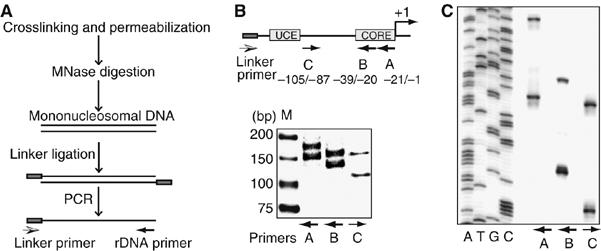
Figure 1
Figure 1
Mapping of nucleosome positions at the rDNA promoter. (A) Schematic representation of the method used to map nucleosome positions. The black lines represent mononucleosomal genomic DNA. The box indicates staggered linker. The arrows represent the primers used for LM-PCR mapping. (B) Mapping of nucleosome positions at the murine rDNA promoter. Mononucleosome-sized DNA from crosslinked NIH3T3 cells was subjected to LM-PCR using the linker primer and either of the rDNA-specific primers shown at the top. 32P-labeled PCR products were analyzed by PAGE. Lane M refers to the DNA marker. The scheme on top indicates the location of the core promoter and the UCE relative to the transcription start site at +1. The horizontal arrows represent the position of primers used for LM-PCR mapping. (C) Sequencing gel used to determine the lengths of LM-PCR products. Lanes A, T, G and C show products of sequencing reactions. The adjacent lanes show the LM-PCR products obtained with the linker primer and rDNA-specific primers A, B and C as indicated.
Figure 2
Figure 2
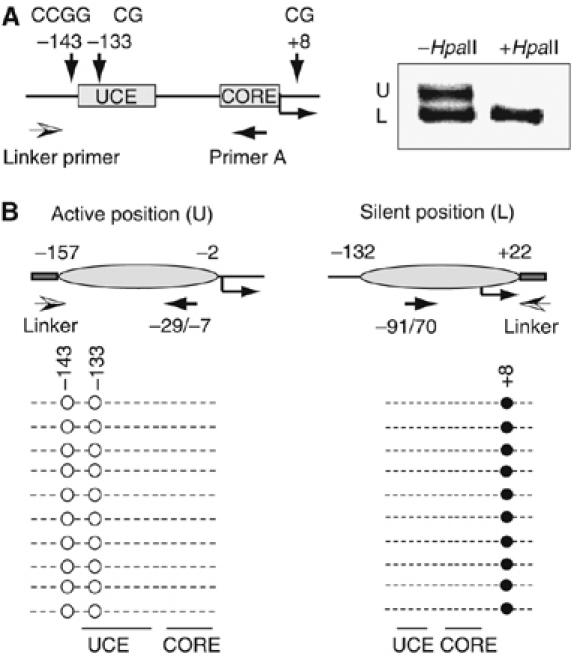
Nucleosomes are differently positioned at the promoter of active and silent rRNA genes. (A) Nucleosome positions at the promoter of methylated and unmethylated rDNA repeats. Nucleosomal DNA was incubated in the absence or presence of HpaII before amplification by LM-PCR. The transcription start site, the HpaII site at −143, the CpG residues at −133 and +8 and the primers used for LM-PCR are illustrated above. (B) Methylation analysis of specific CpG residues. The scheme on top shows the position of CpG residues within the murine rDNA promoter. The methylation status of each CpG was determined by bisulfite treatment of mononucleosomal DNA, cloning of the upper and lower LM-PCR fragment and sequencing of 10 randomly selected clones. Each row represents the sequence of an individual clone. The open and filled circles denote unmethylated and methylated CpGs, respectively, the arrows indicate the primers used for LM-PCR and the ellipses show the position of nucleosomes at the promoter of active and silent rDNA copies.
Figure 3
Figure 3
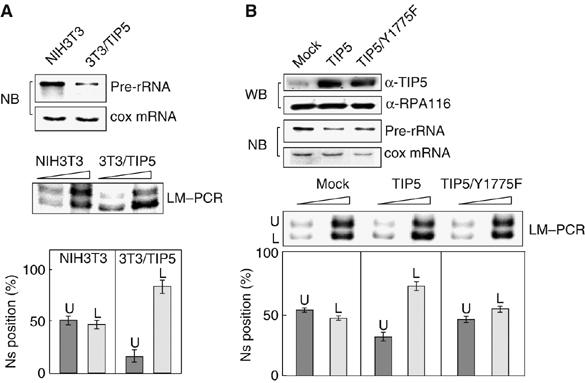
NoRC alters the ratio of ‘active' and ‘silent' nucleosomes. (A) Overexpression of TIP5 represses Pol I transcription and shifts nucleosomes into the ‘silent' position. Mononucleosomal DNA from NIH3T3 and 3T3/TIP5 cells was subjected to LM-PCR to determine specific nucleosome positions. The bar diagram below shows the percentage of the upper (dark bar) and lower PCR fragment (light bar) estimated in three independent experiments. A Northern blot (NB) monitoring the level of pre-RNA synthesis in NIH3T3 and 3T3/TIP5 cells is shown above. (B) Functional NoRC is required for shifting nucleosomes into the ‘silent' position. Flag-tagged TIP5 or TIP5/Y1775F was expressed in NIH3T3 cells by retroviral infection using pBABE, pBABE-flTIP5 or pBABE-flTIP5/Y1775F. The Western blot (upper panel, WB) shows the amount of overexpressed wild-type and mutant TIP5 (flTIP5 and flTIP5/Y1775F) as well as endogenous Pol I (α-RPA116). The Northern blot (middle panel, NB) shows the level of pre-rRNA and cytochrome c oxidase (cox) mRNA. The nucleosome positions as determined in three independent experiments are shown below (LM-PCR). The dark bars (labeled U) indicate the relative amount of nucleosomes in the ‘active' position; the light bars (labeled L) mark nucleosomes in the ‘silent' position.
Figure 4
Figure 4
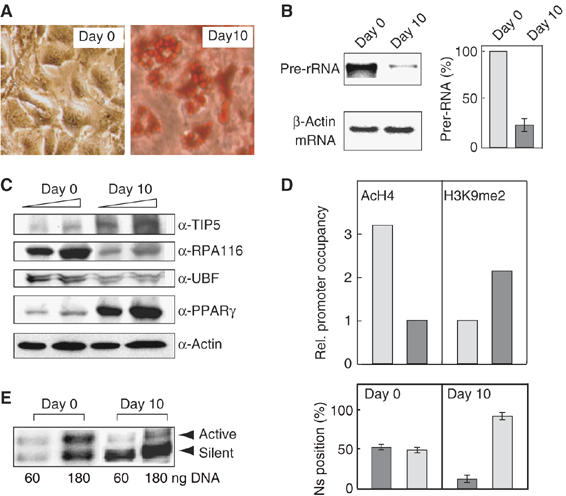
Repression of rDNA transcription in differentiated cells is accompanied by changes in nucleosome positions at the rDNA promoter. (A) Differentiation of 3T3-L1 cells into adipocytes. Phase-contrast micrographs of uninduced 3T3-L1 cells (day 0), and 10 days after induction of differentiation. The images show cells stained with Oil Red-O. (B) Pre-RNA synthesis is decreased in differentiated adipocytes. RNA from undifferentiated (day 0) and differentiated (day 10) 3T3-L1 cells was subjected to Northern blot analysis (left panel) and quantitative RT–PCR (bars) to compare the relative level of 45S pre-rRNA. The percentage of pre-rRNA levels in undifferentiated (light bar) and differentiated 3T3-L1 cells (dark bar) as determined in three independent experiments is shown. (C) Western blots showing the level of cellular Pol I (RPA116), UBF, TIP5, SIRT1, PPARγ and β-actin in undifferentiated (day 0) and differentiated (day 10) 3T3-L1 cells. (D) Heterochromatic histone modifications at the rDNA promoter are enhanced in differentiated adipocytes. The bars show the relative levels of histone H4 acetylation (AcH4) and H3K9 dimethylation (H3K9me2) in undifferentiated cells (day 0, light bars) and in differentiated adipocytes (day 10, dark bar). Values represent the average of two independent experiments. (E) Nucleosome positions are altered during adipocyte differentiation. Nucleosome positioning was analyzed in undifferentiated and differentiated 3T3-L1 cells by LM-PCR. The bar diagram shows the ratio of nucleosomes in the ‘active' (dark bars) and ‘silent' position (light bars) as determined in three independent experiments. Error bars indicate standard deviations.

References

    1. Bazett-Jones DP, Leblanc B, Herfort M, Moss T (1994) Short-range DNA looping by the Xenopus HMG-box transcription factor, xUBF. Science 264: 1134–1137 - PubMed
    1. Clapier CR, Längst G, Corona DF, Becker PB, Nightingale KP (2001) Critical role for the histone H4 N terminus in nucleosome remodeling by ISWI. Mol Cell Biol 21: 875–883 - PMC - PubMed
    1. Clos J, Normann A, Öehrlein A, Grummt I (1986) The core promoter of mouse rDNA consists of two functionally distinct domains. Nucleic Acids Res 14: 7581–7595 - PMC - PubMed
    1. Cooper JP, Roth SY, Simpson RT (1994) The global transcriptional regulators, SSN6 and TUP1, play distinct roles in the establishment of a repressive chromatin structure. Genes Dev 8: 1400–1410 - PubMed
    1. Corona DF, Tamkun JW (2004) Multiple roles for ISWI in transcription, chromosome organization and DNA replication. Biochim Biophys Acta 1677: 113–119 - PubMed

Publication types