. 2006 Dec 1;2(12):e164.
doi: 10.1371/journal.pcbi.0020164. Epub 2006 Oct 23.

Transcriptional regulation by competing transcription factor modules

Affiliations

Transcriptional regulation by competing transcription factor modules

Rutger Hermsen et al. PLoS Comput Biol. .

Abstract

Gene regulatory networks lie at the heart of cellular computation. In these networks, intracellular and extracellular signals are integrated by transcription factors, which control the expression of transcription units by binding to cis-regulatory regions on the DNA. The designs of both eukaryotic and prokaryotic cis-regulatory regions are usually highly complex. They frequently consist of both repetitive and overlapping transcription factor binding sites. To unravel the design principles of these promoter architectures, we have designed in silico prokaryotic transcriptional logic gates with predefined input-output relations using an evolutionary algorithm. The resulting cis-regulatory designs are often composed of modules that consist of tandem arrays of binding sites to which the transcription factors bind cooperatively. Moreover, these modules often overlap with each other, leading to competition between them. Our analysis thus identifies a new signal integration motif that is based upon the interplay between intramodular cooperativity and intermodular competition. We show that this signal integration mechanism drastically enhances the capacity of cis-regulatory domains to integrate signals. Our results provide a possible explanation for the complexity of promoter architectures and could be used for the rational design of synthetic gene circuits.


Conflict of interest statement

Competing interests. The authors have declared that no competing interests exist.

Figures

Figure 1
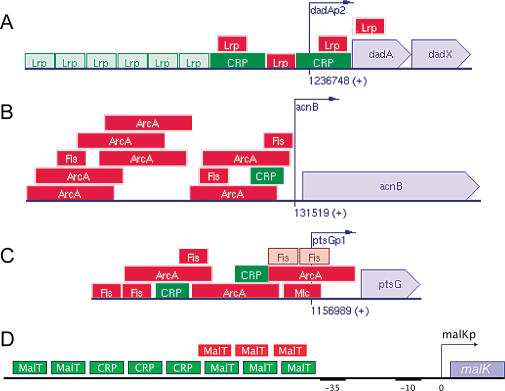
Figure 1. Examples of Complex E. coli Promoters
(A–C) Taken directly from the EcoCyc database [8]. (D) Described in [25]. Green blocks denote TF binding sites that have an activating effect; red blocks denote repressor sites. Brown sites can both activate and repress transcription. Note that repetitive and overlapping binding sites occur frequently. Understanding these kinds of promoters requires detailed quantitative information about binding affinities and interactions.
Figure 2
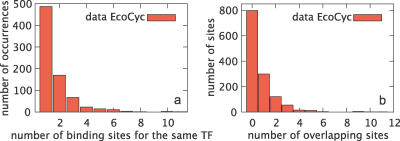
Figure 2. Repetitive and Overlapping Binding Sites
(A) Histogram of the number of binding sites responsible for each interaction between a TF and an operon, according to the EcoCyc database [8]. Note that multiple sites are common; the cis-regulatory region of focA, e.g., has as many as 11 binding sites for NarL. (B) Histogram of the number of binding sites overlapping with each binding site [8]. For example, bin 1 with height 300 should be interpreted as: there are 300 binding sites that overlap with exactly one other binding site. Overlap is common; some ArcA sites in the sodA regulatory region overlap with as many as 11 sites.
Figure 3
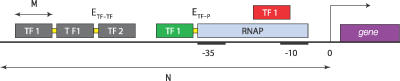
Figure 3. Illustration of the Model
The cis-regulatory region consists of N = 100 bp directly upstream of the transcription start site. In E. coli, most TFs bind to this region, although binding sites are also found downstream of the transcription start site; mechanisms requiring such downstream sites are excluded by our model. A TF binding domain counts M amino acids, which can bind M = 10 bp [54,55]. When two TFs bind within a distance less than k = 3 bp, they interact with energy E TF−TF; this is indicated by a yellow connection between the TFs, although it should be realized that these cooperative interactions could also be mediated via the DNA. When a TF binds close to the RNAP, we assume an interaction energy E TF−P. The core promoter, consisting of the −10 and −35 hexamers, is indicated; when the RNAP binds to it, it blocks both hexamers and the spacer between them. The TF that binds overlapping with the RNAP is red, to indicate that it represses transcription by steric hindrance; the green TF is an activator, since it recruits RNAP. The gray TFs bind too far upstream from the core promoter to influence the transcription rate. In our simulations, we used k = 3 and E TF−TF = E TF−P = 3.40 kBT or 2.0 kCal/mol (so that e βETF−TF = 30.0) [= 30 [1].
Figure 4
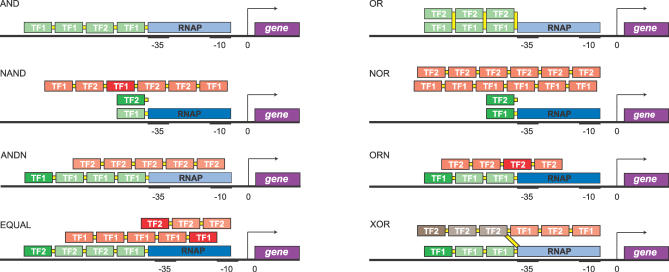
Figure 4. Cartoons of cis-Regulatory Constructs Emerging from Our In Silico Design of Transcriptional Logic Gates
The boxes indicate the TF binding sites; green indicates that a TF acts as an activator, red that it acts as a repressor, and brown that the action of the TF depends upon the concentrations of the two TFs. Weak binding sites (K D > 2 × 10³ nM) have a light color, strong ones are dark. Yellow connections between TFs signify cooperative interactions. The designs show that the logic gates are constructed as overlapping arrays of cooperative binding sites. Each layer acts as a module, either activating or repressing transcription. Signals are integrated via the interplay between intramodular cooperativity and intermodular competition.
Figure 5
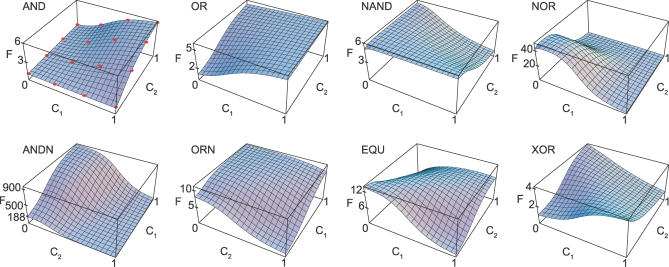
Figure 5. Response Plots of Logic Gates Emerging from the Simulations
The quantity F on the vertical axis is the fold change of the transcription rate, defined here as F = A(c 1,c 2)/A min, where A min is the minimal transcription rate on this TF concentration domain. The concentrations c 1 and c 2 are in μM and plotted on a linear rather than a logarithmic scale. The red dots in the AND gate indicate the measurement points (c 1,c 2) that are used in the fitness function.
Figure 6
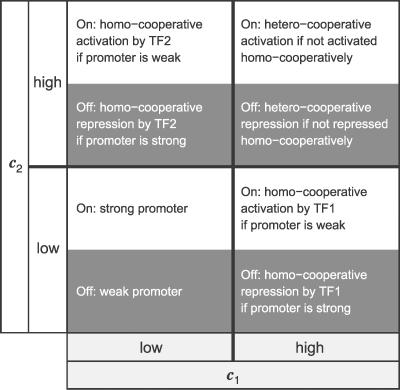
Figure 6. Table Summarizing Which Homo-Cooperative or Hetero-Cooperative Activation or Repression Modules Are Needed to Obtain a Particular Transcriptional Logic Gate
The table consists of four quadrants, corresponding to different TF concentrations c 1 and c 2 (each being low or high). Each quadrant is divided into two parts (white and gray), corresponding to the alternative promoter states (on or off). As an example, the AND gate is on only if both TF1 and TF2 are present; this requires a hetero-cooperative activation module. In contrast, an OR gate should be on if either TF1 or TF2 is present. This requires homo-cooperative activation modules for each of the species, because the promoter is weak (the gate must be off when both species are absent); however, since the activation modules do not compete with one another, a hetero-activation module is not required: the homo-cooperative activation modules also turn the gate on when both TFs are present. In general, the design can be most easily understood by first considering the design constraints when both TFs are absent, then the requirements when one of the two are present, and lastly the design constraints when both TFs are present. The EQU and XOR gates discussed in the main text illustrate this perhaps most clearly. Note that the EQU gate is an example of a gate in which a hetero-activation module is required, despite the fact that the promoter is strong; the hetero-activation module is needed to counteract the two homo-cooperative repression modules when both TFs are present.

References

    1. Buchler NE, Gerland U, Hwa T. On schemes of combinatorial transcription logic. Proc Natl Acad Sci U S A. 2003;100:5136–5141. - PMC - PubMed
    1. Istrail S, Davidson EH. Gene regulatory networks special feature: Logic functions of the genomic cis-regulatory code. Proc Natl Acad Sci U S A. 2005;102:4954–4959. doi: . - DOI - PMC - PubMed
    1. Yuh CH, Bolouri H, Davidson EH. Genomic cis-regulatory logic: Experimental and computational analysis of a sea urchin gene. Science. 1998;279:1896–1902. doi: . - DOI - PubMed
    1. Jacob F, Monod J. Genetic regulatory mechanisms in the synthesis of proteins. J Mol Biol. 1961;3:318–356. - PubMed
    1. Müller-Hill B. The lac operon: A short history of a genetic paradigm. Berlin: Walter de Gruyter; 1996. 207

Publication types

MeSH terms

Substances