Comparative Study
. 2006 Dec;63(12):1313-23.
doi: 10.1001/archpsyc.63.12.1313.

Preserved subliminal processing and impaired conscious access in schizophrenia

Affiliations
Comparative Study

Preserved subliminal processing and impaired conscious access in schizophrenia

Antoine Del Cul et al. Arch Gen Psychiatry. 2006 Dec.

Abstract

Background: Studies of visual backward masking have frequently revealed an elevated masking threshold in schizophrenia. This finding has frequently been interpreted as indicating a low-level visual deficit. However, more recent models suggest that masking may also involve late and higher-level integrative processes, while leaving intact early bottom-up visual processing.

Objective: To test the hypothesis that the backward-masking deficit in schizophrenia corresponds to a deficit in the late stages of conscious perception, whereas the subliminal processing of masked stimuli is fully preserved.

Design: Twenty-eight patients with schizophrenia and 28 normal control subjects performed 2 backward-masking experiments. We used Arabic digits as stimuli and varied quasi-continuously the interval with a subsequent mask, thus allowing us to progressively unmask the stimuli. We finely quantified their degree of visibility using objective and subjective measures to evaluate the threshold duration for access to consciousness. We also studied the priming effect caused by the variably masked numbers in a comparison task performed on a subsequently presented and highly visible target number.

Results: The threshold delay between the digit and mask necessary for the conscious perception of the masked stimulus was longer in patients compared with controls. This higher consciousness threshold in patients was confirmed by an objective and a subjective measure, and both measures were highly correlated for the patients and controls. However, subliminal priming of masked numbers was effective and identical in patients and controls.

Conclusions: Access to conscious report of masked stimuli is impaired in schizophrenia, whereas fast bottom-up processing of the same stimuli, as assessed by subliminal priming, is preserved. These findings suggest a high-level origin of the masking deficit in schizophrenia, although they leave open for further research its exact relation to previously identified bottom-up visual processing abnormalities.


Figures
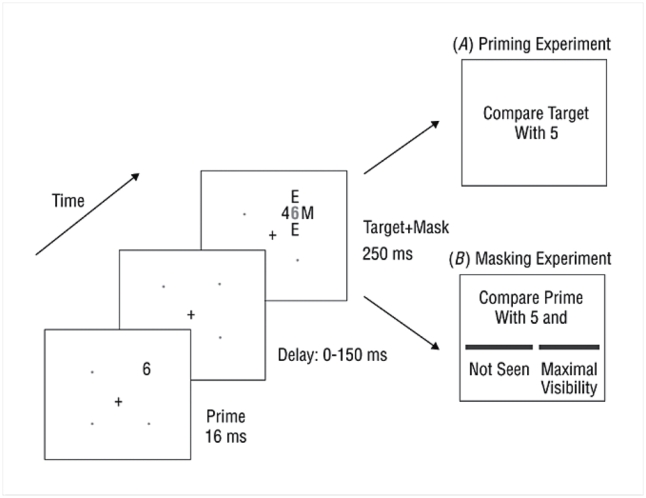
Figure 1
Figure 1. Experiment design
The prime was presented for 16 ms at one of four positions (1.4 degrees above or below and 1.4 degrees right or left to the fixation cross). The mask (duration of presentation 250ms) was composed of three letters (M, M, E) and the target number (1 ° from the fixation cross). Those four symbols surrounded the prime number without touching it. In the first experiment, referred to as the “priming experiment”, subjects were asked to compare each target number with 5, pressing the right-hand key as fast as possible for numbers larger than 5 and the left hand key for numbers smaller than 5. The second experiment aimed at measuring the consciousness threshold in two different ways. We measured an objective visibility threshold by examining subjects’ ability to perform the number comparison task on the prime. We also measured a subjective threshold by collecting introspective ratings of prime visibility, on a subjective continuous scale.
Figure 2
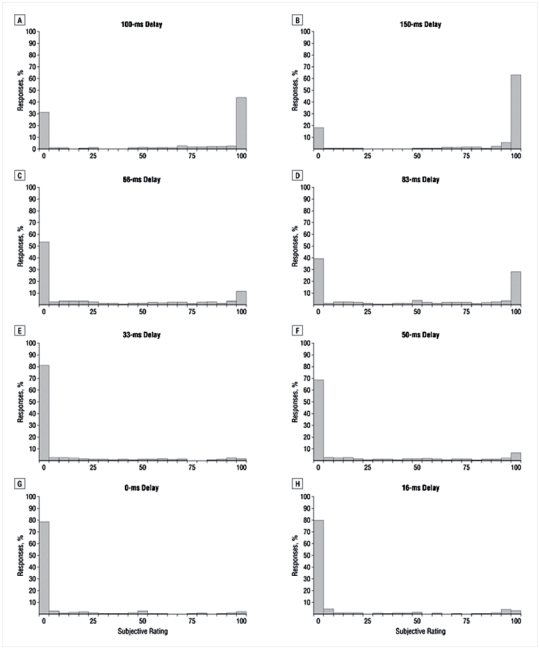
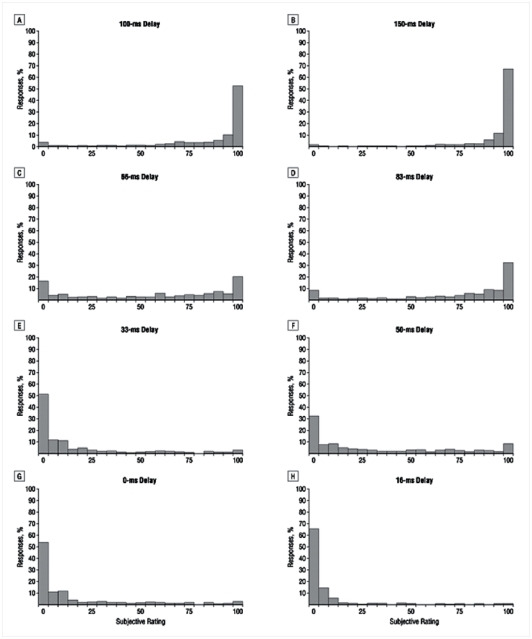
Figure 2. Distribution of subjective visibility ratings
In both groups, we observed a bimodal repartition of scores, with a first set of responses close to maximal visibility (scale score > 16) and a second set of responses peaking at zero visibility (score < 6). Responses between 6 and 16 were rare (< 10%). More not seen responses were observed in patients than in controls, particularly at short delays.
Figure 3
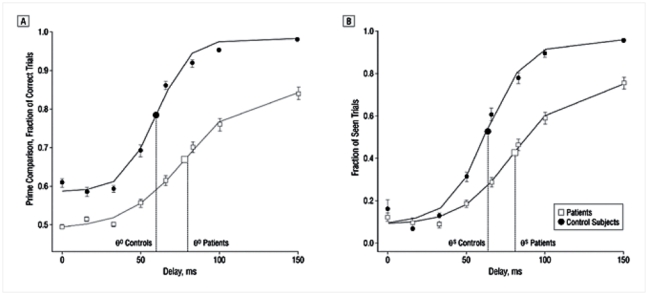
Figure 3. Objective and subjective measures of access to consciousness
a) Percentage of correct responses in prime comparison to 5 as a function of delay. At each delay, the controls outperformed the patients. In controls, performance was significantly superior to chance at all the delays whereas in patients, performance only became superior to chance for delays of 50 ms and above. b) Proportion of trials subjectively rated as “seen” as a function of delay. At all delays above 33 ms, the proportion of “seen” trials was significantly lower in patients. In both graphs, the sigmoid curve fitting the data is represented as a continuous line. The mean objective θo and subjective θs thresholds were defined in each group as the delay for which the sigmoid curve reached its inflexion point. Error bars represent the standard error.
Figure 4
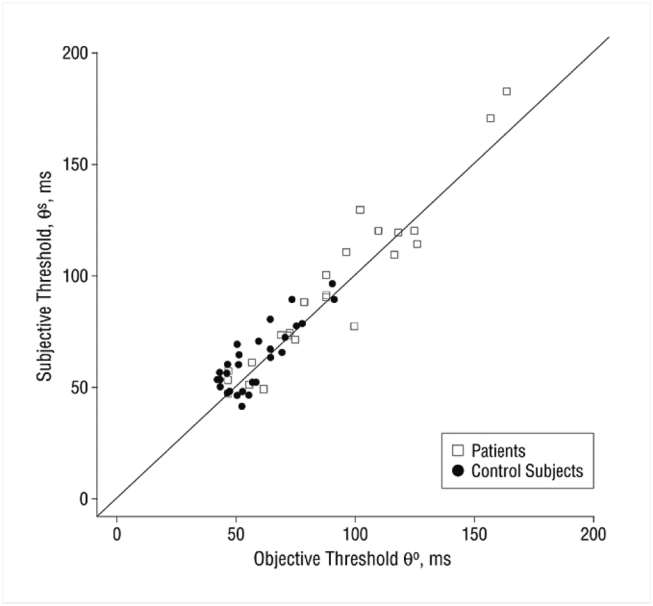
Figure 4. Positive correlation between objective and subjective consciousness thresholds across subjects
The two values were highly correlated, both as a whole (r2 = 0.951, p<0.001), within the controls (r2 = 0.834, p<0.001) and within the patients (r2 = 0.955 p<0.001). In all cases, the slope did not differ from 1, and the intercept was not significant.
Figure 5
Figure 5
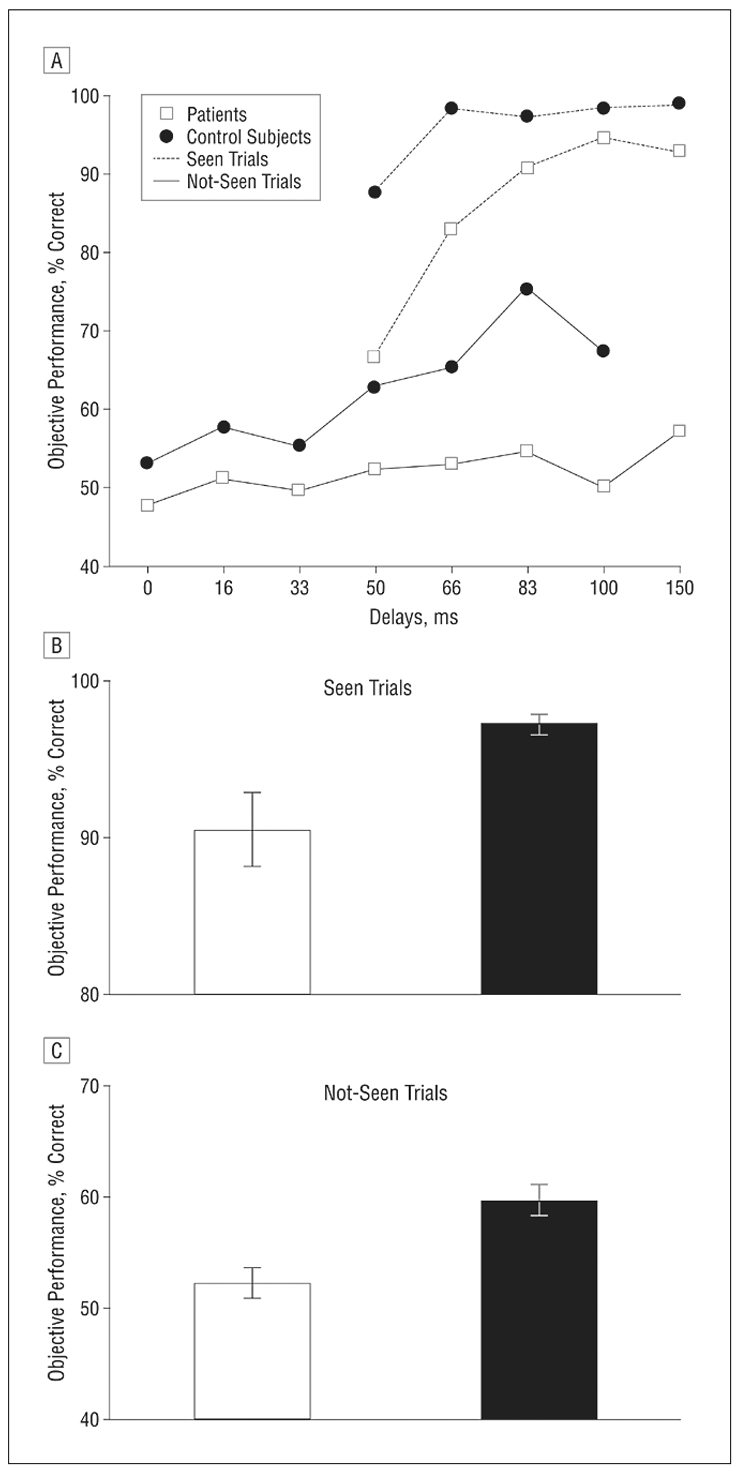
Objective performance in prime comparison in each group respectively for “seen trials” (conservatively defined as a subjective score greater than to 16) and “not seen” trials (subjective score smaller or equal to 5). a) Performance at each delay b) and c) performance averaged across delays. The results demonstrate, in normal subjects a capacity for objective prime processing even on trials subjectively rated as “not seen” (subliminal perception); and, conversely, in patients, an invalability of objective information on some trials judged as “seen” (hallucinations). Error bars represent the standard error.
Figure 6
Figure 6. Measures of priming during the target number comparison task
a) Mean RT for each group, for each condition of prime-target relation and for each delay. Response priming was defined as the difference in reaction time between incongruent (InCong) and congruent non-repeated (CongNonRep) trials, and repetition priming as the difference between congruent non-repeated and congruent repeated (CongRep) trials. Both effects were significant across and within each group without significant difference between groups. b) and c) Delays were sorted into two categories according whether they fell below and above the previously measured consciousness thresholds. Error bars represent the standard error.

References

    1. Meyer-Lindenberg A, et al. Evidence for abnormal cortical functional connectivity during working memory in schizophrenia. Am J Psychiatry. 2001;158(11):1809–17. - PubMed
    1. Fletcher P, et al. Abnormal cingulate modulation of fronto-temporal connectivity in schizophrenia. Neuroimage. 1999;9(3):337–42. - PubMed
    1. Haraldsson HM, et al. Transcranial Magnetic Stimulation in the investigation and treatment of schizophrenia: a review. Schizophr Res. 2004;71(1):1–16. - PubMed
    1. Lawrie SM, et al. Reduced frontotemporal functional connectivity in schizophrenia associated with auditory hallucinations. Biol Psychiatry. 2002;51(12):1008–11. - PubMed
    1. Tononi G, Edelman GM. Schizophrenia and the mechanisms of conscious integration. Brain Res Brain Res Rev. 2000;31(2–3):391–400. - PubMed

Publication types

MeSH terms