


Mutualism or parasitism? The variable outcome of cleaning symbioses
- PMID: 17148155
- PMCID: PMC1626222
- DOI: 10.1098/rsbl.2004.0288
Mutualism or parasitism? The variable outcome of cleaning symbioses
Abstract
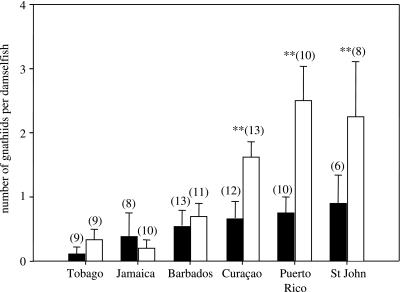
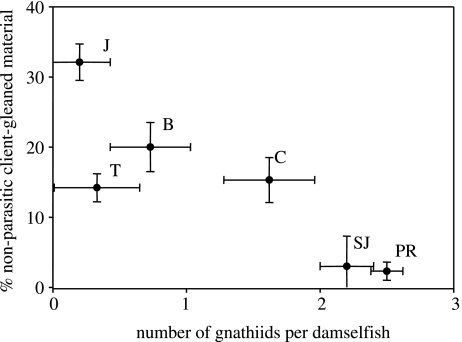
The exact nature of many interspecific interactions remains unclear, with some evidence suggesting mutualism and other evidence pointing to parasitism for the same pair of interacting species. Here, we show spatial variation in the outcome of the cleaning relationship between Caribbean cleaning gobies (Elacatinus evelynae) and longfin damselfish (Stegastes diencaeus) over the distribution range of these species, and link this variation to the availability of ectoparasites. Cleaning interactions at sites with more ectoparasites were characterized by greater reductions in ectoparasite loads on damselfish clients and lower rates of removal of scales and mucus (i.e. cheating) by cleaning gobies, whereas the opposite was observed at sites where ectoparasite abundance was lower. For damselfish clients, cleaning was therefore clearly mutualistic in some locations, but sometimes neutral or even parasitic in others. Seasonal variability in ectoparasite abundance may ensure that locally low parasite availability, which promotes cleanerfish cheating, may be a transient condition at any given site. Conflicting conclusions about the nature of cleaning symbioses may, therefore, be explained by variation in ectoparasite abundance.
Figures
References
-
- Bansemer C, Grutter A.S, Poulin R. Geographic variation in the behaviour of the cleaner fish Labroides dimidiatus (Labridae) Ethology. 2002;108:353–366.
-
- Benkman C.W, Holimon W.C, Smith J.W. The influence of a competitor on the geographic mosaic of coevolution between crossbills and lodgepole pine. Evolution. 2001;55:282–294. - PubMed
-
- Bshary R. Biting cleaner fish use altruism to deceive image-scoring client reef fish. Proc. R. Soc. B. 2002;269:2087–2093. doi:10.1098/rspb.2002.2084 - DOI - PMC - PubMed
-
- Bshary R, Grutter A.S. Asymmetric cheating opportunities and partner control in a cleaner fish mutualism. Anim. Behav. 2002;63:547–555.
-
- Bshray R, Schaffer D. Choosy reef fish select cleaner fish that provide high-quality service. Anim. Behav. 2002;63:557–564.
Publication types
MeSH terms
LinkOut - more resources
Full Text Sources
