


doi: 10.1098/rsbl.2004.0260.
Malaria parasite growth is stimulated by mosquito probing
Affiliations
- PMID: 17148162
- PMCID: PMC1626230
- DOI: 10.1098/rsbl.2004.0260
Item in Clipboard
Malaria parasite growth is stimulated by mosquito probing
Biol Lett.
.
Abstract
The ability of malaria parasites to respond positively to the presence of feeding mosquito vectors would clearly be advantageous to transmission. In this study, Anopheles stephensi mosquitoes probed mice infected with the rodent malaria parasite, Plasmodium chabaudi. Growth of asexual stages was accelerated and gametocytes appeared 1-2 days earlier than in controls. This first study, to our knowledge, of the effects of mosquitoes on 'in-host' growth and development of Plasmodium has profound implications for malaria epidemiology, suggesting that individuals exposed to high mosquito numbers can contribute disproportionately high numbers of parasites to the transmission pool.
Figures
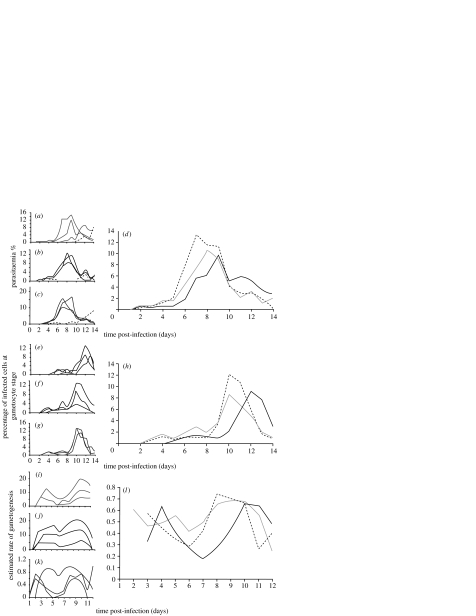
Effect of probing by 25 or 50 female Anopheles stephensi on parasite (a–d) and gametocyte (e–h) populations of Plasmodium chabaudi 96DK within MF1 mice. Parasite (a–c) and gametocyte (e–g) populations in individual hosts are averaged to show the mean parasitaemia (d) and gametocyte rate (h). Individual (i–k) and mean (l) estimated rates of gametogenesis are calculated using the model of Buckling et al. (1999). In the small panels each line represents the characteristics of infection in an individual mouse. In the large panels, geometric mean values for control (black) mice, or mice probed by 25 (grey) or 50 (dashed line) were calculated from four (d) or three (h,l) mice.
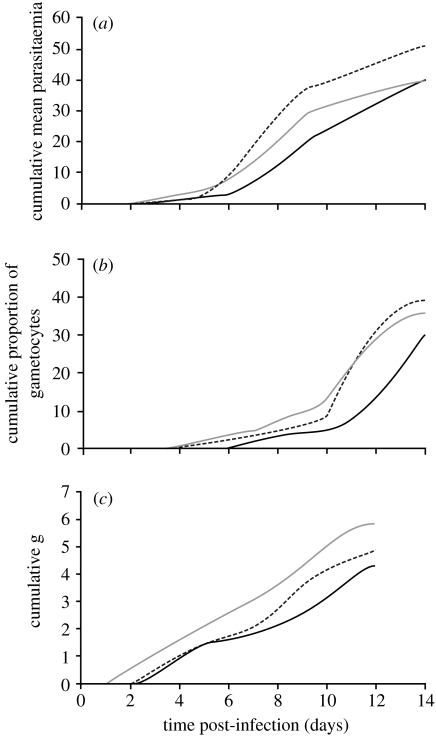
Cumulative parasitaemia (a), proportion of infected cells at the gametocyte stage (b) and estimated rate of gametocytogenesis of Plasmodium chabaudi in control (solid) mice and mice probed daily by 25 (grey) or 50 (dashed line) Anopheles stephensi mosquitoes.
References
-
- Almeida A.P.G, Billingsley P.F. Induced immunity against the mosquito Anopheles stephensi Liston (Diptera: Culicidae): effects on mosquito survival and fecundity. Int. J. Parasitol. 1998;28:1721–1731. - PubMed
-
- Al-Olayan E.M, Beetsma A.L, Butcher G.A, Sinden R.E, Hurd H. Complete development of mosquito phases of the malaria parasite in vitro. Science. 2002;295:677–679. - PubMed
-
- Buckling A, Crooks L, Read A. Plasmodium chabaudi: effect of antimalarial drugs on gametocytogensis. Exp. Parasitol. 1999;93:45–54. - PubMed
-
- Carter R, Graves P.M. Gametocytes. In: Wernsdorfer W.H, McGregor I, editors. Malaria: principles and practice of malariology. Churchill Livingstone; Edinburgh: 1988. pp. 253–305.
-
- Charlwood J.D, Kihonda J, Sama S, Billingsley P.F, Hadji H, Verhave J.P, Lyimo E, Luttikhuizen P.C, Smith T. The rise and fall of Anopheles arabiensis (Diptera: Culicidae) in a Tanzanian village. Bull. Entomol. Res. 1995;85:37–44.
MeSH terms
LinkOut - more resources
Full Text Sources
