


Sensitivity to dimethyl sulphide suggests a mechanism for olfactory navigation by seabirds
- PMID: 17148193
- PMCID: PMC1617144
- DOI: 10.1098/rsbl.2005.0350
Sensitivity to dimethyl sulphide suggests a mechanism for olfactory navigation by seabirds
Abstract
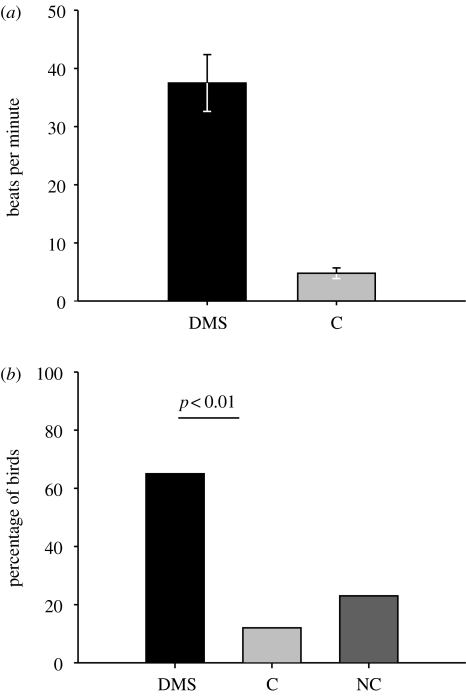
Petrels, albatrosses and other procellariiform seabirds have an excellent sense of smell, and routinely navigate over the world's oceans by mechanisms that are not well understood. These birds travel thousands of kilometres to forage on ephemeral prey patches at variable locations, yet they can quickly and efficiently find their way back to their nests on remote islands to provision chicks, even with magnetic senses experimentally disrupted. Over the seemingly featureless ocean environment, local emissions of scents released by phytoplankton reflect bathymetric features such as shelf breaks and seamounts. These features suggest an odour landscape that may provide birds with orientation cues. We have previously shown that concentrated experimental deployments of one such compound, dimethyl sulphide (DMS), attracts procellariiforms at sea, suggesting that some species can use it as a foraging cue. Here we present the first physiological demonstration that an Antarctic seabird can detect DMS at biogenic levels. We further show that birds can use DMS as an orientation cue in a non-foraging context within a concentration range that they might naturally encounter over the ocean.
Figures
References
-
- Benhamou S, Bonadonna F, Jouventin P. Successful homing of magnet-carrying white-chinned petrels released in the open sea. Anim. Behav. 2003;65:729–734. - PubMed
-
- Benvenuti S, Ioalè P, Gagliardo A, Bonadonna F. Effects of zinc sulfate-induced anosmia on homing behavior of pigeons. Comp. Biochem. Physiol. 1992;103:519–526.
-
- Berresheim H. Biogenic sulfur emissions from the sub-Antarctic and Antarctic oceans. J. Geophys. Res. Atmos. 1987;92:13 245–13 262.
-
- Bonadonna F, Nevitt G.A. Partner-specific odor recognition in an Antarctic seabird. Science. 2004;306:835. - PubMed
-
- Bonadonna F, Chamaille-Jammes S, Pinaud D, Weimerskirch H. Magnetic cues: are they important in black-browed Albatross Diomedea melanophris orientation? Ibis. 2003b;145:152–155.
Publication types
MeSH terms
Substances
LinkOut - more resources
Full Text Sources
