


Genetic diversity predicts pathogen resistance and cell-mediated immunocompetence in house finches
- PMID: 17148199
- PMCID: PMC1617150
- DOI: 10.1098/rsbl.2005.0303
Genetic diversity predicts pathogen resistance and cell-mediated immunocompetence in house finches
Abstract
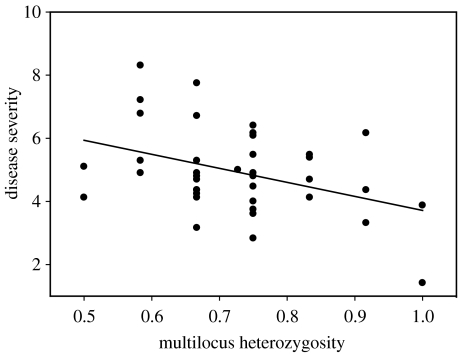
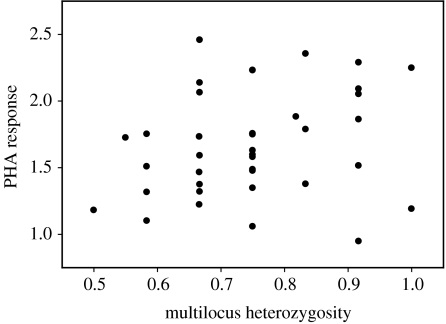
Evidence is accumulating that genetic variation within individual hosts can influence their susceptibility to pathogens. However, there have been few opportunities to experimentally test this relationship, particularly within outbred populations of non-domestic vertebrates. We performed a standardized pathogen challenge in house finches (Carpodacus mexicanus) to test whether multilocus heterozygosity across 12 microsatellite loci predicts resistance to a recently emerged strain of the bacterial pathogen, Mycoplasma gallisepticum (MG). We simultaneously tested whether the relationship between heterozygosity and pathogen susceptibility is mediated by differences in cell-mediated or humoral immunocompetence. We inoculated 40 house finches with MG under identical conditions and assayed both humoral and cell-mediated components of the immune response. Heterozygous house finches developed less severe disease when infected with MG, and they mounted stronger cell-mediated immune responses to phytohaemagglutinin. Differences in cell-mediated immunocompetence may, therefore, partly explain why more heterozygous house finches show greater resistance to MG. Overall, our results underscore the importance of multilocus heterozygosity for individual pathogen resistance and immunity.
Figures
References
-
- Acevedo-Whitehouse K, Gulland F, Grieg D, Amos W. Disease susceptibility in California sea lions. Nature. 2003;422:35. - PubMed
-
- Adamo S.A. How should behavioural ecologists interpret measures of immunity? Anim. Behav. 2004;68:1443–1449.
-
- Cassinello J, Gomendio M, Roldan E.R.S. Relationship between coefficient of inbreeding and parasite burden in endangered gazelles. Conserv. Biol. 2001;15:1171–1174.
-
- Coltman D.W, Pilkington J.G, Smith J.A, Pemberton J.M. Parasite-mediated selection against inbred Soay sheep in a free-living, island population. Evolution. 1999;53:1259–1267. - PubMed
Publication types
MeSH terms
Substances
LinkOut - more resources
Full Text Sources
