


Climate change and outbreaks of amphibian chytridiomycosis in a montane area of Central Spain; is there a link?
- PMID: 17148254
- PMCID: PMC1685858
- DOI: 10.1098/rspb.2006.3713
Climate change and outbreaks of amphibian chytridiomycosis in a montane area of Central Spain; is there a link?
Abstract
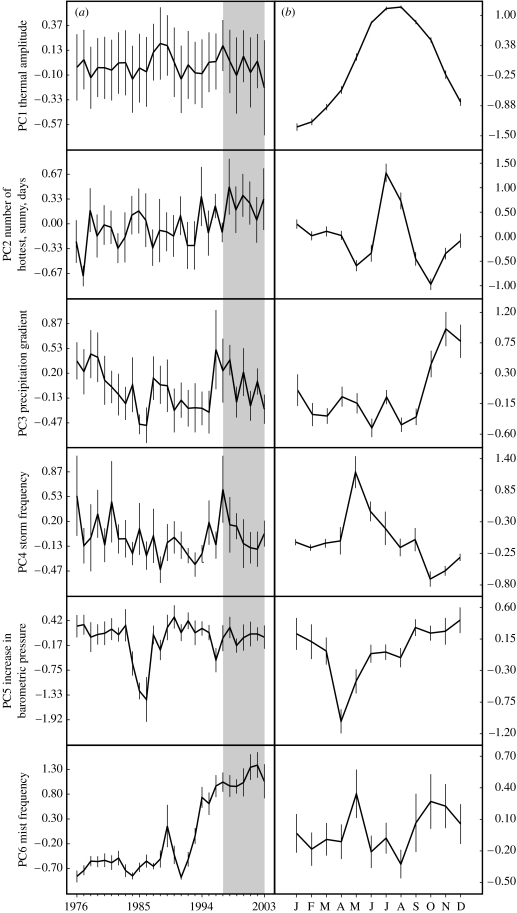
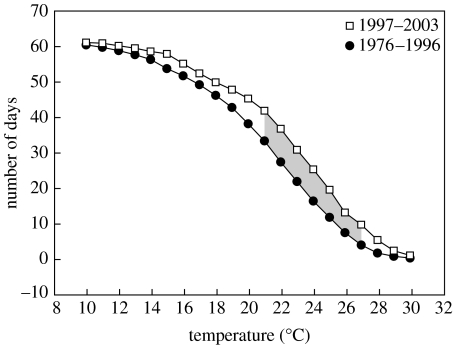
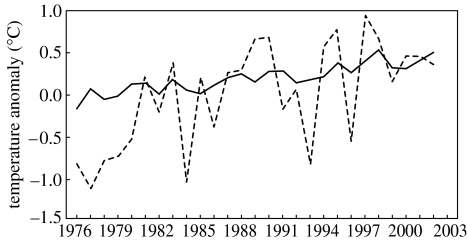
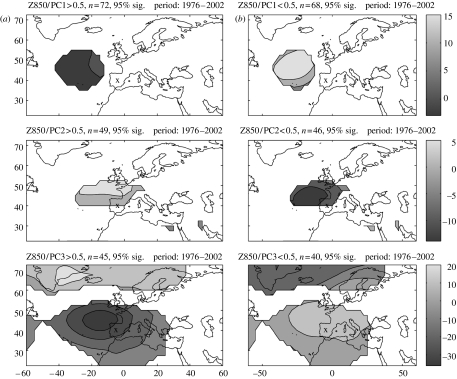
Amphibian species are declining at an alarming rate on a global scale in large part owing to an infectious disease caused by the chytridiomycete fungus, Batrachochytrium dendrobatidis. This disease of amphibians has recently emerged within Europe, but knowledge of its effects on amphibian assemblages remains poor. Importantly, little is known about the environmental envelope that is associated with chytridiomycosis in Europe and the potential for climate change to drive future disease dynamics. Here, we use long-term observations on amphibian population dynamics in the Peñalara Natural Park, Spain, to investigate the link between climate change and chytridiomycosis. Our analysis shows a significant association between change in local climatic variables and the occurrence of chytridiomycosis within this region. Specifically, we show that rising temperature is linked to the occurrence of chytrid-related disease, consistent with the chytrid-thermal-optimum hypothesis. We show that these local variables are driven by general circulation patterns, principally the North Atlantic Oscillation. Given that B. dendrobatidis is known to be broadly distributed across Europe, there is now an urgent need to assess the generality of our finding and determine whether climate-driven epidemics may be expected to impact on amphibian species across the wider region.
Figures
References
-
- Araújo M.B, Thuiller W, Pearson R.G. Climate warming and the decline of amphibians and reptiles in Europe. J. Biogeogr. 2006;33:1712–1728. doi:10.1111/j.1365-2699.2006.01482.x - DOI
-
- Beniston M, Diaz H.F, Bradley R.S. Climatic change at high elevation sites: an overview. Clim. Change. 1997;36:233–251. doi:10.1023/A:1005380714349 - DOI
-
- Blaustein A.R, Romansic J.M, Kiesecker J.M, Hatch A.C. Ultraviolet radiation, toxic chemicals and amphibian population declines. Divers. Distrib. 2003;9:123–140.
-
- Bosch J, Martínez-Solano I. Chytrid fungus infection related to unusual mortalities of Salamandra salamandra and Bufo bufo in the Peñalara Natural Park (Central Spain) Oryx. 2006;40:84–89. doi:10.1017/S0030605306000093 - DOI
Publication types
MeSH terms
LinkOut - more resources
Full Text Sources
