


doi: 10.1098/rsbl.2006.0515.
Typing single polymorphic nucleotides in mitochondrial DNA as a way to access Middle Pleistocene DNA
Affiliations
- PMID: 17148299
- PMCID: PMC1833985
- DOI: 10.1098/rsbl.2006.0515
Item in Clipboard
Typing single polymorphic nucleotides in mitochondrial DNA as a way to access Middle Pleistocene DNA
Biol Lett.
.
Abstract
In this study, we have used a technique designed to target short fragments containing informative mitochondrial substitutions to extend the temporal limits of DNA recovery and study the molecular phylogeny of Ursus deningeri. We present a cladistic analysis using DNA recovered from 400 kyr old U. deningeri remains, which demonstrates U. deningeri's relation to Ursus spelaeus. This study extends the limits of recovery from skeletal remains by almost 300 kyr. Plant material from permafrost environments has yielded DNA of this age in earlier studies, and our data suggest that DNA in teeth from cave environments may be equally well preserved.
Figures
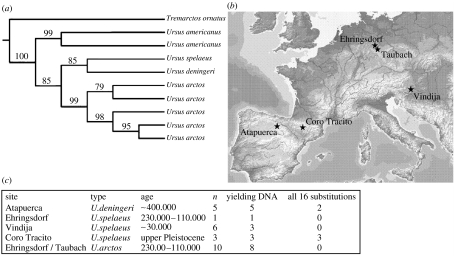
(a) Phylogenetic position of Ursus deningeri. Maximum parsimony tree using molecular data from cytochrome b. The grouping of U. deningeri and U. spelaeus was well supported (1000 replicates). (b) Sites for the caves with bear samples. (c) Out of 25 samples, 20 yielded bear DNA, out of which 5 yielded all 16 polymorphic sites.
References
-
- Anderung C, et al. Prehistoric contacts over the Straits of Gibraltar indicated by genetic analysis of Iberian Bronze Age cattle. Proc. Natl Acad. Sci. USA. 2005;102:8431–8435. doi:10.1073/pnas.0503396102 - DOI - PMC - PubMed
-
- Austin J.J, Ross A.J, Smith A.B, Fortey R.A, Thomas R.H. Problems of reproducibility—does geologically ancient DNA survive in amber-preserved insects? Proc. R. Soc. B. 1997;264:467–474. doi:10.1098/rspb.1997.0067 - DOI - PMC - PubMed
-
- Bada J.L, Wang X.S, Poinar H.N, Paabo S, Poinar G.O. Amino acid racemization in amber-entombed insects: implications for DNA preservation. Geochim. Cosmochim. Acta. 1994;58:3131–3135. doi:10.1016/0016-7037(94)90185-6 - DOI - PubMed
-
- Banerjee M, Brown T. Non-random DNA damage resulting from heat treatment: implications for sequence analysis of ancient DNA. J. Archaeol. Sci. 2004;31:59–63. doi:10.1016/S0305-4403(03)00099-2 - DOI
-
- Bischoff J.L, Shamp D.D, Aramburu A, Arsuaga J.L, Carbonell E, Bermudez de Castro J.M. The Sima de los Huesos hominids date to beyond U/Th equilibrium (>350 kyr) and perhaps to 400–500 kyr: new radiometric dates. J. Archaeol. Sci. 2003;30:275–280. doi:10.1006/jasc.2002.0834 - DOI
Publication types
MeSH terms
Substances
LinkOut - more resources
Full Text Sources
