. 2007 Jan;35(Database issue):D643-9.
doi: 10.1093/nar/gkl1049. Epub 2006 Dec 6.

Mouse Phenome Database (MPD)

Affiliations

Mouse Phenome Database (MPD)

Molly A Bogue et al. Nucleic Acids Res. 2007 Jan.

Abstract

The Mouse Phenome Database (MPD; http://www.jax.org/phenome) is a repository of phenotypic and genotypic data on commonly used and genetically diverse inbred strains of mice. Strain characteristics data are contributed by members of the scientific community. Electronic access to centralized strain data enables biomedical researchers to choose appropriate strains for many systems-based research applications, including physiological studies, drug and toxicology testing and modeling disease processes. MPD provides a community data repository and a platform for data analysis and in silico hypothesis testing. The laboratory mouse is a premier genetic model for understanding human biology and pathology; MPD facilitates research that uses the mouse to identify and determine the function of genes participating in normal and disease pathways.


Figures
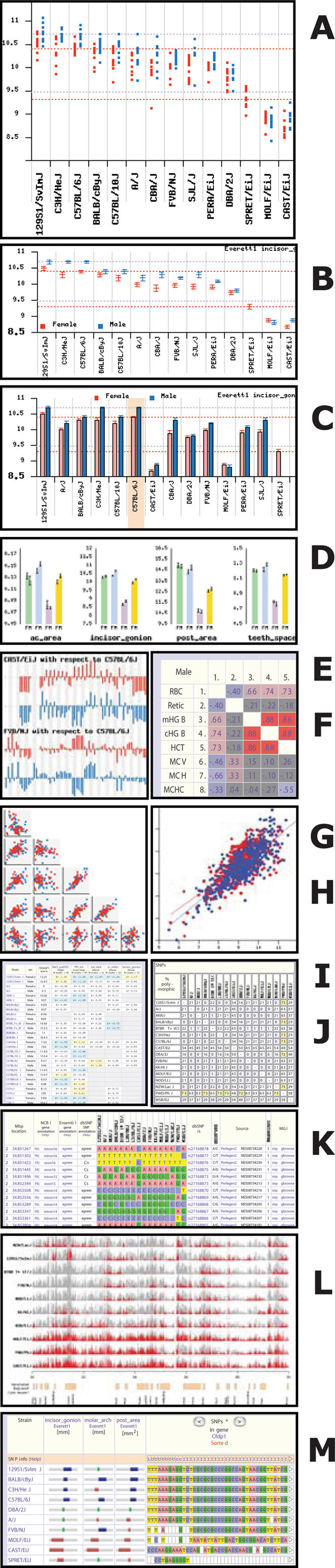
Figure 1
Figure 1
MPD displays and graphics from selected tools. Thumbnail images illustrate a variety of MPD visualization and analysis tools. The key for A through M is shown in Table 4. Learn more about these tools and graphic output options in MPD Demos 1–4 (Supplementary Data 8–11, Table 1).
Figure 2
Figure 2
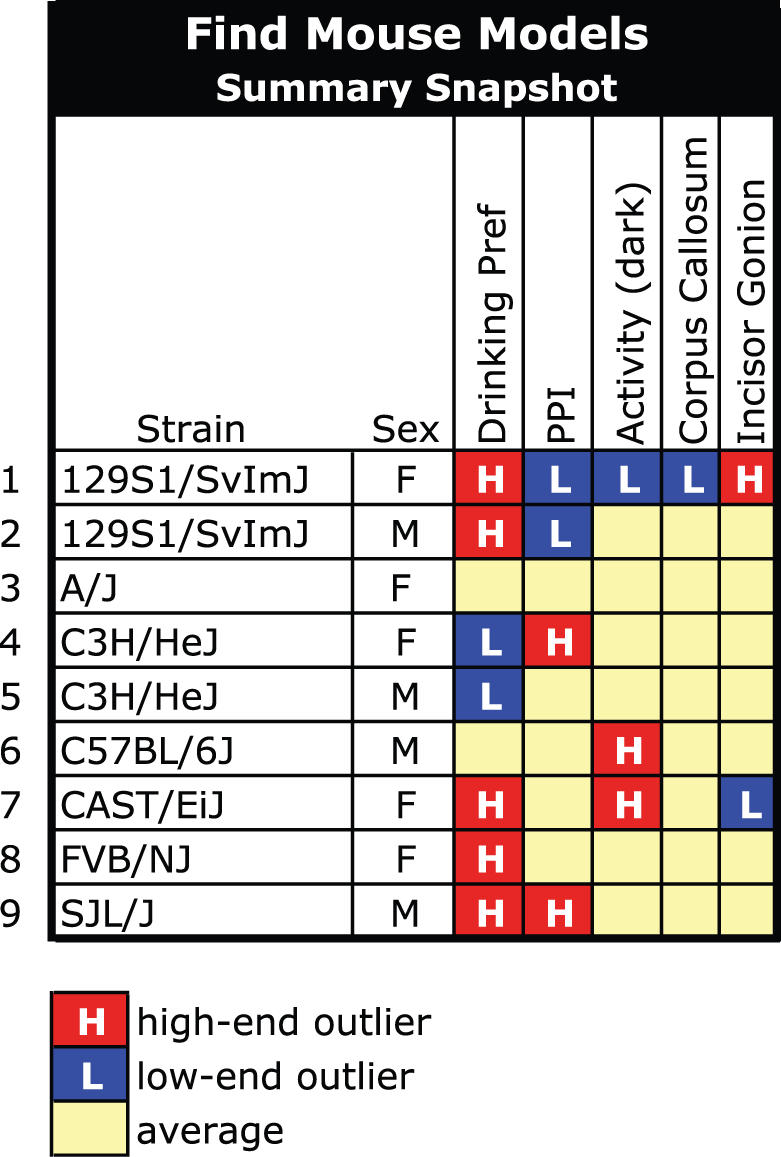
Find mouse models—criteria fit tool. This tool helps identify strains best matching user-specified criteria. Users choose measurements of interest and specify criteria for each. A search is issued across the entire MPD and the strains giving the best fit are returned in a results table of statistical information, ranked by an overall best fit score. We provide an example to illustrate the power of this tool (see Supplementary Data 10 for more details). The data in our example are real and are available in MPD. The syndrome in our example is hypothetical. This figure is not an MPD display but is used to summarize our findings. For example, a new syndrome has been identified that involves several independent complex traits. The syndrome is most severe in females exhibiting a higher than average drinking preference for NaCl, a lower than average prepulse inhibition (PPI), lower than average activity levels, a smaller than average corpus callosum, and a greater than average distance between the mandible infradentale and gonion. Less severe cases of this syndrome are observed where only some of the syndrome traits are expressed. For this example, we have to identify the best mouse model for studying this syndrome and its prevention, diagnosis and treatment. First, we choose MPD measurements that quantify the five traits of interest. These measurements are gathered from five different projects that tested overlapping strain sets. We then apply our criteria to each measurement and issue a search across the entire MPD. The returned results are in tabular form and rank strains in order of best match. For this particular example, we find 129S1/SvImJ females are the only strain (by sex) that meet all criteria. To find other strains that may exhibit milder forms of the syndrome, we highlight high- and low-end ouliers in our online results table to help quickly identify strains with unique complex phenotypes across the five traits [illustrated in Figure 1(I)]. Supplementary Data 10 shows the MPD results table for this query. The illustration in our figure here simplifies the results: there are nine distinct genotypes (strain/sex) which exhibit nine distinct complex phenotypes. 129S1/SvImJ females are an excellent match for modeling this syndrome. The other eight genotypes may exhibit milder forms of the syndrome, or none at all. These strains represent diversity in the population and would, for example, be excellent to include in drug studies to identify particular genotypes that react adversely to a test drug, or not at all.

References

    1. Bogue M. Mouse Phenome Project: understanding human biology through mouse genetics and genomics. J. Appl. Physiol. 2003;95:1335–1337. - PubMed
    1. Grubb S.C., Churchill G.A., Bogue M.A. A collaborative database of inbred mouse strain characteristics. Bioinformatics. 2004;20:2857–2859. - PubMed
    1. Blake J.A., Eppig J.T., Bult C.J., Kadin J.A., Richardson J.E., the Mouse Genome Database Group The Mouse Genome Database (MGD): updates and enhancements. Nucleic Acids Res. 2006;34:D562–D567. - PMC - PubMed
    1. Wheeler D.L., Barrett T., Benson D.A., Bryant S.H., Canese K., Chetvernin V., Church D.M., DiCuccio M., Edgar R., Federhen S., et al. Database resources of the National Center for Biotechnology Information. Nucleic Acids Res. 2006;34:D173–D180. - PMC - PubMed
    1. Birney E., Andrews D., Caccamo M., Chen Y., Clarke L., Coates G., Cox T., Cunningham F., Curwen V., Cutts T., et al. Ensembl 2006. Nucleic Acids Res. 2006;34:D556–D561. - PMC - PubMed

Publication types