


Design, synthesis, and biological evaluation of new cyclic melanotropin peptide analogues selective for the human melanocortin-4 receptor
- PMID: 17154518
- PMCID: PMC1764620
- DOI: 10.1021/jm060768f
Design, synthesis, and biological evaluation of new cyclic melanotropin peptide analogues selective for the human melanocortin-4 receptor
Abstract
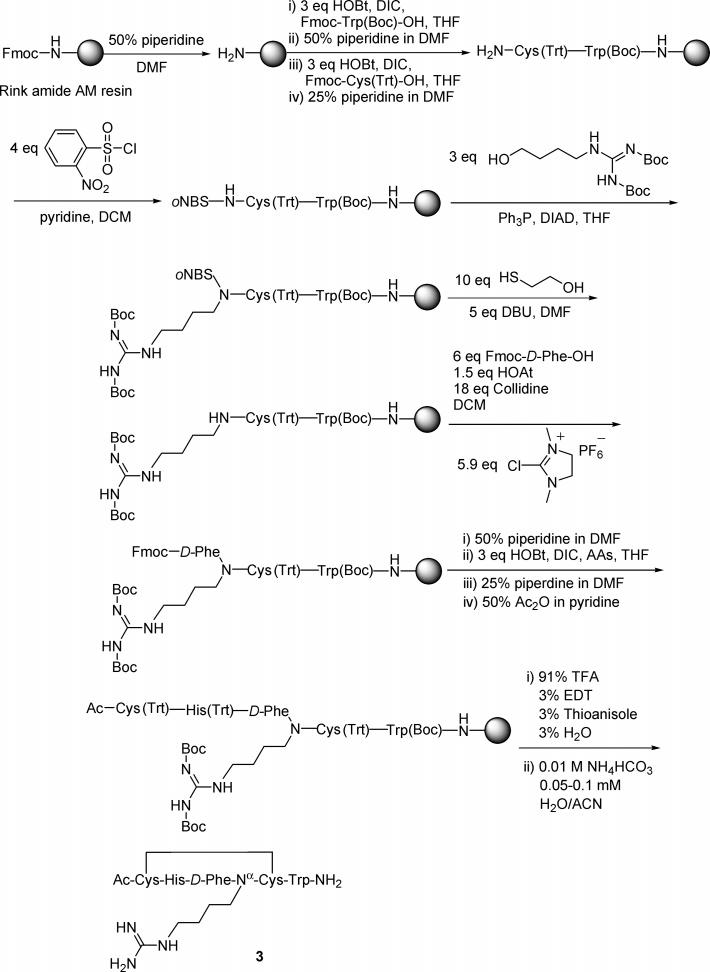
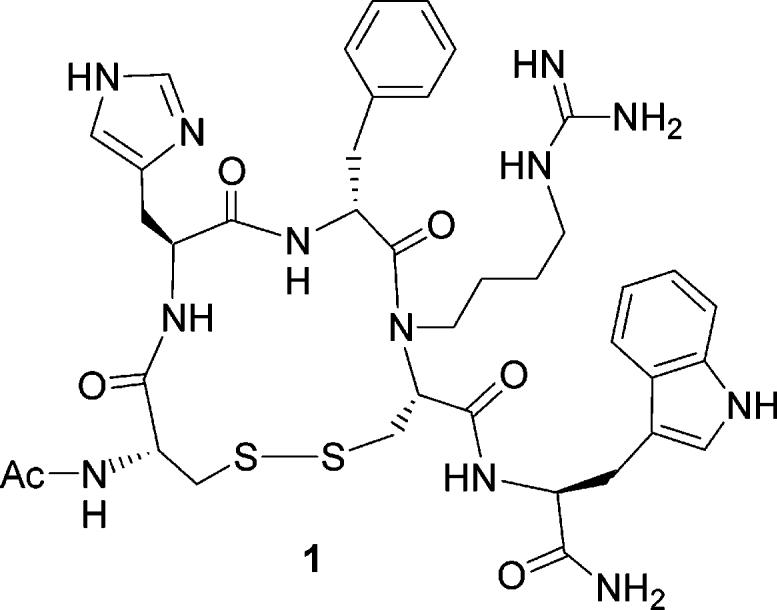
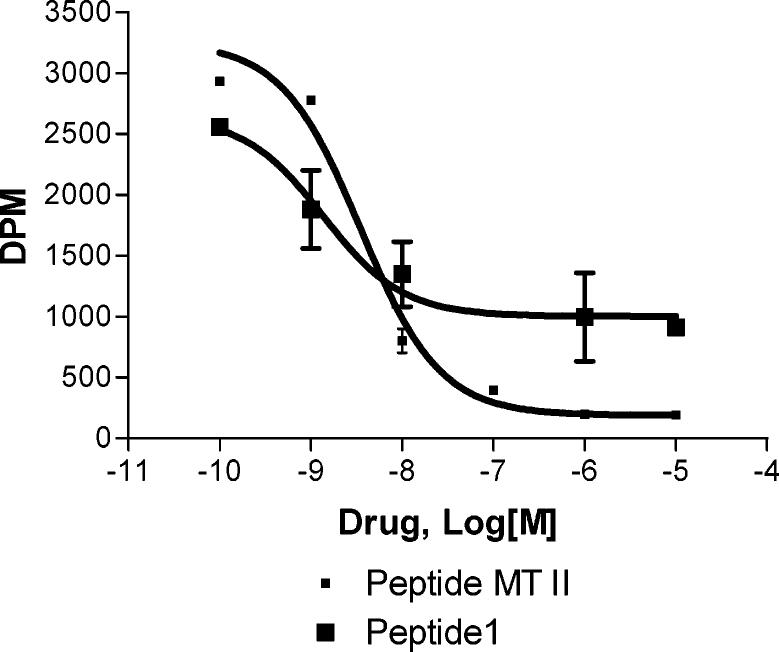
Intensive efforts have been made to develop potent and selective ligands for certain human melanocortin receptors as possible treatments for obesity and sexual dysfunction due to the role of these receptors in feeding behavior, energy homeostasis, sexual function, etc. A number of novel alpha-MSH analogues were designed and synthesized primarily on the basis of our previous MTII NMR structure. In these peptide analogues, a disulfide or lactam bridge between residues at positions 5 and 8 was used as a conformational constraint to enhance the beta-turn spanning His6 and D-Phe7, while the pharmacophore group in Arg8 was mimicked via Nalpha-alkylation of residues 8 or 9 with the guanidinylbutyl group. Biological assays for binding affinities and adenylate cyclase activities for the hMC1R, hMC3R, hMC4R, and hMC5R showed that three analogues have good binding affinity for the hMC4R (0.7-4.1 nM), but have no binding affinity up to 10 microM at the other three melanocortin receptors. Interestingly, the three hMC4R selective analogues display only 50% binding efficiency, suggesting there is allosteric modulation of the melanocortin-4 receptor. These analogues were found to act as antagonists of the hMC4R. This result represents a discovery of very selective peptide-based antagonists for the hMC4R. The high selectivity may be due to the strong conformational constraint via ring contraction as compared to MTII, and the rigid conformation preferred by these new ligands allows them to recognize only the hMC4R, but not to activate the second messenger. The MTII NMR structure-based design thus not only examined the structural model of melanocortin ligands, but also yielded new biologically unique alpha-MSH analogues.
Figures
References
-
- Hruby VJ, Han G. The Melanocortin Receptors. Humana Press; Totowa, NJ: 2000. The Molecular Pharmacology of α-MSH–Structure Activity Relationships for Melanotropins at the Melanocortin Receptors; pp. 239–261.
-
- Hruby VJ, Wilkes BC, Cody WL, Sawyer TK, Hadley ME. Melanotropins: Structural, Conformational and Biological Considerations in the Development of Superpotent and Superprolonged Analogs. Pept. Protein Rev. 1984;3:1–64.
-
- Mountjoy KG, Robbins LS, Mortrud MT, Cone RD. The Cloning of a Family of Genes that Encode the Melanocortin Receptors. Science. 1992;257:1248–1251. - PubMed
-
- Chen AS, Marsh DJ, Trumbauer ME, Frazier EG, Guan XM, Yu H, Rosenblum CI, Vongs A, Feng Y, Cao L, Metzger JM, Strack AM, Camacho RE, Mellin TN, Nunes CN, Min W, Fisher J, Gopal-Truter S, MacIntyre DE, Chen HY, Van der Ploeg LHT. Inactivation of the Mouse Melanocortin-3 Receptor Results in Increased Fat Mass and Reduced Lean Body Mass. Nat. Genet. 2000;26:97–102. - PubMed
-
- Butler AA, Kesterson RA, Khong K, Cullen MJ, Pelley-mounter MA, Dekoning J, Baetscher M, Cone RD. A Unique Metabolic Syndrome Causes Obesity in the Melanocortin-3 Receptor-Deficient Mouse. Endocrinology. 2000;141:3518–3521. - PubMed
Publication types
MeSH terms
Substances
Grants and funding
LinkOut - more resources
Full Text Sources
Other Literature Sources
Chemical Information
