. 2007 Feb;128(2):196-205.
doi: 10.1016/j.mad.2006.11.025. Epub 2006 Dec 8.

Life span and stress resistance of Caenorhabditis elegans are differentially affected by glutathione transferases metabolizing 4-hydroxynon-2-enal

Affiliations

Life span and stress resistance of Caenorhabditis elegans are differentially affected by glutathione transferases metabolizing 4-hydroxynon-2-enal

Srinivas Ayyadevara et al. Mech Ageing Dev. 2007 Feb.

Abstract

The lipid peroxidation product 4-hydroxynon-2-enal (4-HNE) forms as a consequence of oxidative stress, and acts as a signaling molecule or, at superphysiological levels, as a toxicant. The steady-state concentration of the compound reflects the balance between its generation and its metabolism, primarily through glutathione conjugation. Using an RNAi-based screen, we identified in Caenorhabditis elegans five glutathione transferases (GSTs) capable of catalyzing 4-HNE conjugation. RNAi knock-down of these GSTs (products of the gst-5, gst-6, gst-8, gst-10, and gst-24 genes) sensitized the nematode to electrophilic stress elicited by exposure to 4-HNE. However, interference with the expression of only two of these genes (gst-5 and gst-10) significantly shortened the life span of the organism. RNAi knock-down of the other GSTs resulted in at least as much 4-HNE adducts, suggesting tissue specificity of effects on longevity. Our results are consistent with the oxidative stress theory of organismal aging, broadened by considering electrophilic stress as a contributing factor. According to this extended hypothesis, peroxidation of lipids leads to the formation of 4-HNE in a chain reaction which amplifies the original damage. 4-HNE then acts as an "aging effector" via the formation of 4-HNE-protein adducts, and a resulting change in protein function.


Figures
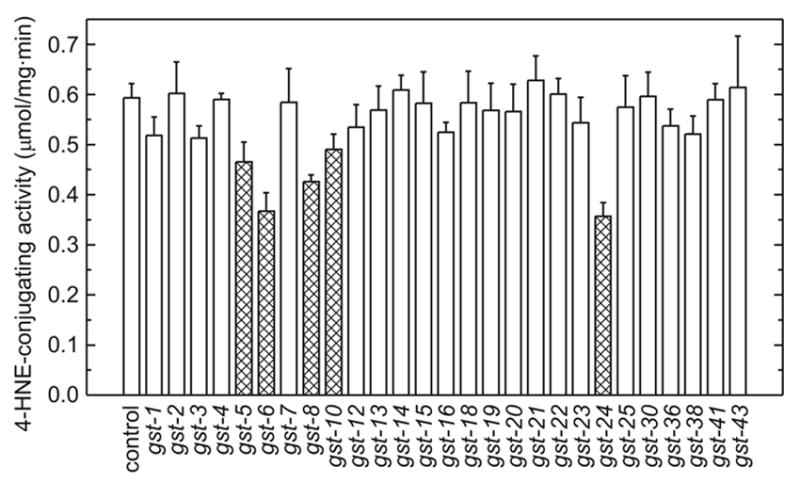
Fig. 1
Fig. 1
Effect of RNAi targeted to individual C. elegans GSTs on 4-HNE-conjugating enzyme activity in whole-worm homogenates. C. elegans strain Bristol-N2 was fed bacteria expressing double-stranded RNA as described in the Materials and Methods section. Animals were collected on day 5 after hatching, homogenized without freezing, and 4-HNE-conjugating activity was determined. The bars represent means ± S.D. of triplicate enzyme activity determinations carried out on the same homogenate. Cross-hatched bars represent RNAi treatments for which the resulting mean enzymatic activity is equal to or lower than that for RNAi targeted to gst-10. Control animals were fed bacteria transformed with the insert-free vector.
Fig. 2
Fig. 2
Western blot of C. elegans in which individual GSTs (as labeled in the Figure) were knocked down by RNAi, probed with antibody against CeGSTP2-2 (gst-10 gene product). Control: worms fed bacteria transformed with insert-free vector. The blot was re-probed with anti-β-actin antibody to check for equal loading.
Fig. 3
Fig. 3
Electrophile stress resistance of C. elegans in which individual GSTs were knocked down by RNAi. Worms fed bacteria expressing double-stranded RNA were exposed to 10 mM 4-HNE, and their survival time was recorded. Control: worms fed bacteria transformed with insert-free vector. For presentation clarity, the survival curves are divided into four groups: GSTs whose knock-down causes a lowering of resistance to 4-HNE versus control at P < 10−100 are shown in panel A; those with 10−100 < P ≤ 10−8, in panel B; those with 10−8 < P ≤ 0.05, in panel C; and those not significantly different from control (P > 0.05), in panel D. The control is common for the four panels. RNAi targeted to individual GSTs is denoted by distinct symbols listed in the respective panels. Each survival curve shown in the Figure represents a mean of 3 independent experiments with 50 worms per experiment. The P values listed above were calculated by Cox regression utilizing the original data from the 3 replicate experiments, adjusting for inter-experiments variability, and applying the Holm correction (Holm, 1979) for multiple comparisons versus control.
Fig. 4
Fig. 4
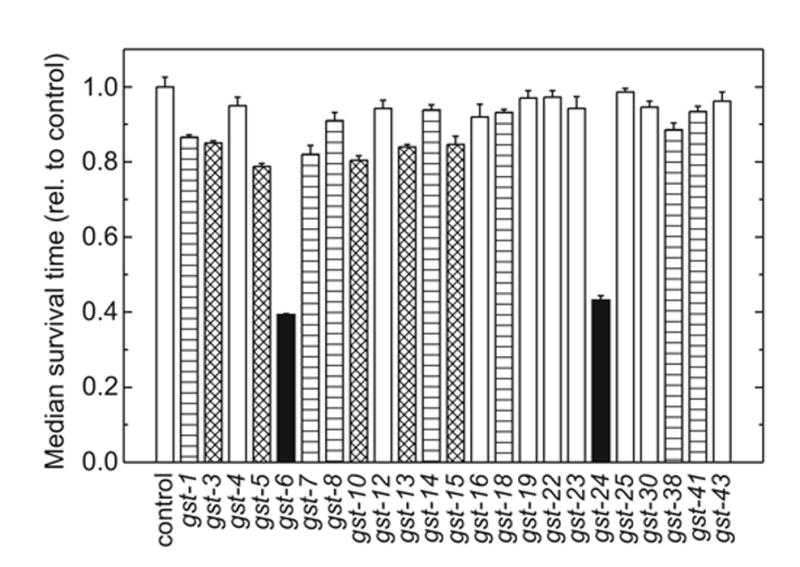
Median survival time in the presence of 10 mM 4-HNE of C. elegans in which individual GSTs were knocked down by RNAi. The Gompertz function was fitted to each survival curve shown in Fig. 3, and the resulting calculated median survival times ± asymptotic standard errors, normalized to those of control animals (5.00 ± 0.13 hr), are plotted. GSTs whose knock-down causes a lowering of resistance to 4-HNE versus control at P < 10−100 are shown as filled bars; those with 10−100 < P ≤ 10−8, as cross-hatched bars; those with 10−8 < P ≤ 0.05, as horizontally hatched bars; and those not significantly different from control (P > 0.05), as open bars. P values were calculated as described in the legend to Fig. 3.
Fig. 5
Fig. 5
Total 4-HNE-protein adduct formation in C. elegans treated with millimolar 4-HNE (open circles and upper abscissa), and in cultured mammalian cells (mouse embryonic fibroblasts) treated with micromolar 4-HNE (open squares and lower abscissa). Five-day-old worms in S-buffer (see Materials and Methods) supplemented with 0.5% cholesterol, and mouse embryonic fibroblasts in serum-free medium were treated with the indicated concentration of 4-HNE for 6 hr, homogenized, and assayed for 4-HNE adducts as described in Materials and Methods. Means ± S.D. of triplicate measurements on the same homogenate are shown; error bars smaller than the plotting symbol are drawn inside the symbol.
Fig. 6
Fig. 6
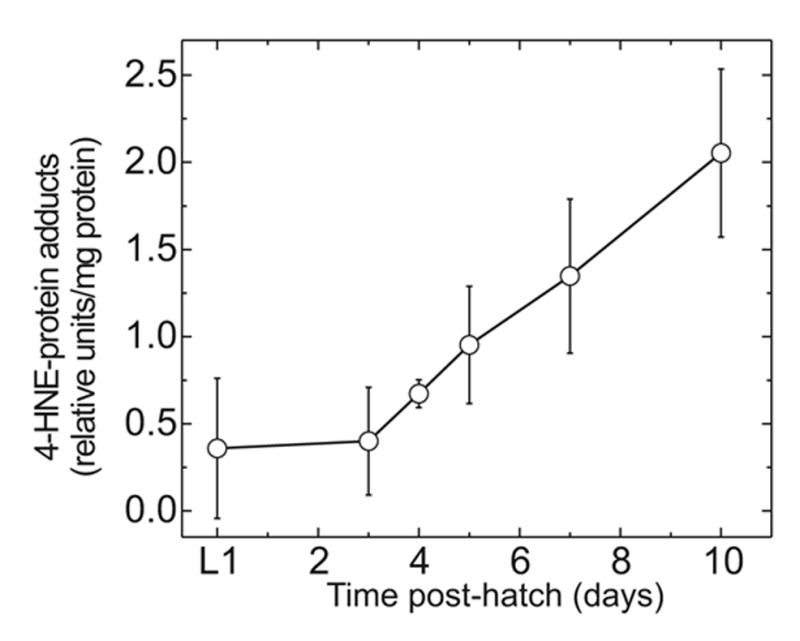
Level of 4-HNE-protein adducts in C. elegans Bristol-N2 as a function of age. Adducts were measured by ELISA as described in Materials and Methods. The values shown are means ± S.D. of three independent experiments, each normalized to its average level of adducts over the time period measured (0 to 10 days). Analysis of the data by General Linear Model ANOVA indicates that the adduct levels are not equal at the different ages at which they were measured (P = 0.0015).
Fig. 7
Fig. 7
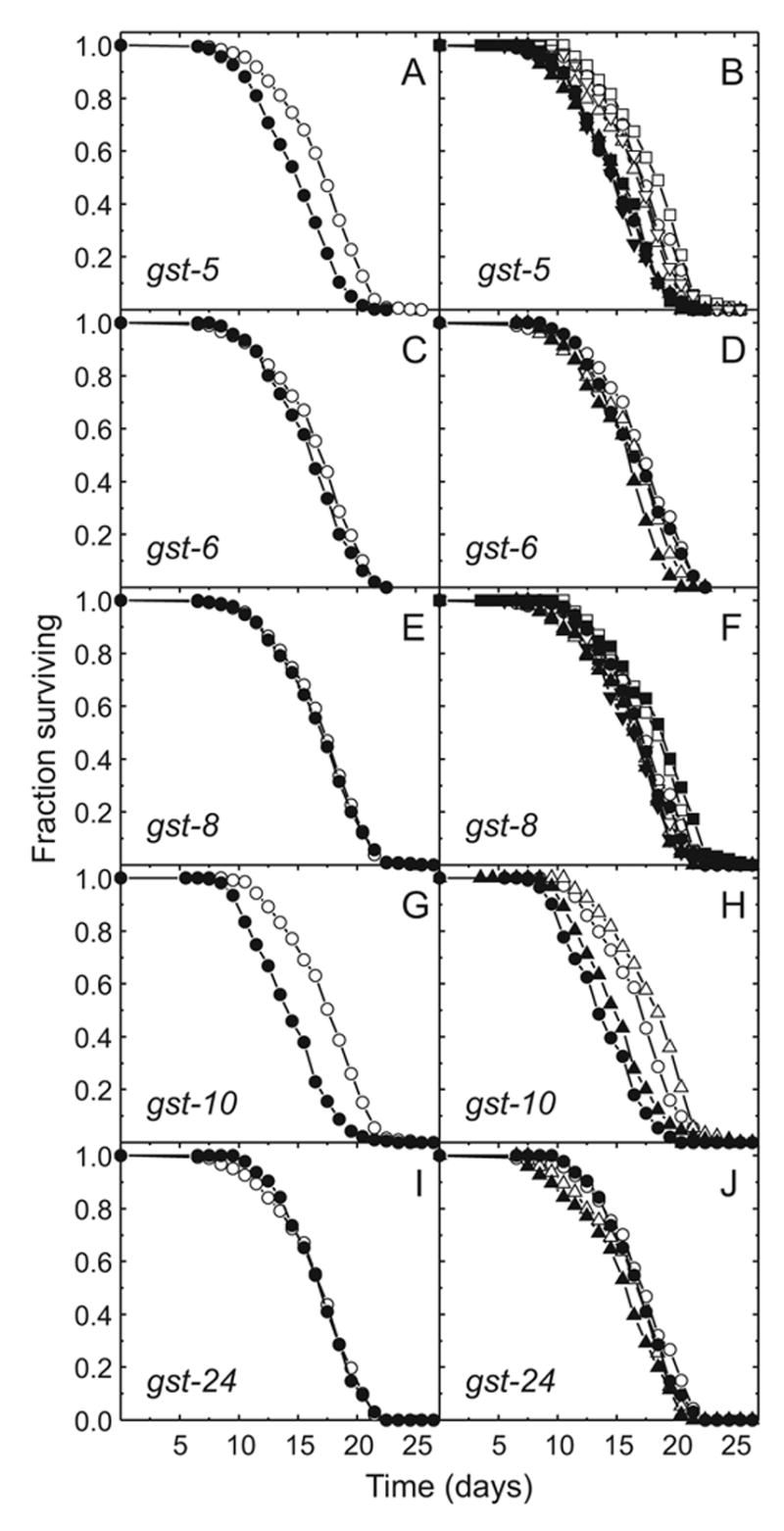
Effect of GST knock-down by RNAi on life span of C. elegans Bristol-N2. The life span of control animals fed bacteria transformed with insert-free vector (open symbols) was recorded simultaneously with that of animals in which individual GSTs (listed in the Figure) were knocked down by RNAi (closed symbols). Panels A, C, E, G, and I show means of independent life span determinations plotted separately and denoted by distinct symbols in panels B (4 independent experiments), D (2 experiments), F (4 experiments), H (2 experiments), and J (2 experiments), respectively. Each survival curve shown in panels B, D, F, H, and J represents a population of 100 or 150 worms. For each GST, data from the individual experiments were analyzed by Cox regression. After adjusting for inter-experiment variability and applying the Holm correction for multiple comparisons (Holm, 1979), RNAi targeted to gst-5 was found to be different from control at P = 4.8 × 10⁻²¹, gst-6 at P = 0.09, gst-8 at P = 0.27, gst-10 at P = 4.8 × 10⁻²⁰, and gst-24 at P = 0.14.
Fig. 8
Fig. 8
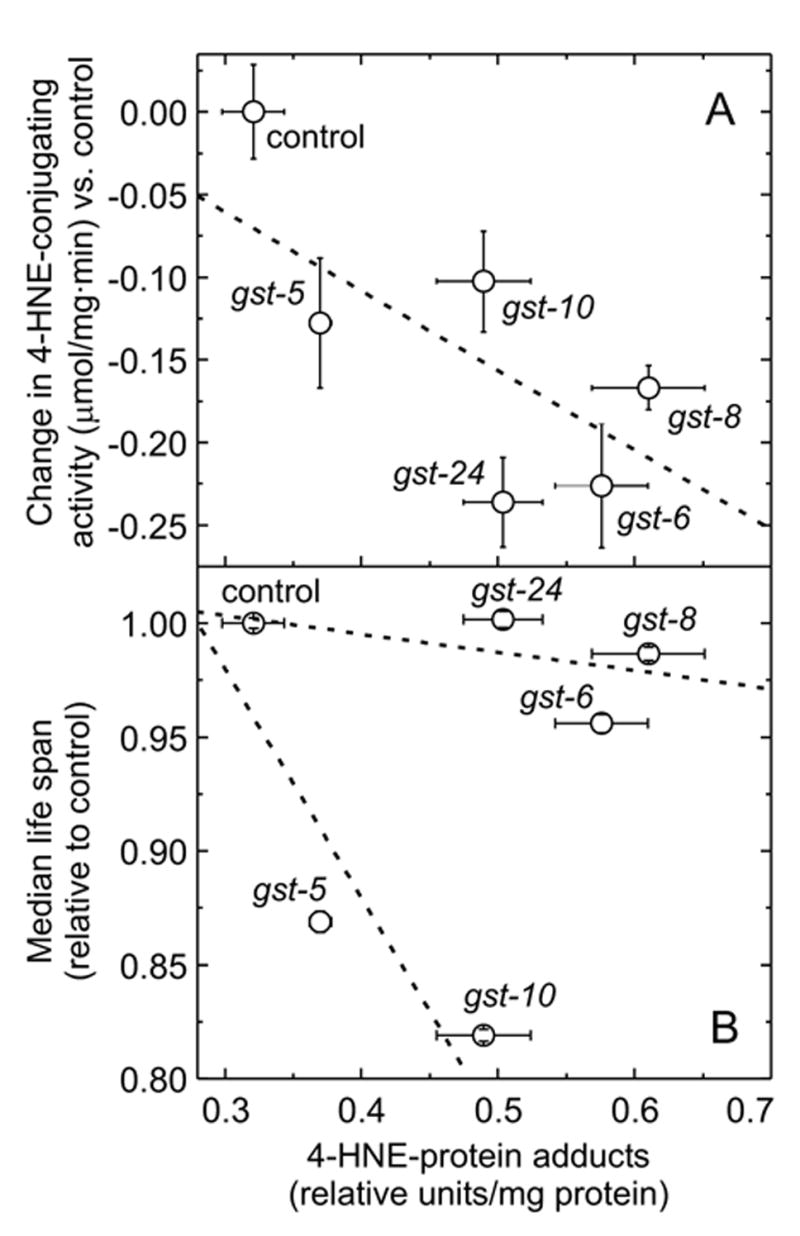
Effect of GST knock-down by RNAi on formation of 4-HNE-protein adducts. The amount of 4-HNE-protein adducts in whole-body homogenates of worms subjected to RNAi against gst-5, gst-6, gst-8, gst-10, and gst-24 is shown on the abscissa; control: insert-free feeding vector. Panel A: 4-HNE-protein adducts correlate (R2 = 0.50) with the decrement of 4-HNE-conjugating activity (taken from Fig. 1) in worms in which expression of individual GSTs was knocked down by RNAi. Panel B: for control animals and worms subjected to RNAi against gst-5 and gst-10, 4-HNE-protein adducts correlate well (R2 = 0.70) with the decrease in median life span (taken from Fig. 7). For control animals and worms subjected to RNAi against gst-6, gst-8, and gst-24, the correlation of 4-HNE-protein adducts with change in median life span is poor (R2 = 0.37). Regression lines were calculated using as the weight for each point the square root of the product of the standard deviations in the x-dimension and y-dimension. Error bars are shown inside the plotting symbol when they are smaller than the symbol diameter.
Fig. 9
Fig. 9
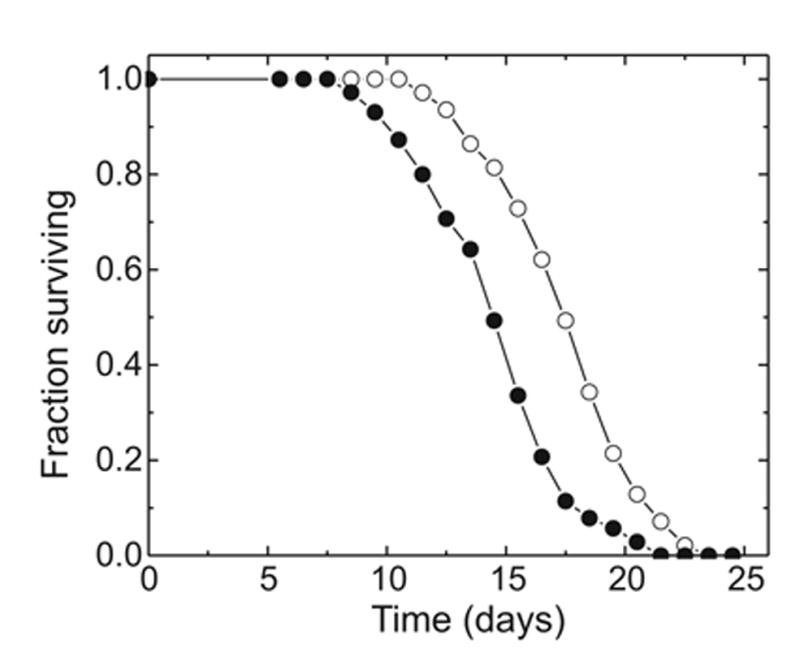
Reduction of life span in C. elegans strain NL2099 by RNAi targeted to gst-10. Open symbols: control worms fed bacteria transformed with insert-free vector; closed symbols: RNAi against gst-10. Each group consisted of 150 worms. The median life span is shortened by gst-10 knock-down by 17.3%, as calculated from approximating the survival curves by fitting the Gompertz function.
Fig. 10
Fig. 10
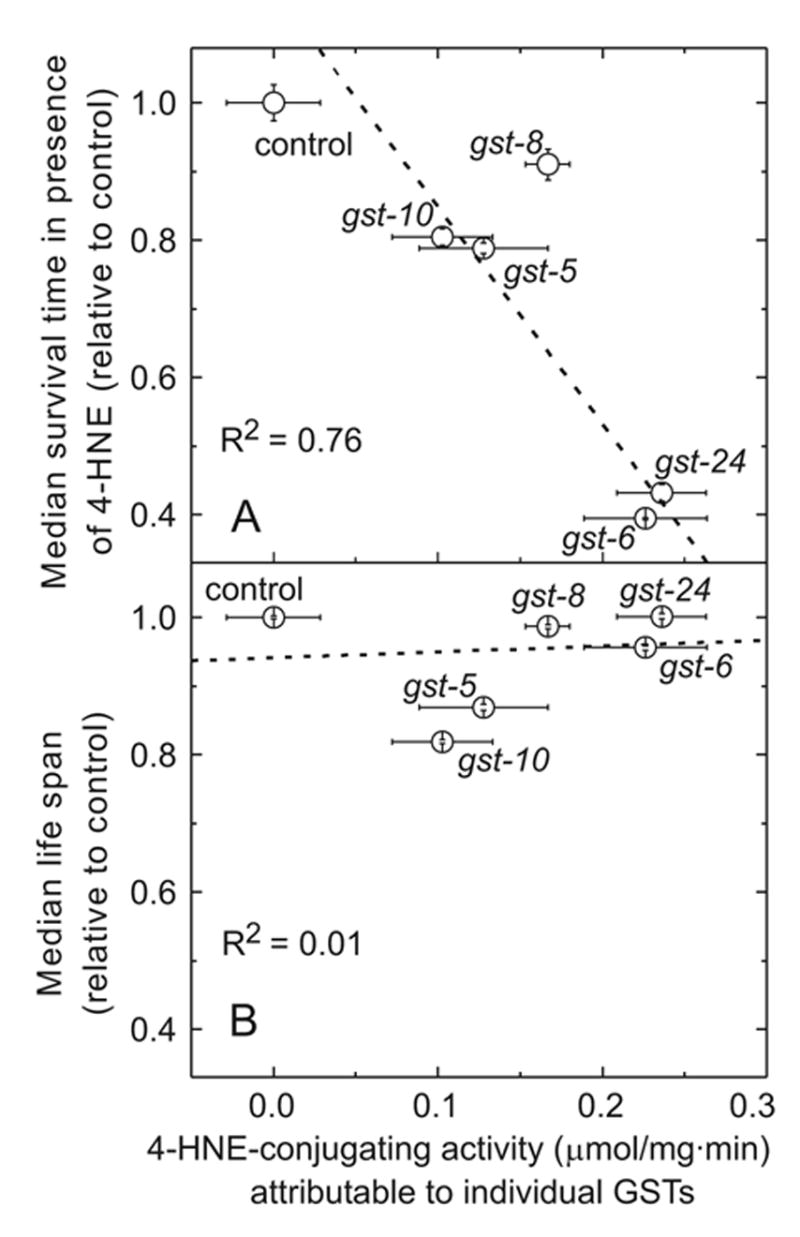
Correlation between 4-HNE-conjugating activity of selected C. elegans GSTs and (panel A) resistance against stress evoked by exposure to 4-HNE, or (panel B) life span. Shown are only those GSTs which have been identified as able to conjugate 4-HNE. 4-HNE-conjugating activity (abscissa) is equal to the decrease in activity caused by RNAi knock-down of each GST (from Fig. 1). Resistance to 4-HNE (ordinate, panel A) is expressed as the median survival time in the presence of 10 mM 4-HNE (from Fig. 4). Life span (ordinate, panel B) is the median survival time under unstressed conditions (from Fig. 7). Regression lines were calculated using as the weight for each point the square root of the product of the standard deviation of enzyme activity (x-dimension error) and the asymptotic standard error of the median survival time (y-dimension error). Error bars are shown inside the plotting symbol when they are smaller than the symbol diameter.
Fig. 11
Fig. 11
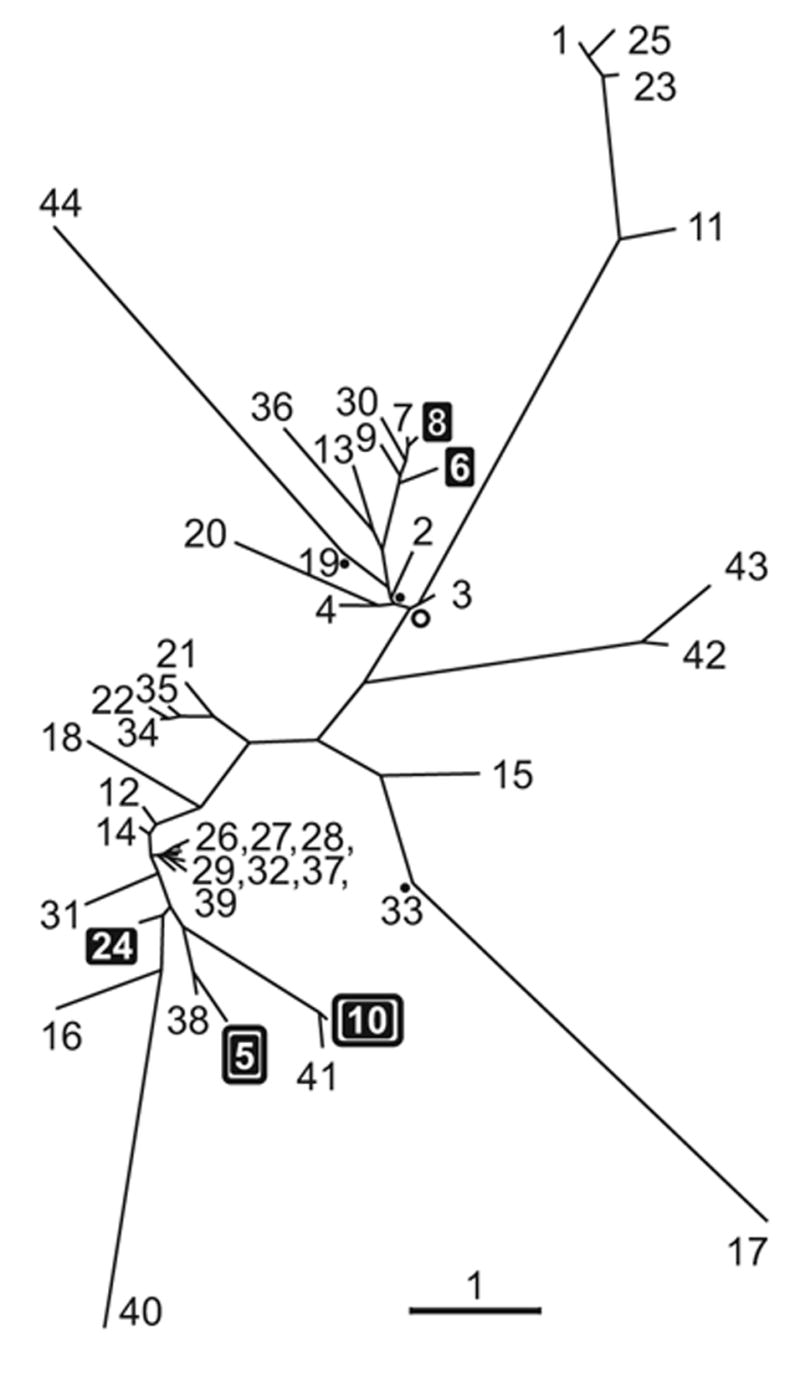
Unrooted radial phylogenetic tree of C. elegans gst coding sequences constructed by the maximum likelihood method, as implemented in the software fastDNAml (Olsen et al., 1994), and visualized using TreeView (Page, 1996). The numbers refer to gst gene designations. The 5 GSTs which we identified as having 4-HNE-conjugating activity are shown on black background; of these, the 2 enzymes (gst-5 and gst-10) whose knock-down by RNAi leads to life span shortening are boxed. The length of 3 branches in the tree (marked with filled circles) may not be significantly greater than zero (P ≥ 0.05), and the length of one branch (marked with open circle) is positive at 0.01 ≤ P < 0.05; all other branches are significant at P < 0.01. The scale bar represents a branch length corresponding to an evolutionary distance equivalent to one expected nucleotide substitution at any given site.

References

    1. Alcedo J, Kenyon C. Regulation of C. elegans longevity by specific gustatory and olfactory neurons. Neuron. 2004;41:45–55. - PubMed
    1. Alin P, Danielson UH, Mannervik B. 4-Hydroxyalk-2-enals are substrates for glutathione transferase. FEBS Lett. 1985;179:267–270. - PubMed
    1. Ayyadevara S, Dandapat A, Singh SP, Benes H, Zimniak L, Shmookler Reis RJ, Zimniak P. Lifespan extension in hypomorphic daf-2 mutants of Caenorhabditis elegans is partially mediated by glutathione transferase CeGSTP2-2. Aging Cell. 2005a;4:299–307. - PubMed
    1. Ayyadevara S, Engle MR, Singh SP, Dandapat A, Lichti CF, Benes H, Shmookler Reis RJ, Liebau E, Zimniak P. Lifespan and stress resistance of Caenorhabditis elegans are increased by expression of glutathione transferases capable of metabolizing the lipid peroxidation product 4-hydroxynonenal. Aging Cell. 2005b;4:257–271. - PubMed
    1. Bagley AC, Krall J, Lynch RE. Superoxide mediates the toxicity of paraquat for Chinese hamster ovary cells. Proc Natl Acad Sci USA. 1986;83:3189–3193. - PMC - PubMed

Publication types

MeSH terms