. 2007 Feb;1773(2):232-42.
doi: 10.1016/j.bbamcr.2006.10.011. Epub 2006 Oct 26.

The Saccharomyces cerevisiae YFR041C/ERJ5 gene encoding a type I membrane protein with a J domain is required to preserve the folding capacity of the endoplasmic reticulum

Affiliations

The Saccharomyces cerevisiae YFR041C/ERJ5 gene encoding a type I membrane protein with a J domain is required to preserve the folding capacity of the endoplasmic reticulum

M Carla Famá et al. Biochim Biophys Acta. 2007 Feb.

Abstract

YFR041C/ERJ5 was identified in Saccharomyces cerevisiae as a gene regulated by the unfolded protein response pathway (UPR). The open reading frame of the gene has a J domain characteristic of the DnaJ chaperone family of proteins that regulate the activity of Hsp70 chaperones. We determined the expression and topology of Erj5p, a type I membrane protein with a J domain in the lumen of the endoplasmic reticulum (ER) that colocalizes with Kar2p, the major Hsp70 in the yeast ER. We identified synthetic interactions of Deltaerj5 with mutations in genes involved in protein folding in the ER (kar2-159, Deltascj1Deltajem1) and in the induction of the unfolded protein response (Deltaire1). Loss of Erj5p in yeast cells with impaired ER protein folding capacity increased sensitivity to agents that cause ER stress. We identified the ERJ5 mRNA and confirmed that agents that promote accumulation of misfolded proteins in the ER regulate its abundance. We found that loss of the non-essential ERJ5 gene leads to a constitutively induced UPR, indicating that ERJ5 is required for maintenance of an optimal folding environment in the yeast ER.


Figures
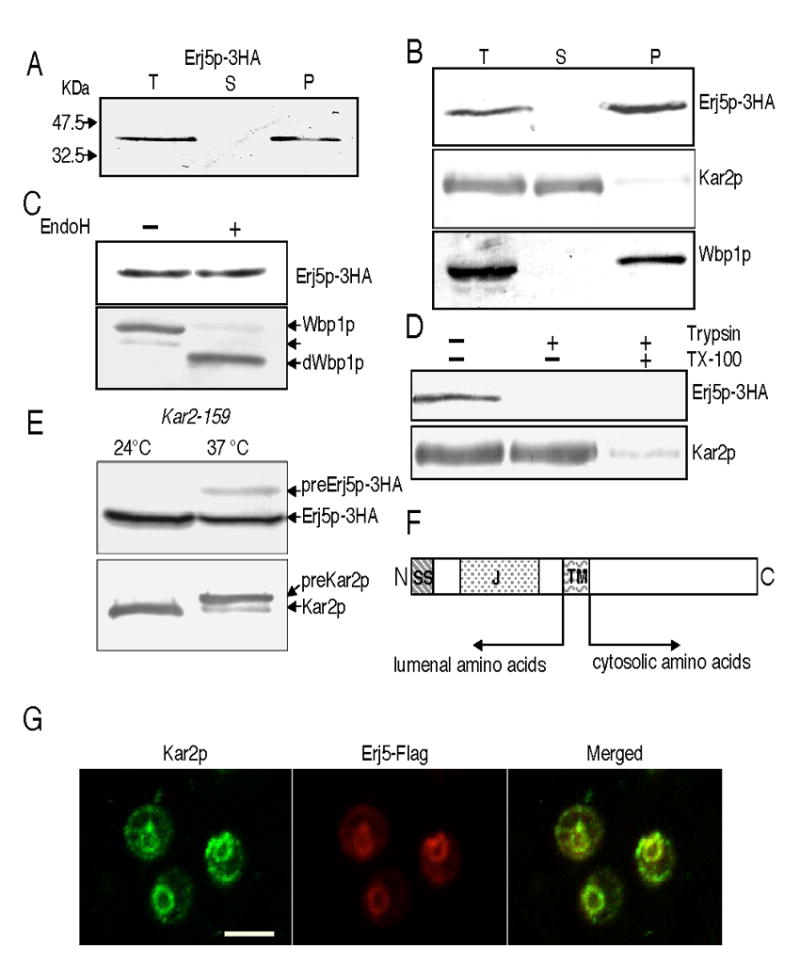
Figure 1
Figure 1
ERJ5 encodes a novel type I ER membrane protein. The Erj5p-3HA protein was detected with anti HA antibodies, the soluble ER lumenal Kar2p and the integral ER membrane Wbp1p were detected with specific antisera. Experiments were performed as described in Materials and Methods. A) Erj5p-3HA is detected in yeast microsomes. Cell homogenates from SSY211 cells that express the Erj5p-3HA fusion protein were centrifuged to obtain microsomal membranes. Supernatant (S) and pellet (P) fractions derived from the equivalent amount of total cell homogenate (T) were resolved by SDS/PAGE and immunobloted for detection of the HA-epitope. B) Erj5p remains in the membrane fraction after treatment of the cell homogenates with 0.1M sodium carbonate pH: 11.5. Supernatant (S) and pellet (P) derived from the equivalent amount of total cell homogenate (T) were immunobloted for detection of Erj5p-3HA. Soluble Kar2p and the integral membrane Wbp1p were immunodetected as controls. C) Erj5p is not N-glycosylated. Microsomes were incubated in presence or absence of Endoglycosidase H before SDS/PAGE and immunodetections of Erj5p-3HA and the Wbp1p glycoprotein as a control. Wbp1p glycoforms containing one or two N-oligosaccharydes or fully deglycosylated (dWbp1p) are indicated with arrows. D) The carboxy-terminus of Erj5p is accessible to proteases in intact microsomes. Three aliquots of yeast microsomes were incubated with or without trypsin in the presence or absence of Triton X-100. Erj5p-3HA and the lumenal soluble Kar2p were immunodetected. E) preErj5p is detected in yeast strains defective in ER protein translocation. A kar2-159 strain expressing the Erj5p-3HA fusion protein (SSY301) was grown to mid-log phase at 24ºC in liquid YPD. Cultures were divided, half was kept at 24ºC, and half was shifted at 37ºC as indicated. After 3 h of incubation, aliquots were removed, cells were lysed with glass beads, and proteins resolved in SDS/PAGE for immunoblotting. Labeled arrows indicate the migration position of preErj5p-3HA and Erj5p-3HA, preKar2p and Kar2p. F) Schematic representation of the overall structure of Erj5p. SS: signal sequence for translocation across the ER; J: J domain, TM: transmembrane region. G) Colocalization of Erj5p and Kar2p in the ER by immunofluorescence. BJ5464 cells expressing Erj5-Flag protein were analyzed by double label immunofluorescence microscopy using anti-Kar2p and anti-Flag antibodies. Left: fluorescent image of Kar2p; middle: fluorescent image of Erj5-Flag; right: merged image. Bar indicates 5 μm.
Figure 2
Figure 2
Sequence alignment of the conserved J domains of E. coli DnaJ and the S. cerevisiae DnaJ proteins with J domains located in the lumen of the ER. The multiple alignments were performed with ClustalX [51]. Numbers in the left and the right indicate first and last amino acids of each aligned sequence. The four α-helical regions of the J domain of E. coli DnaJ and its human homologue HDJ1 that were determined by NMR structure [37] are indicated. The highly conserved HPD tripeptide, a hallmark of the J domains that mediate interactions with Hsp70s, and essential amino acids identified in E.coli J domain are in black boxes.
Figure 3
Figure 3
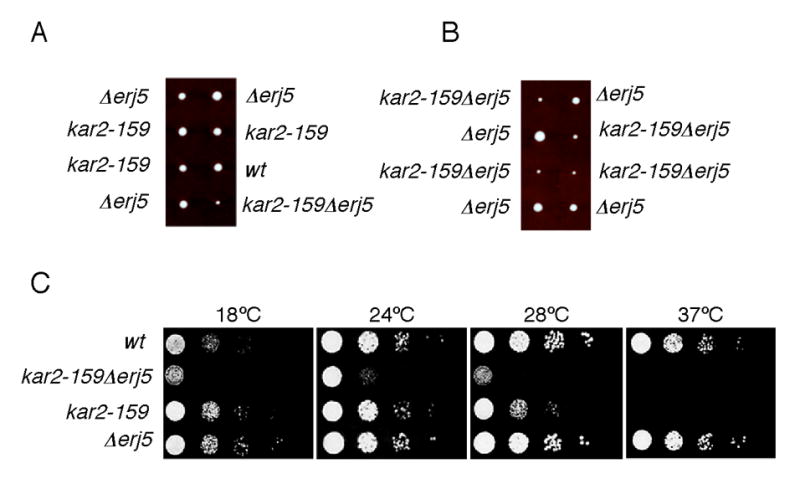
Growth of strains combining the kar2-159 conditional allele and the erj5 deletion. A) Diploids that were heterozygous for kar2-159 and for Δerj5 were obtained by crossing strains MS1380 and SSY201. To minimize effects of different strain backgrounds, a kar2-159 haploid isolated from the initial cross was backcrossed to SSY201 three times. A diploid from the last cross was sporulated and tetrads were dissected. B) Tetrads dissected from a diploid obtained by crossing haploids kar2-159 Δerj5 and Δerj5 obtained from the last backcross described in A. Plates were incubated at 24ºC for 3 d. C) Strains obtained from a tetratype tetrad as of Panel A were grown in liquid YPD at 24ºC and diluted to a density of 106 cells/ml. 5-μl aliquots of 10-fold serial dilutions of the cultures were plated on YPD-agar and incubated at the indicated temperatures for 3 d.
Figure 4
Figure 4
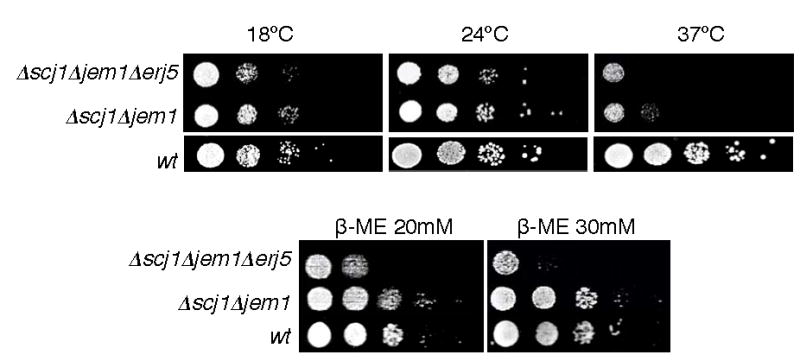
Loss of Erj5p aggravates the growth defect and sensitivity to agents that produce stress in the ER of a Δscj1Δjem1 strain. Isogenic Δscj1Δjem1Δerj5, Δscj1Δjem1, and wild-type strains were grown in liquid YPD at 24ºC and diluted to a density of 106 cells/ml. 5-ul aliquots of 10-fold serial dilutions of the cultures were plated on YPD-agar or on plates with the same medium containing β-mercaptoethanol at the indicated concentrations. YPD plates were incubated at the indicated temperatures for 3 d. Plates containing β-mercaptoethanol were incubated at 24ºC for 4 d.
Figure 5
Figure 5
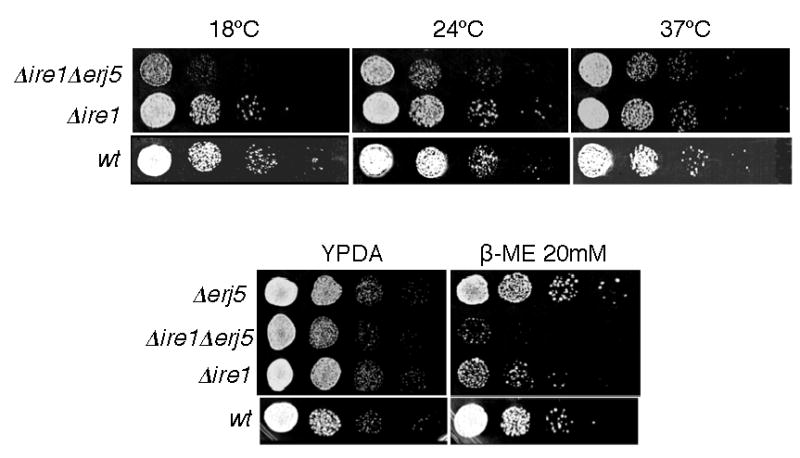
Loss of Erj5p in a Δire1 strain results in a growth defect and hypersensitivity to ER stress. Isogenic Δire1Δerj5, Δire1, Δerj5, and wild-type strains were grown in liquid YPD at 24ºC and diluted to a density of 106 cells/ml. 5-ul aliquots of 10-fold serial dilutions of the cultures were plated on YPD-agar or on plates with the same medium containing β-mercaptoethanol at the indicated concentrations. YPD plates were incubated at the indicated temperatures for 3 d. Plates containing β-mercaptoethanol were incubated at 28ºC for 4 d.
Figure 6
Figure 6
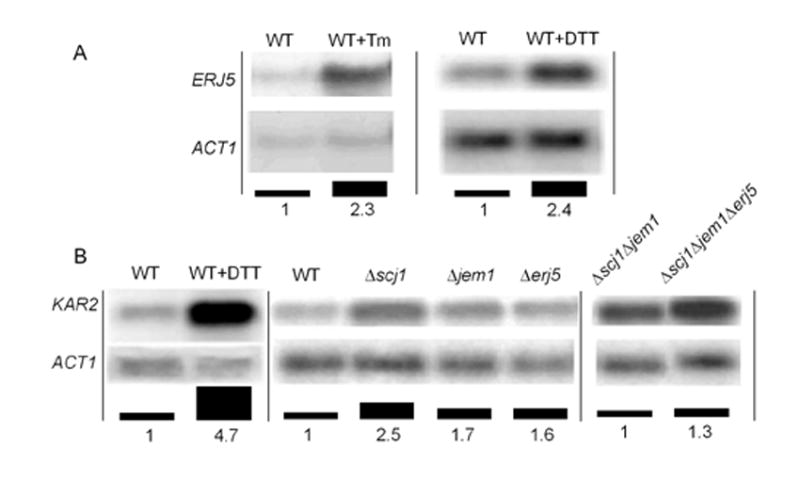
Northern blot analysis. Yeast cells RNA preparation and Northern blot analysis were performed as described in Materials and Methods. A) Induction of the ERJ5 mRNA by agents that promote the accumulation of unfolded proteins in the ER. A wild type strain (RGY132) was grown at 24ºC in the absence or presence of 10 μg/ml of tunicamycin (Tm) or 10 mM DTT. ERJ5 mRNA, normalized to ACT1 mRNA probed on the same blot, is expressed as bars corresponding to the fold-induction of ERJ5 mRNA relative to the expression in the wild-type in absence of the treatments. B) Induction of the unfolded protein response. KAR2 mRNA normalized to ACT1 mRNA probed on the same blots, is expressed as bars corresponding to the fold-induction of KAR2 mRNA relative to the expression in the wild-type in absence of treatments (left and center panels), or as fold-induction relative to the Δscj1Δjem1 strain (right panel). Representative Northern blots of several independent repetitions are shown.
Figure 7
Figure 7
UPR induction in Δerj5 cells measured by the GFP-fluorescence of a UPR reporter. W303 yeast cells bearing pRS314-UPRE-GFP were grown in minimal medium without tryptophane to mid-log phase. GFP-fluorescence was quantified as described in Materials and Methods from cells incubated for 90 min in the absence or presence of 5 mM DTT. The mean fluorescence of wild-type (WT) and Δerj5 (erj5) cells were normalized to the fluorescence values of the WT in absence of DTT treatment. The mean fold induction was calculated from five experiments and the standard deviation is represented as error bars.

References

    1. Bukau B, Horwich AL. The Hsp70 and Hsp60 chaperone machines. Cell. 1998;92:351–366. - PubMed
    1. Corsi AK, Schekman R. The lumenal domain of Sec63p stimulates the ATPase activity of BiP and mediates BiP recruitment to the translocon in Saccharomyces cerevisiae. J Cell Biol. 1997;137:1483–1493. - PMC - PubMed
    1. Rudiger S, Schneider-Mergener J, Bukau B. Its substrate specificity characterizes the DnaJ co-chaperone as a scanning factor for the DnaK chaperone. EMBO J. 2001;20:1042–1050. - PMC - PubMed
    1. Ng DT, Spear ED, Walter P. The unfolded protein response regulates multiple aspects of secretory and membrane protein biogenesis and endoplasmic reticulum quality control. J Cell Biol. 2000;150:77–88. - PMC - PubMed
    1. Rutkowski DT, Kaufman RJ. A trip to the ER: coping with stress. Trends Cell Biol. 2004;14:20–28. - PubMed

Publication types

MeSH terms