. 2007;35(1):113-24.
doi: 10.1093/nar/gkl885. Epub 2006 Dec 7.

LEDGF/p75 interacts with divergent lentiviral integrases and modulates their enzymatic activity in vitro

Affiliations

LEDGF/p75 interacts with divergent lentiviral integrases and modulates their enzymatic activity in vitro

Peter Cherepanov. Nucleic Acids Res. 2007.

Abstract

Transcriptional co-activator LEDGF/p75 is the major cellular interactor of HIV-1 integrase (IN), critical to efficient viral replication. In this work, a series of INs from the Betaretrovirus, Gammaretrovirus, Deltaretrovirus, Spumavirus and Lentivirus retroviral genera were tested for interaction with the host factor. None of the non-lentiviral INs possessed detectable affinity for LEDGF in either pull-down or yeast two-hybrid assays. In contrast, all lentiviral INs examined, including those from bovine immunodeficiency virus (BIV), maedi-visna virus (MVV) and equine infectious anemia virus (EIAV) readily interacted with LEDGF. Mutation of Asp-366 to Asn in LEDGF ablated the interaction, suggesting a common mechanism of the host factor recognition by the INs. LEDGF potently stimulated strand transfer activity of divergent lentiviral INs in vitro. Unprecedentedly, in the presence of the host factor, EIAV IN almost exclusively catalyzed concerted integration, whereas HIV-1 IN promoted predominantly half-site integration, and BIV IN was equally active in both types of strand transfer. Concerted BIV and EIAV integration resulted in 5 bp duplications of the target DNA sequences. These results confirm that the interaction with LEDGF is conserved within and limited to Lentivirus and strongly argue that the host factor is intimately involved in the catalysis of lentiviral DNA integration.


Figures
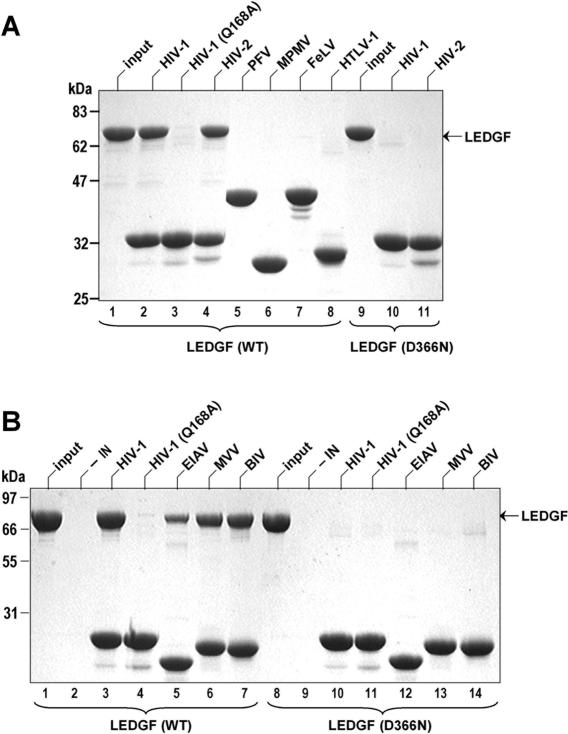
Figure 1
Figure 1
Interaction with LEDGF is limited to and conserved among lentiviral INs. (A) His6-tagged HIV-1, HIV-2, PFV, MPMV, FeLV and HTLV-1 INs (as indicated) were tested for the ability to pull-down WT (lanes 2–8) or D366N LEDGF (lanes 10 and 11). Proteins recovered on Ni-NTA agarose beads were separated in SDS–PAGE gels and detected by staining with Coomassie-R250. Lanes 1 and 9 contained input quantities of WT and D366N LEDGF, respectively. The migration positions of LEDGF and molecular weight markers (kDa) are indicated. (B) His6-tag pull-down assays with lentiviral HIV-1, EIAV, MVV and BIV INs (as indicated) and WT (lanes 3–7) or D366N LEDGF (lanes 10–14). Lanes 1 and 8 contained input quantities of WT and D366N LEDGF. IN was omitted from reactions in lanes 2 and 9.
Figure 2
Figure 2
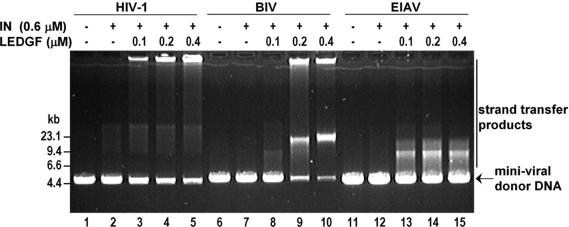
LEDGF stimulates gross strand transfer activity of HIV-1, BIV and EIAV INs. Reactions containing mini-HIV (lanes 1–5), mini-BIV (lanes 6–10) or mini-EIAV (lanes 11–15) DNAs were incubated in the presence of 0.6 μM (∼20 μg/ml) non-tagged recombinant HIV-1 (lanes 2–5), BIV (lanes 7–10) or EIAV (lanes 12–15) IN. LEDGF was added to the reactions in lanes 3–5, 8–10 and 13–15 at indicated concentrations. The proteins were omitted from the mock reactions in lanes 1, 6 and 11.
Figure 3
Figure 3
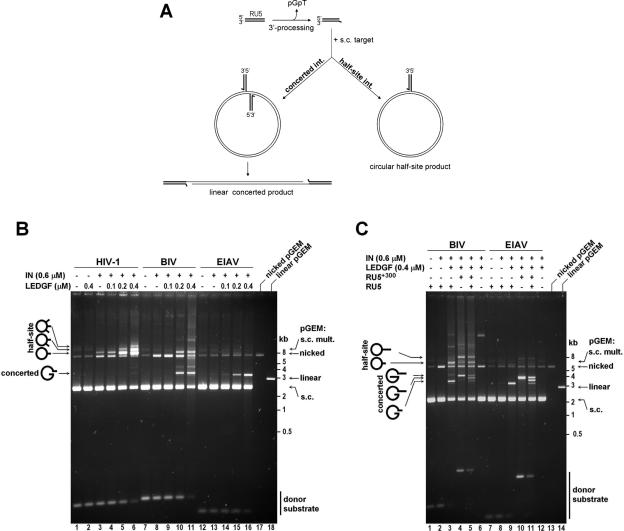
Strand transfer activities of HIV-1, BIV and EIAV INs in the presence of LEDGF. (A) Schematic of in vitro integration with circular DNA target and the expected linear concerted and circular half site strand transfer products. Coordinated insertion of a pair of substrate DNA molecules into opposing strands of target DNA results in a linear concerted integration product (left). Uncoupled insertion of a single substrate molecule into one strand of the target plasmid gives a circular half site product (right). Thick lines are substrate and thin are target-derived DNA. (B) HIV-1 (lanes 1–6), BIV (lanes 7–11), or EIAV (lanes 12–16) RU5 substrates and supercoiled pGEM target DNA were incubated with 0.6 μM (∼20 μg/ml) recombinant HIV-1, BIV, or EIAV INs and 0–0.4 μM LEDGF, as indicated. Deproteinized reaction products were separated in 1.5% agarose gels and detected by staining with ethidium bromide. Lanes 17 and 18 contained nicked circular and linearized pGEM DNA respectively. Migration positions of DNA markers (kb), pGEM DNA forms [supercoiled multimer (s.c. mult.), nicked circular, linear, and supercoiled (s.c.)], substrate RU5 DNAs, and the reaction products (concerted, half-site, and multiple half-site) are indicated. (C) BIV (lanes 1–6) and EIAV (lanes 7–12) integration reactions were carried out with the respective RU5 or/and RU5+300 substrates. Lanes 13 and 14 contained nicked circular and linearized pGEM DNA, respectively. Migration positions of the two circular half site and three linear concerted integration products derived from RU5 and RU5+300 substrates are indicated.
Figure 4
Figure 4
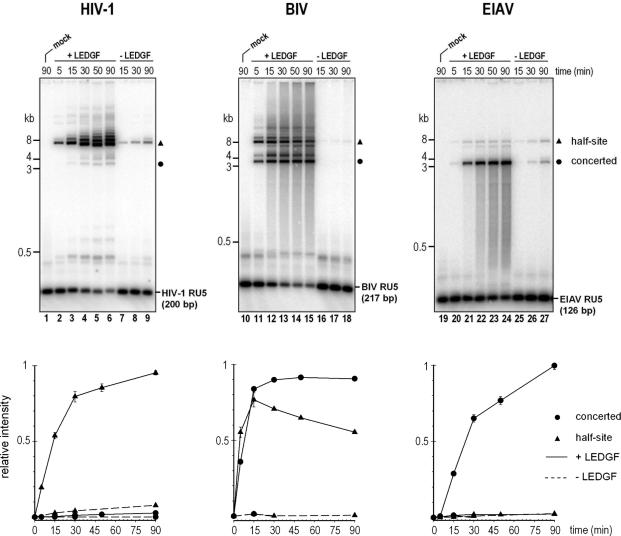
Time course of LEDGF-dependent HIV-1, BIV and EIAV integration reactions with radiolabeled donor DNA substrates. HIV-1 (lanes 1–9), BIV (lanes 10–18) and EIAV (lanes 19–27) RU5 substrates were incubated with their respective INs (0.6 μM) for 5–90 min (as indicated), in the presence (lanes 2–6, 11–15 and 20–24) or absence (lanes 7–9, 16–18 and 25–27) of 0.4 μM LEDGF. Deproteinized reaction products separated in 1.5% agarose gels were detected and quantified by phosphor autoradiography. Lanes 1, 10 and 19 contained mock samples where IN and LEDGF were omitted. Migration positions of DNA standards (kb) are indicated. The plot below each gel shows accumulation of the concerted (filled circles) or half-site (triangles) integration products in the presence (discontinuous line) or absence (dashed line) of LEDGF in terms of relative band intensity. Error bars represent SDs calculated from duplicate measurements.
Figure 5
Figure 5
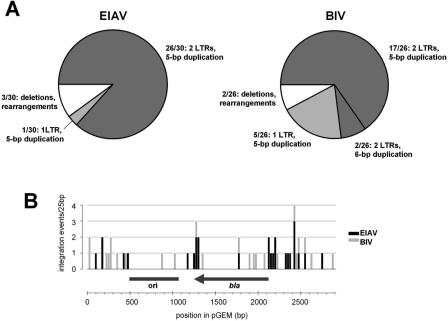
Sequence analysis of cloned EIAV and BIV integration products. (A) Pie charts summarizing the categories of clones obtained by cloning of the gel-purified concerted linear integration products. In total, 30 EIAV- and 26 BIV- derived clones were analyzed. See the Results section for more details. (B) Distribution of the cloned concerted integration events along the pGEM target. The histogram bars represent numbers of EIAV (black) and BIV (gray) integration events within each 25 bp window along the target DNA sequence. The ruler corresponds to nucleotide coordinates within pGEM-9Zf(−) (GenBank accession no. X65312). Positions of the plasmid's replication origin (ori) and the ampicillin resistance gene (bla) are indicated.
Figure 6
Figure 6
Partial sequence alignment of lentiviral INs. Secondary structure elements from 2B4J (32) are indicated above the alignment. Residues comprising the α4/5 connector (167–171 in HIV-1 IN) (32) are boxed. Residues invariant among all six proteins are white on red background, and those with conserved biochemical properties are bold on yellow background. Blue circles and boxes under the alignment indicate residues that in HIV-1 CCD-IBD structure directly participate in the interaction with LEDGF through side chain or backbone atoms, respectively (32). The numbering corresponds to the HIV-1 sequence. The figure was generated using ESPript-2.2 (64), ().

References

    1. Buchen-Osmond C. The universal virus database ICTVDB. Comput. Sci. Eng. 2003;5:16–25.
    1. LaFemina R.L., Schneider C.L., Robbins H.L., Callahan P.L., LeGrow K., Roth E., Schleif W.A., Emini E.A. Requirement of active human immunodeficiency virus type 1 integrase enzyme for productive infection of human T-lymphoid cells. J. Virol. 1992;66:7414–7419. - PMC - PubMed
    1. Grinsztejn B., Nguyen B.Y., Katlama C., Gatell J., Lazzarin A., Vittecoq D., Gonzalez C., Chen J., Isaacs R. The_Protocol_005_Study_Team. The 13th Conference on Retroviruses and Opportunistic Infections; February 5–8, 2006; Denver, CO. 2006.
    1. Hazuda D.J., Felock P., Witmer M., Wolfe A., Stillmock K., Grobler J.A., Espeseth A., Gabryelski L., Schleif W., Blau C., et al. Inhibitors of strand transfer that prevent integration and inhibit HIV-1 replication in cells. Science. 2000;287:646–650. - PubMed
    1. Craigie R. Retroviral DNA integration. In: Craig N.L., Craigie R., Gellert M., Lambowitz A.M., editors. Mobile DNA II. Washington DC: ASM Press; 2002. pp. 613–630.

Publication types

MeSH terms