. 2007 Feb;143(2):838-48.
doi: 10.1104/pp.106.092627. Epub 2006 Dec 8.

Vitamin B1-induced priming is dependent on hydrogen peroxide and the NPR1 gene in Arabidopsis

Affiliations

Vitamin B1-induced priming is dependent on hydrogen peroxide and the NPR1 gene in Arabidopsis

Il-Pyung Ahn et al. Plant Physiol. 2007 Feb.

Abstract

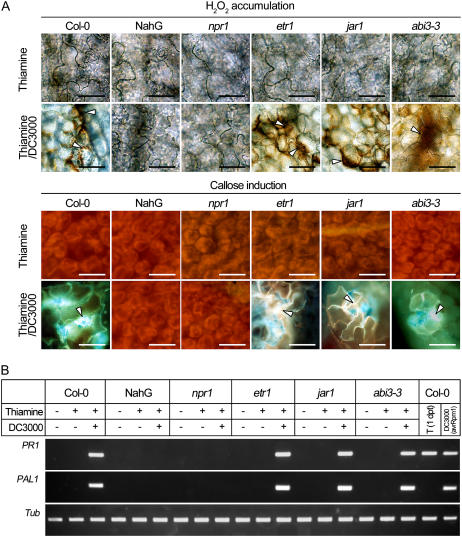
Thiamine confers systemic acquired resistance (SAR) on susceptible plants through priming, leading to rapid counterattack against pathogen invasion and perturbation of disease progress. Priming reduces the metabolic cost required for constitutive expression of acquired resistance. To investigate the effects of priming by thiamine on defense-related responses, Arabidopsis (Arabidopsis thaliana) was treated with thiamine and effects of pathogen challenge on the production of active oxygen species, callose deposition, hypersensitive cell death, and pathogenesis-related 1 (PR1)/Phe ammonia-lyase 1 (PAL1) gene expression was analyzed. Thiamine did not induce cellular and molecular defense responses except for transient expression of PR1 per se; however, subsequent Pseudomonas syringae pv tomato challenge triggered pronounced cellular defense responses and advanced activation of PR1/PAL1 gene transcription. Thiamine treatment and subsequent pathogen invasion triggered hydrogen peroxide accumulation, callose induction, and PR1/PAL1 transcription activation in Arabidopsis mutants insensitive to jasmonic acid (jar1), ethylene (etr1), or abscisic acid (abi3-3), but not in plants expressing bacterial NahG and lacking regulation of SAR (npr1 [nonexpressor of PR genes 1]). Moreover, removal of hydrogen peroxide by catalase almost completely nullified cellular and molecular defense responses as well as SAR abolishing bacterial propagation within plants. Our results indicated that priming is an important cellular mechanism in SAR by thiamine and requires hydrogen peroxide and intact NPR1.


Figures
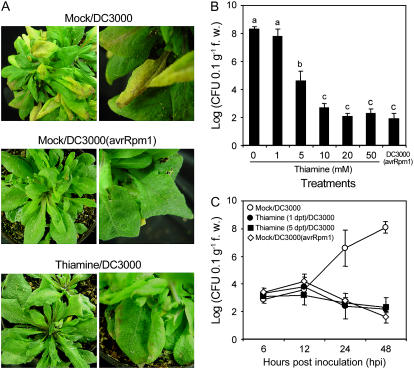
Figure 1.
Figure 1.
Effect of thiamine application on disease progression in Arabidopsis. A, Arabidopsis ecotype Col-0 plants were inoculated with virulent P. syringae pv tomato strain DC3000 (1 × 10⁸ CFU mL−1 in 250 μg mL−1 Tween 20 [mock]) at 4 h after spraying mock or thiamine (10 mm in mock) solutions. Col-0 was also inoculated with DC3000 expressing avrRpm1 [DC3000 (avrRpm1)] as a resistance control. Samples were collected from 25 plants at 4 dpi. The necrotic lesion on Arabidopsis ecotype Col-0 caused by DC3000 was suppressed in thiamine-treated plants. B, DC3000 growth in the leaves of Arabidopsis ecotype Col-0 treated with increasing concentrations of thiamine prior to DC3000 inoculation. Samples (±1 g fresh weight) were collected from five plants 3 dpi. Each bar represents the mean ± se. Different letters indicate statistically significant differences between treatments (Duncan's multiple range test; P < 0.05). C, Inhibitory effects of thiamine on bacterial growth in Arabidopsis. Arabidopsis ecotype Col-0 was inoculated with DC3000 1 and 5 d after 10 mm thiamine treatment. Samples (±1 g fresh weight) were collected from five plants at 6, 12, 24, and 48 h after inoculation. Each point represents the mean ± se of bacterial count. dpt, Days posttreatment.
Figure 2.
Figure 2.
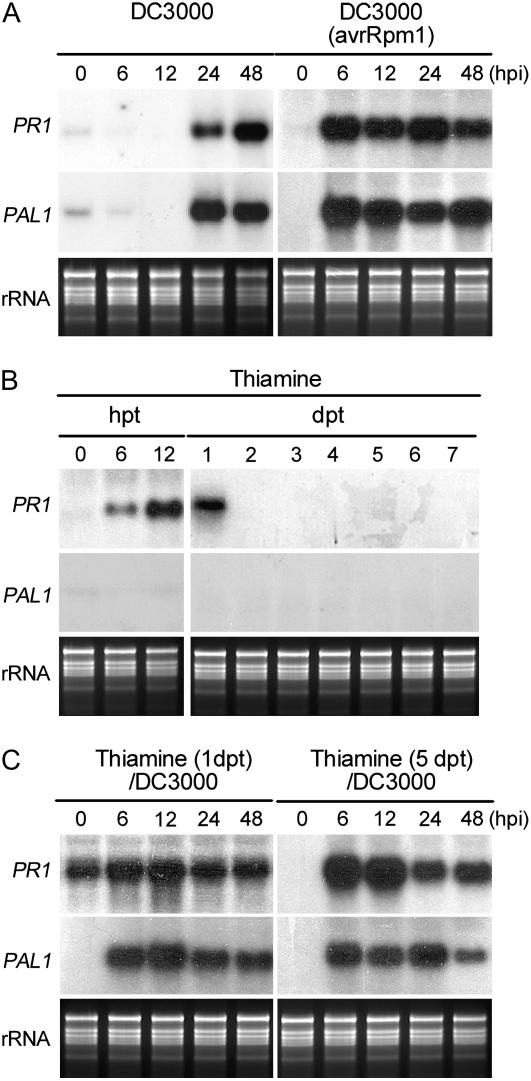
PR1 and PAL1 gene expression induced by thiamine treatment and DC3000 inoculation at varying hours posttreatment (hpt), days posttreatment (dpt), hpi, and dpi. Bacterial inoculation and thiamine treatment were performed as described in Figure 1C. A, PR1 and PAL1 gene expression induced by virulent DC3000 or avirulent DC3000 (avrRpm1) infection at 0, 6, 12, 24, and 48 hpi. B, Expression of PR1 and PAL1 genes in Arabidopsis sprayed with 10 mm thiamine at 0, 6, and 12 hpt and 1, 2, 3, 4, 5, 6, and 7 dpt. C, PR1 and PAL1 gene expression in Arabidopsis challenged with virulent DC3000 1 and 5 d after 10 mm thiamine treatment. Total RNA was extracted from the leaves of five Arabidopsis plants recovered 0, 6, 12, 24, and 48 hpi with DC3000.
Figure 3.
Figure 3.
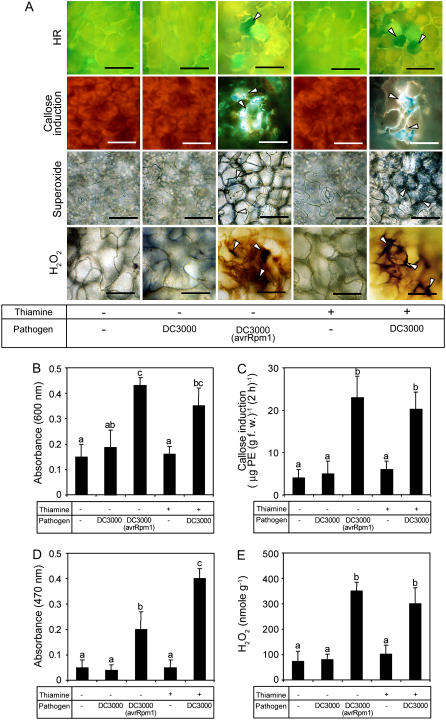
Effects of priming by thiamine and pathogen challenge on the cellular defense responses in Arabidopsis. Arabidopsis ecotype Col-0 was sprayed with 10 mm thiamine (+) in 250 μg mL−1 Tween 20 (mock) or mock only (−). Five days after thiamine treatment, Arabidopsis was inoculated with virulent DC3000 (+). Mock (−) was inoculated with avirulent DC3000 (avrRpm1; +). A, Microscopic observation and quantification of hydrogen peroxide and callose deposition were performed on leaves recovered at 6 hpi. Analyses of superoxide accumulation and HR were conducted on leaves harvested 3 and 12 hpi. Blue formazan precipitate or deep-brown color indicates formula image or H2O2 production. The presence of fluorescence indicates callose deposition. Cell death was determined by the presence (live) or absence (dead) of luminescence. Arrowheads indicate cell death, callose deposition, and superoxide and hydrogen peroxide production. Bars = 50 μm. B, Effects of thiamine and/or DC3000 inoculation on the HR examined by staining with Evans blue. C, Effects of thiamine and/or DC3000 inoculation on callose deposition. D, Effects of thiamine and/or DC3000 inoculation on formula image accumulation. E, Effects of thiamine and/or DC3000 inoculation on hydrogen peroxide accumulation. Data presented in B to E were taken in experiments conducted three times. Each bar represents the mean ± se. Different letters indicate statistically significant differences between treatments (Duncan's multiple range test; P < 0.05).
Figure 4.
Figure 4.
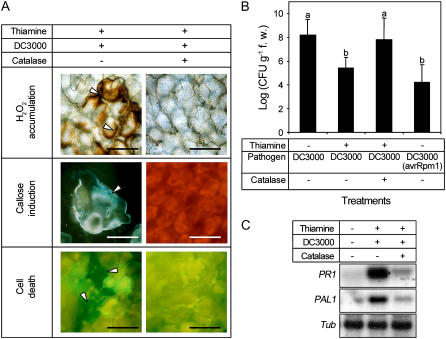
Effects of catalase on cellular defense responses, bacterial growth, and PR1/PAL1 gene expression in Arabidopsis treated with thiamine and challenged with DC3000. Virulent DC3000 (5 × 10⁶ CFU mL−1) and/or 5,000 units mL−1 catalase (+) were infiltrated with needleless syringes into Arabidopsis (ecotype Col-0) leaves 5 d after spraying with 10 mm thiamine in 250 μg mL−1 Tween 20 (+) or 250 μg mL−1 Tween 20 only (mock; −). A, Effects of exogenous application of catalase on cellular defense responses induced by thiamine. Samples for determination of hydrogen peroxide accumulation, callose deposition, and cell death (HR) were harvested 6, 6, and 12 hpi, respectively. Arrowheads indicate each response. Bars = 50 μm. B, Titers of DC3000 in Arabidopsis Col-0 plants leaves sprayed with thiamine and/or infiltrated with catalase. DC3000 (avrRpm1) plants are infiltrated with avirulent DC3000 (avrRpm1). Each bar represents the mean ± se. Different letters indicate statistically significant differences between treatments (Duncan's multiple range test; P < 0.05). C, Analysis of PR1 and PAL1 gene expression in the Col-0 leaves sprayed with thiamine and infiltrated with virulent DC3000 and/or catalase. Total RNA was extracted from five plants 6 h after infiltration, separated using denaturing gel electrophoresis, and transferred to nylon membrane. The blots were hybridized with Arabidopsis PR1 and PAL1 probes labeled with [32P]dCTP. All experiments were done at least three times and similar results were obtained.
Figure 5.
Figure 5.
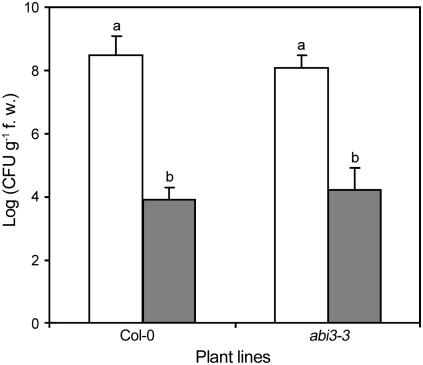
Effects of thiamine on pathogen growth in Col-0 and abi3-3. Bacterial growth is shown on Col-0 and abi3-3 challenged with DC3000 5 d after thiamine treatment. Data were from experiments conducted independently three times. Each bar represents the mean ± se. Different letters indicate statistically significant differences between treatments (Duncan's multiple range test; P < 0.05).
Figure 6.
Figure 6.
Effects of priming by thiamine on the accumulation of hydrogen peroxide, callose deposition, and PR1/PAL1 transcription in Arabidopsis Col-0 and its mutants. DC3000 was inoculated 5 d after thiamine spray and samples were recovered 6 hpi. A, Hydrogen peroxide accumulation and callose deposition in Arabidopsis Col-0, NahG, npr1, etr1, jar1, and abi3-3. B, Transcription of PR1 and PAL1 in Arabidopsis Col-0, NahG, npr1, etr1, jar1, and abi3-3. Data were from Arabidopsis sprayed with 10 mm thiamine and 250 μg mL−1 Tween 20 (+) or 250 μg mL−1 Tween 20 only (mock; −). Samples were harvested 6 hpi. In addition, leaves of Col-0 were harvested 1 d after thiamine spray (T [1 dpt]) and avirulent DC3000 (avrRpm1) inoculation.

References

    1. Abbasi PA, Graham TL (2001) Age-related regulation of induced isoflavonoid responses in soybean lines differing in inherent elicitation competency. Physiol Mol Plant Pathol 59 143–152
    1. Able AJ, Guest DI, Sutherland MW (2000) Hydrogen peroxide yields during the incompatible interaction of tobacco suspension cells inoculated with Phytophthora nicotianae. Plant Physiol 124 899–910 - PMC - PubMed
    1. Ahn I-P, Kim S, Kang S, Suh S-C, Lee Y-H (2005. a) Rice defense mechanisms against Cochliobolus miyabeanus and Magnaporthe grisea are distinct. Phytopathology 95 1248–1255 - PubMed
    1. Ahn I-P, Kim S, Lee Y-H (2005. b) Vitamin B1 functions as an activator of plant disease resistance. Plant Physiol 138 1505–1515 - PMC - PubMed
    1. Al-Daoude A, de Torres Zabala M, Ko J-H, Grant M (2005) RIN13 is a positive regulator of the plant disease resistance protein RPM1. Plant Cell 17 1016–1028 - PMC - PubMed

Publication types

MeSH terms