


Evaluation of the ability of Streptococcus agalactiae strains isolated from genital and neonatal specimens to bind to human fibrinogen and correlation with characteristics of the fbsA and fbsB genes
- PMID: 17158903
- PMCID: PMC1828567
- DOI: 10.1128/IAI.00996-06
Evaluation of the ability of Streptococcus agalactiae strains isolated from genital and neonatal specimens to bind to human fibrinogen and correlation with characteristics of the fbsA and fbsB genes
Abstract
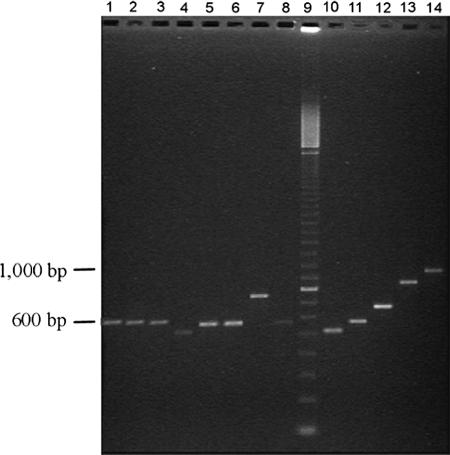
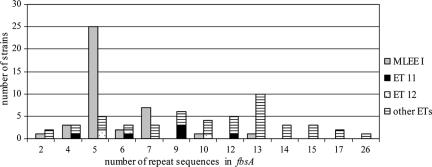
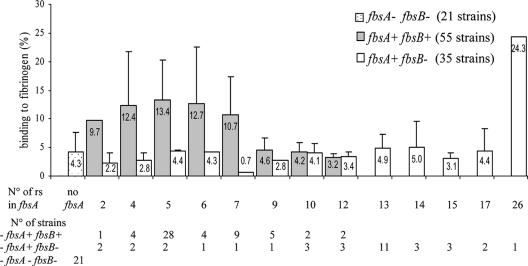
The ability of 111 Streptococcus agalactiae strains to bind to human fibrinogen was quantified. We correlated the percentages of bacteria that bound to immobilized fibrinogen with fibrinogen-binding (fbs) gene characteristics of strains and with clinical origin, serotypes, and phylogenetic positions of strains. Percentages varied from 0.4 to 29.9%. Fifty-five strains (49.5%) had the fbsB gene sensu stricto described by Gutekunst et al. (Infect. Immun., 72:3495-3504, 2004), allowing adhesion to human fibrinogen, and all of the other strains had an fgag variant gene. Ninety strains (81.1%) had a fbsA gene and 55 of them also had the fbsB gene. The other 21 strains (18.9%) had a truncated form of fbsA without the fbsB gene sensu stricto. The numbers of 48-nucleotide repeat sequences (rs) in the fbsA gene varied from 2 to 26. The population of strains with the highest ability to bind to human fibrinogen significantly more frequently had the fbsB gene sensu stricto and 4 to 7 rs in the fbsA gene (P < 0.05). However, the single strain that carried the highest number of rs (26 rs) in the fbsA gene showed high fibrinogen-binding activity (24.3%). Strains exhibiting significantly higher levels of binding to human fibrinogen belonged to a phylogenetic group of strains associated with neonatal meningitis, currently known as the ST-17 clone, that is mostly composed of serotype III strains. These findings indicate that S. agalactiae strains possess a wide variety of fbs gene content that markedly influences the ability of strains to bind to human fibrinogen. Variations in the configuration and the expression of the Fbs proteins may therefore partly explain the variability of virulence in S. agalactiae species.
Figures
References
-
- Bidet, P., N. Brahimi, C. Chalas, Y. Aujard, and E. Bingen. 2003. Molecular characterization of serotype III group B-Streptococcus isolates causing neonatal meningitis. J. Infect. Dis. 188:1132-1137. - PubMed
-
- Bolduc, G. R., M. J. Baron, C. Gravekamp, C. S. Lachenauer, and L. C. Madoff. 2002. The alpha C protein mediates internalization of group B Streptococcus within human cervical epithelial cells. Cell. Microbiol. 4:751-758. - PubMed
-
- Brochet, M., E. Couvé, M. Zouine, T. Vallaeys, C. Rusniok, M.-C. Lamy, C. Buchrieser, P. Trieu-Cuot, F. Kunst, C. Poyart, and P. Glaser. 2006. Genomic diversity and evolution within the species Streptococcus agalactiae. Microbes Infect. 8:1227-1243. - PubMed
Publication types
MeSH terms
Substances
LinkOut - more resources
Full Text Sources
