


Flux control and excess capacity in the enzymes of glycolysis and their relationship to flight metabolism in Drosophila melanogaster
- PMID: 17159148
- PMCID: PMC1748240
- DOI: 10.1073/pnas.0607095104
Flux control and excess capacity in the enzymes of glycolysis and their relationship to flight metabolism in Drosophila melanogaster
Abstract
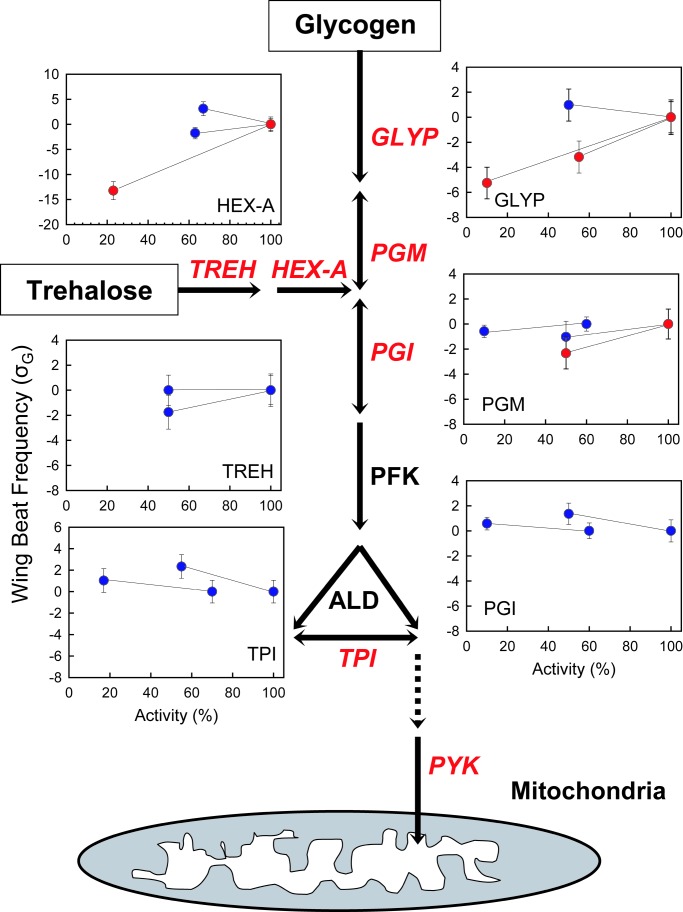
An important question in evolutionary and physiological genetics is how the control of flux-base phenotypes is distributed across the enzymes in a pathway. This control is often related to enzyme-specific levels of activity that are reported to be in excess of that required for demand. In glycolysis, metabolic control is frequently considered vested in classical regulatory enzymes, each strongly displaced from equilibrium. Yet the contribution of individual steps to control is unclear. To assess enzyme-specific control in the glycolytic pathway, we used P-element excision-derived mutagenesis in Drosophila melanogaster to generate full and partial knockouts of seven metabolic genes and to measure tethered flight performance. For most enzymes, we find that reduction to half of the normal activity has no measurable impact on wing beat frequency. The enzymes catalyzing near-equilibrium reactions, phosphoglucose isomerase, phosphoglucomutase, and triosephosphate isomerase fail to show any decline in flight performance even when activity levels are reduced to 17% or less. At reduced activities, the classic regulatory enzymes, hexokinase and glycogen phosphorylase, show significant drops in flight performance and are nearer to saturation. Our results show that flight performance is canalized or robust to the activity variation found in natural populations. Furthermore, enzymes catalyzing near-equilibrium reactions show strong genetic dominance down to low levels of activity. This implies considerable excess enzyme capacity for these enzymes.
Conflict of interest statement
The authors declare no conflict of interest.
Figures
References
Publication types
MeSH terms
Substances
Grants and funding
LinkOut - more resources
Full Text Sources
Other Literature Sources
Molecular Biology Databases
