Comparative Study
. 2007 Jan;39(1):31-40.
doi: 10.1038/ng1946. Epub 2006 Dec 10.

Convergent adaptation of human lactase persistence in Africa and Europe

Affiliations
Comparative Study

Convergent adaptation of human lactase persistence in Africa and Europe

Sarah A Tishkoff et al. Nat Genet. 2007 Jan.

Abstract

A SNP in the gene encoding lactase (LCT) (C/T-13910) is associated with the ability to digest milk as adults (lactase persistence) in Europeans, but the genetic basis of lactase persistence in Africans was previously unknown. We conducted a genotype-phenotype association study in 470 Tanzanians, Kenyans and Sudanese and identified three SNPs (G/C-14010, T/G-13915 and C/G-13907) that are associated with lactase persistence and that have derived alleles that significantly enhance transcription from the LCT promoter in vitro. These SNPs originated on different haplotype backgrounds from the European C/T-13910 SNP and from each other. Genotyping across a 3-Mb region demonstrated haplotype homozygosity extending >2.0 Mb on chromosomes carrying C-14010, consistent with a selective sweep over the past approximately 7,000 years. These data provide a marked example of convergent evolution due to strong selective pressure resulting from shared cultural traits-animal domestication and adult milk consumption.


Figures
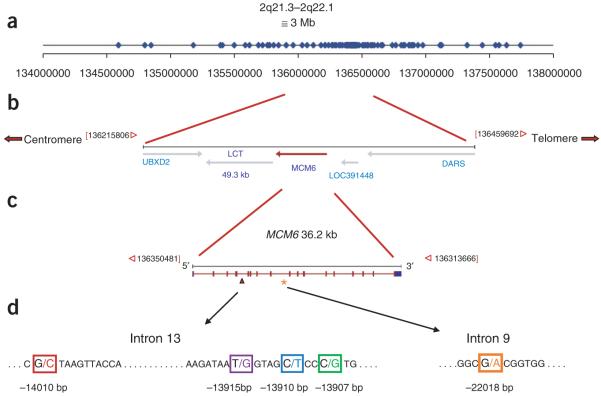
Figure 1
Figure 1
Map of the LCT and MCM6 gene region and location of genotyped SNPs. (a) Distribution of 123 SNPs included in genotype analysis. (b) Map of the LCT and MCM6 gene region. (c) Map of the MCM6 gene. (d) Location of lactase persistence–associated SNPs within introns 9 and 13 of the MCM6 gene in African and European populations.
Figure 2
Figure 2
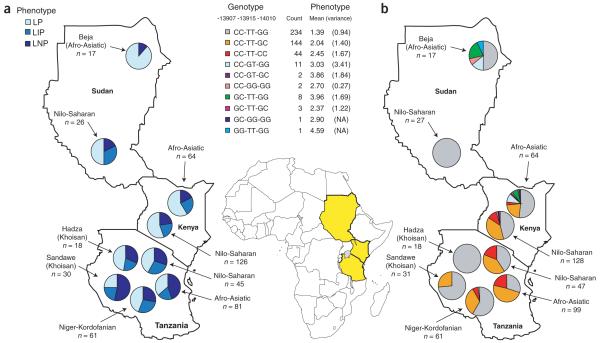
Map of phenotype and genotype proportions for each population group considered in this study. (a) Pie charts representing the proportion of each phenotype by geographic region. LP indicates lactase persistence, LIP indicates lactase intermediate persistence and LNP indicates lactase non-persistence. Phenotypes were binned using an LTT test according to the rise in blood glucose after digestion of 50 g lactose: lactase persistence, >1.7 mM; LIP, between 1.1 mM and 1.7 mM; LNP, <1.1 mM. (b) Proportion of compound genotypes for G/C-13907, T/G-13915 and C/G-14010 in each region. The pie charts are in the approximate geographic location of the sampled individuals.
Figure 3
Figure 3
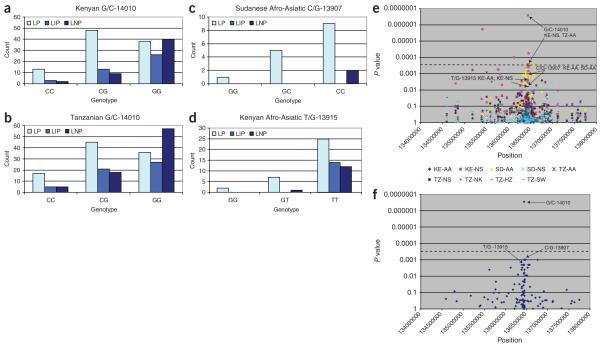
Genotype-phenotype association for G/C-14010, T/G-13915 and C/G-13907. (a-d) Number of individuals in various genotype and phenotype classes in major geographic regions and/or populations in which they are most prevalent. We observed a significant association for G/C-14010 in Kenya (n = 190, d.f. = 4, χ2 = 21.77, P = 0.0002) and in Tanzania (n = 231, d.f. = 4, χ2 = 21.90, P = 0.0002) We did not observe a significant association for C/G-13907 in the Afro-Asiatic Sudanese (n = 17, d.f. = 2, χ2 = 2.54, P = 0.2808) or for T/G-13915 in Afro-Asiatic Kenyans (n = 61, d.f. = 4, χ2 = 6.14, P = 0.1889). A large proportion of individuals who are homozygous for the ancestral G-14010, T-13915 and C-13907 alleles are classified as lactase persistent, indicating that there are additional unidentified variants associated with lactase persistence in these populations. (e) Linear regression-based test of association for each polymorphic SNP genotyped in this study in each of the subpopulations. Dashed line denotes significance after a conservative Bonferroni correction for the total number of SNPs tested. G/C-14010 is the most significant of all 123 genotyped SNPs in the Kenyan Nilo-Saharan (KE-NS) and Tanzanian Afro-Asiatic (TZ-AA) samples. C/G-13907 shows the strongest (though not significant) association of all other genotyped SNPs in the Kenyan Afro-Asiatic (KE-AA) samples. (f) Meta-analysis of the combined P values for each SNP over all subpopulations. G/C-14010 is highly significant, even after Bonferroni correction (P = 2.9 × 10⁻⁷). C/G-13907 and T/G-13915 are not significant after Bonferroni correction (P = 0.001 and P = 0.002, respectively). SD-AA, Sudanese Afro-Asiatic; SD-NS, Sudanese Nilo-Saharan; TZ-NS, Tanzanian Nilo-Saharan; TZ-NK, Tanzanian Niger-Kordofanian; TZ-HZ, Tanzanian Hadza; TZ-SW, Tanzanian Sandawe.
Figure 4
Figure 4
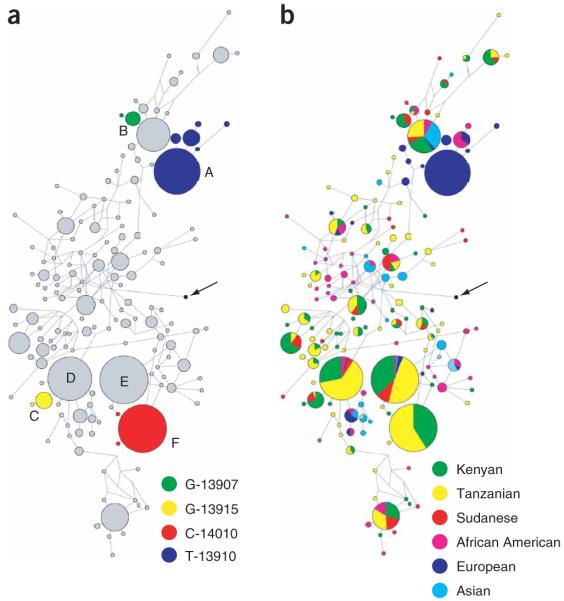
Haplotype networks consisting of 55 SNPs spanning a 98-kb region encompassing LCT and MCM6. (a) Distribution of the lactase persistence–associated haplotypes. Haplotypes with a T allele at -13910 are indicated in blue, those with a G allele at -13907 in green, those with a C allele at -14010 in red and those with a G allele at -13915 in yellow. The arrow points to the inferred ancestral-state haplotype. (b) Network analysis of LCT and MCM6 haplotypes indicating frequencies in the current data set and in Europeans, Asians and African Americans previously genotyped in ref. .
Figure 5
Figure 5
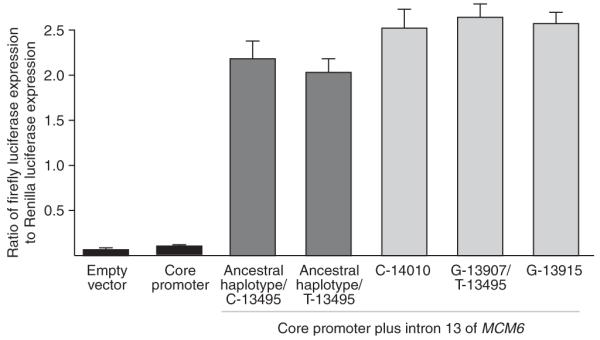
Dual-luciferase reporter assay of LCT promoter and MCM6 introns. As a control, cells were transfected with the promoterless pGL3-basic vector (‘empty vector’). Basal levels of expression were assessed using a pGL3-basic vector with 3 kb of the 5′ flanking region of LCT (‘core promoter’). Five different haplotypes of the MCM6 intron 13 were inserted upstream of the core promoter that differed at the following sites: (i) a haplotype that is ancestral for the three lactase persistence–associated SNPs, with a C at position -13495; (ii) a haplotype that is ancestral for the three lactase persistence–associated SNPs, with a T at position -13495; (iii) a haplotype that differs from (i) only at C -14010; (iv) a haplotype that differs from (i) at G-13907 and T-13495 and from (ii) only at G-13907; and (v) a haplotype that differs from (i) only at G-13915. Expression levels are reported as the ratio of firefly to Renilla luciferase; error bars represent a 95% c.i. The differences between the core promoter alone and all five MCM6 intronic constructs, as well as between the three derived versus two ancestral haplotypes, were significant (P < 0.0008, paired t tests). There was no significant difference in expression between the empty vector and the core promoter, between the two ancestral haplotypes (with and without the T-13495 allele) or between the three derived haplotypes. The construct with ancestral lactase persistence–associated alleles that differed at T-13495 served as an internal control for the expression differences for the G-13907 and T-13495 alleles, indicating that only the G-13907 allele results in increased gene expression.
Figure 6
Figure 6
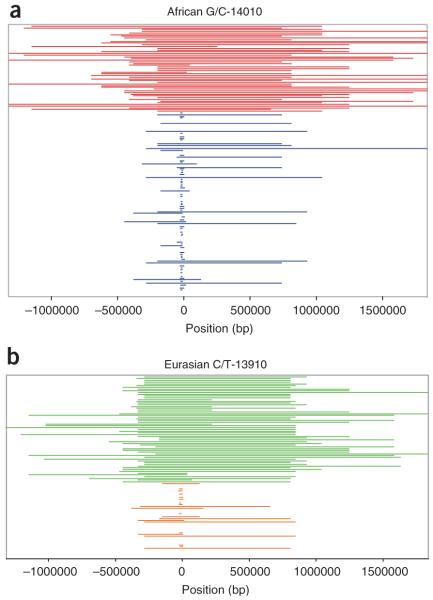
Comparison of tracts of homozygous genotypes flanking the lactase persistence–associated SNPs. (a) Kenyan and Tanzanian C-14010 lactase-persistent (red) and non-persistent G-14010 (blue) homozygosity tracts. (b) European and Asian T-13910 lactase-persistent (green) and C-13910 non-persistent (orange) homozygosity tracts, based on the data from ref. . Positions are relative to the start codon of LCT. Note that some tracks are too short to be visible as plotted.
Figure 7
Figure 7
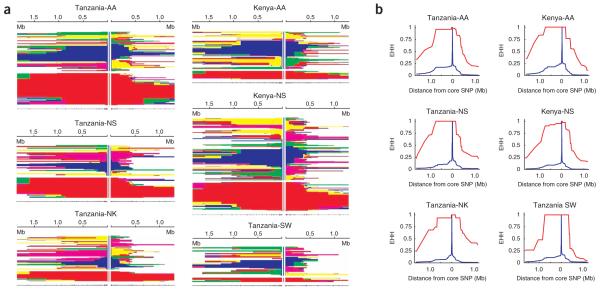
Plots of the extent and decay of haplotype homozygosity in the region surrounding the C-14010 allele. (a) Decay of haplotypes for the C-14010 allele in African subpopulations. Horizontal lines are haplotypes; SNP positions are marked below the haplotype plot. These plots are divided into two parts: the upper portion shows haplotypes with the ancestral G allele at site -14010 (blue), and the lower portion shows haplotypes with the derived C allele at -14010 (red). For a given SNP, adjacent haplotypes with the same color carry identical genotypes everywhere between that SNP and the central (selected) site. The left- and right-hand sides are sorted separately. Haplotypes are no longer plotted beyond the points at which they become unique. Note the large extent of haplotype homozygosity surrounding the C-14010 allele (red) extending as far as 2.9 Mb in individual populations, which is consistent with the action of positive selection rapidly increasing the frequency of chromosomes with the C-14010 allele. (b) Decay of extended haplotype homozygosity for the C-14010 allele in African subpopulations over physical distance. In each case, the decay of haplotype homozygosity for the ancestral allele (blue) occurs much more quickly than for the derived allele (red). This is the expectation for strong positive selection acting on haplotypes containing this derived allele. AA: Afro-Asiatic language family; NK: Niger-Kordofanian; NS: Nilo-Saharan; SW: Sandawe.

Comment in

  • Following the herd.
    Wooding SP. Wooding SP. Nat Genet. 2007 Jan;39(1):7-8. doi: 10.1038/ng0107-7. Nat Genet. 2007. PMID: 17192779 No abstract available.

References

    1. Swallow DM. Genetics of lactase persistence and lactose intolerance. Annu. Rev. Genet. 2003;37:197–219. - PubMed
    1. Hollox E, Swallow DM. In: The Genetic Basis of Common Diseases. King RA, Rotter JI, Motulsky AG, editors. Oxford Univ. Press; Oxford: 2002. pp. 250–265.
    1. Durham WH. Coevolution: Genes, Culture, and Human Diversity. Stanford University Press; Stanford, California: 1992.
    1. Enattah NS, et al. Identification of a variant associated with adult-type hypolactasia. Nat. Genet. 2002;30:233–237. - PubMed
    1. Wang Y, et al. The lactase persistence/non-persistence polymorphism is controlled by a cis-acting element. Hum. Mol. Genet. 1995;4:657–662. - PubMed

Publication types