


Identification of a novel BBS gene (BBS12) highlights the major role of a vertebrate-specific branch of chaperonin-related proteins in Bardet-Biedl syndrome
- PMID: 17160889
- PMCID: PMC1785304
- DOI: 10.1086/510256
Identification of a novel BBS gene (BBS12) highlights the major role of a vertebrate-specific branch of chaperonin-related proteins in Bardet-Biedl syndrome
Abstract
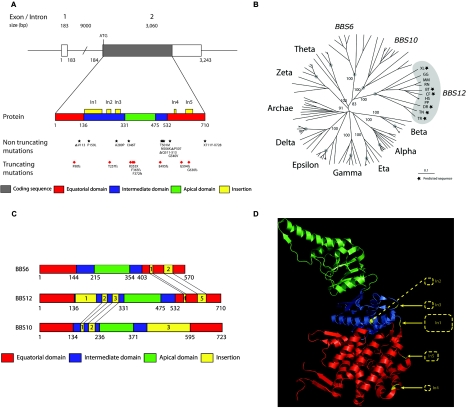
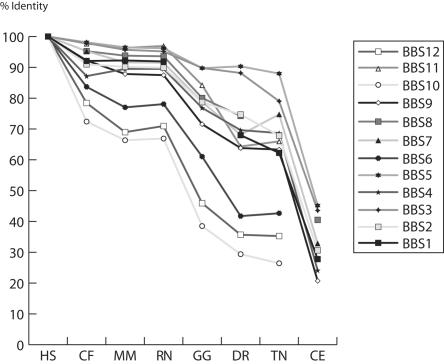
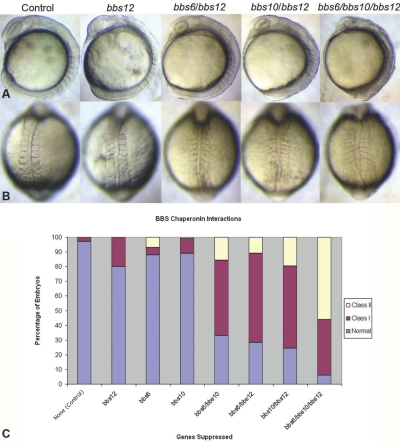
Bardet-Biedl syndrome (BBS) is primarily an autosomal recessive ciliopathy characterized by progressive retinal degeneration, obesity, cognitive impairment, polydactyly, and kidney anomalies. The disorder is genetically heterogeneous, with 11 BBS genes identified to date, which account for ~70% of affected families. We have combined single-nucleotide-polymorphism array homozygosity mapping with in silico analysis to identify a new BBS gene, BBS12. Patients from two Gypsy families were homozygous and haploidentical in a 6-Mb region of chromosome 4q27. FLJ35630 was selected as a candidate gene, because it was predicted to encode a protein with similarity to members of the type II chaperonin superfamily, which includes BBS6 and BBS10. We found pathogenic mutations in both Gypsy families, as well as in 14 other families of various ethnic backgrounds, indicating that BBS12 accounts for approximately 5% of all BBS cases. BBS12 is vertebrate specific and, together with BBS6 and BBS10, defines a novel branch of the type II chaperonin superfamily. These three genes are characterized by unusually rapid evolution and are likely to perform ciliary functions specific to vertebrates that are important in the pathophysiology of the syndrome, and together they account for about one-third of the total BBS mutational load. Consistent with this notion, suppression of each family member in zebrafish yielded gastrulation-movement defects characteristic of other BBS morphants, whereas simultaneous suppression of all three members resulted in severely affected embryos, possibly hinting at partial functional redundancy within this protein family.
Figures

References
Web Resources
-
- Bardet Biedl Syndrome: Multiple Alignment, http://bips.u-strasbg.fr/BBS/ (for alignment of BBS12)
-
- Ciliary Proteome Database, http://www.ciliaproteome.org/
-
- CryptoDB, http://cryptodb.org/cryptodb/ (for cryptosporidia)
-
- Cyanidioschyzon merolae Genome Project, http://merolae.biol.s.u-tokyo.ac.jp/ (for C. merolae)
References
-
- Green JS, Parfrey PS, Harnett JD, Farid NR, Cramer BC, Johnson G, Heath O, McManamon PJ, O‘Leary E, Pryse-Phillips W (1989) The cardinal manifestations of Bardet-Biedl syndrome, a form of Laurence-Moon-Biedl syndrome. N Engl J Med 321:1002–1009 - PubMed
-
- Farag TI, Teebi AS (1988) Bardet-Biedl and Laurence-Moon syndromes in a mixed Arab population. Clin Genet 33:78–82 - PubMed
-
- Farag TI, Teebi AS (1989) High incidence of Bardet-Biedl syndrome among the Bedouin. Clin Genet 36:463–464 - PubMed
-
- Moore SJ, Green JS, Fan Y, Bhogal AK, Dicks E, Fernandez BA, Stefanelli M, Murphy C, Cramer BC, Dean JC, Beales PL, Katsanis N, Bassett AS, Davidson WS, Parfrey PS (2005) Clinical and genetic epidemiology of Bardet-Biedl syndrome in Newfoundland: a 22-year prospective, population-based, cohort study. Am J Med Genet A 132:352–360 - PMC - PubMed
Publication types
MeSH terms
Substances
Associated data
- Actions
- Actions
LinkOut - more resources
Full Text Sources
Other Literature Sources
Molecular Biology Databases
Miscellaneous
