. 2006 Dec 26;103(52):19678-82.
doi: 10.1073/pnas.0603873103. Epub 2006 Dec 12.

Why molecules move along a temperature gradient

Affiliations

Why molecules move along a temperature gradient

Stefan Duhr et al. Proc Natl Acad Sci U S A. .

Abstract

Molecules drift along temperature gradients, an effect called thermophoresis, the Soret effect, or thermodiffusion. In liquids, its theoretical foundation is the subject of a long-standing debate. By using an all-optical microfluidic fluorescence method, we present experimental results for DNA and polystyrene beads over a large range of particle sizes, salt concentrations, and temperatures. The data support a unifying theory based on solvation entropy. Stated in simple terms, the Soret coefficient is given by the negative solvation entropy, divided by kT. The theory predicts the thermodiffusion of polystyrene beads and DNA without any free parameters. We assume a local thermodynamic equilibrium of the solvent molecules around the molecule. This assumption is fulfilled for moderate temperature gradients below a fluctuation criterion. For both DNA and polystyrene beads, thermophoretic motion changes sign at lower temperatures. This thermophilicity toward lower temperatures is attributed to an increasing positive entropy of hydration, whereas the generally dominating thermophobicity is explained by the negative entropy of ionic shielding. The understanding of thermodiffusion sets the stage for detailed probing of solvation properties of colloids and biomolecules. For example, we successfully determine the effective charge of DNA and beads over a size range that is not accessible with electrophoresis.


Conflict of interest statement

The authors declare no conflict of interest.

Figures
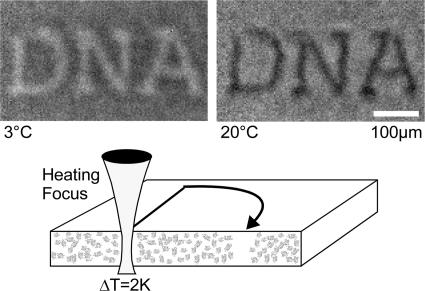
Fig. 1.
Fig. 1.
Thermodiffusion manipulates the DNA concentration by small temperature differences within the bulk solution. A thin water film is heated by 2 K along the letters “DNA” with an infrared laser. For a cooled chamber at 3°C, fluorescently tagged DNA accumulates at the warm letters. However, at room temperature, DNA moves into the cold, showing reduced fluorescence. The chamber is 60 μm thin, containing 50 nM DNA in 1 mM Tris buffer. Every 50th base pair is labeled with TOTO-1 (for details, see supporting information).
Fig. 2.
Fig. 2.
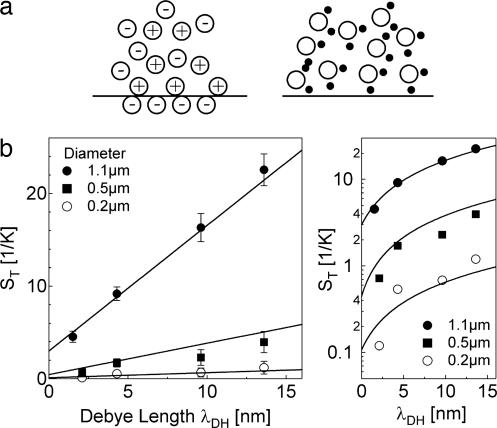
Salt dependence. (a) Thermodiffusion in water is dominated by ionic shielding (Left) and water hydration (Right). (b) Soret coefficient ST versus Debye length for carboxyl-modified polystyrene beads of diameter 1.1, 0.5, and 0.2 μm. Linear plot (Left) and logarithmic plot (Right). The Soret coefficients are described by Eq. 2 with an effective surface charge of σeff = 4,500 e/μm2 known from electrophoresis. The intercept STDH = 0) is fitted with a hydration entropy per particle surface of shyd = −1,400 J/(mol·K·μm2).
Fig. 3.
Fig. 3.
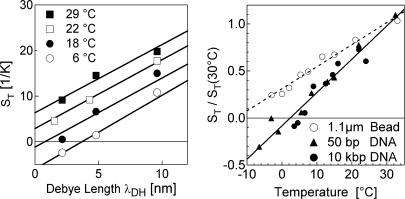
Temperature dependence. (a) The temperature dependence is dominated by the linear change in the hydration entropy Shyd. It shifts the salt-dependent thermodiffusion STDH) to lower values. The particle size is 1.1 μm. (b) The Soret coefficient ST increases linearly with the temperature as expected for a hydration entropy Shyd(T). It depends on the molecule species, not its size, as seen from the rescaled Soret coefficients for DNA with different lengths.
Fig. 4.
Fig. 4.
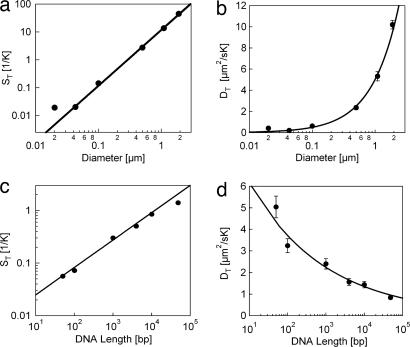
Size dependence. (a) For polystyrene beads, the Soret coefficient scales with the particle surface over four orders of magnitude. Measurements are described by Eq. 2 with an effective surface charge density of σeff = 4,500 e/μm2 (2) and negligible hydration entropy. The deviation for the bead with a diameter of 20 nm can be understood from an increased effective charge due to the onset of charge normalization for a ≤λDH. (b) Accordingly, the thermodiffusion coefficient DT scales linearly with bead diameter. (c) The Soret coefficient of DNA scales according to STL, with the length L of the DNA based on Eq. 2 with an effective charge per base pair of 0.12 e. (d) Thermodiffusion coefficient DT decreases over DNA length with DTL−0.25, caused by the scaling of diffusion coefficient DL−0.75.
Fig. 5.
Fig. 5.
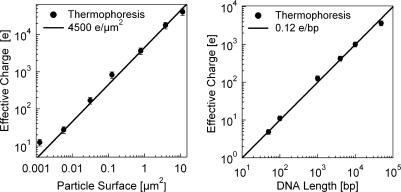
Effective charge from thermodiffusion. Effective charge is inferred from thermodiffusion using Eq. 3. Polystyrene beads (20–2,000 nm) (a) and DNA (50–50,000 bp) (b) were measured over a large size range, which is impossible with electrophoresis. As expected, the effective charge of the beads scales with particle surface and linearly with the length of DNA.

Comment in

References

    1. Ludwig C. Sitzungber Bayer Akad Wiss Wien Math-Naturwiss Kl. 1856;20:539.
    1. Giglio M, Vendramini A. Phys Rev Lett. 1977;38:26–30.
    1. Iacopini S, Piazza R. Europhys Lett. 2003;63:247–253.
    1. Jeon SJ, Schimpf ME, Nyborg A. Anal Chem. 1997;69:3442–3450. - PubMed
    1. Shiundu PM, Liu G, Giddings JC. Anal Chem. 1995;67:2705–2713.

Publication types

LinkOut - more resources