


Differential involvement of endogenous opioids in sucrose consumption and food reinforcement
- PMID: 17166571
- PMCID: PMC1868438
- DOI: 10.1016/j.pbb.2006.10.015
Differential involvement of endogenous opioids in sucrose consumption and food reinforcement
Abstract
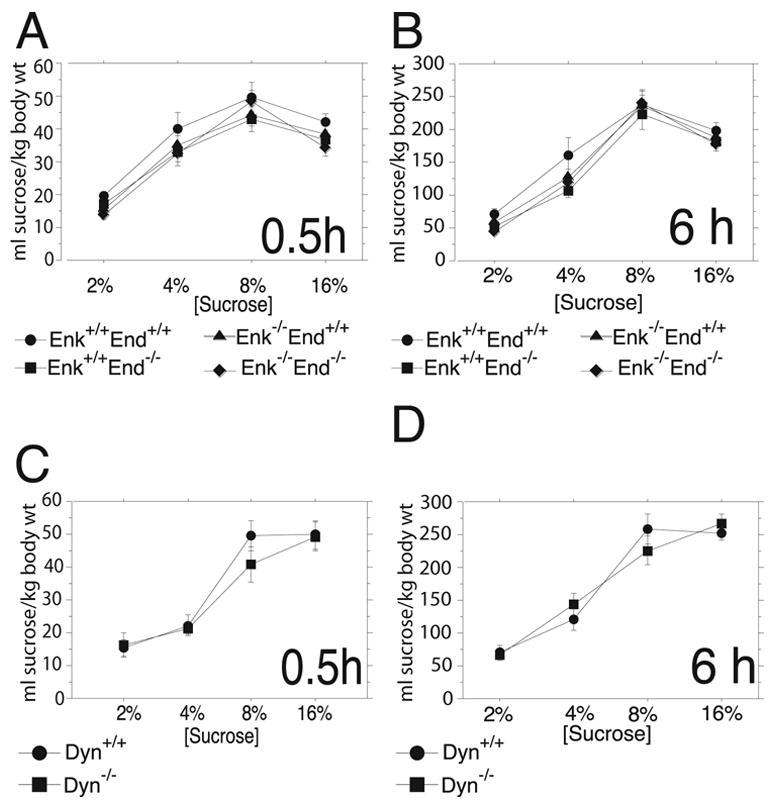
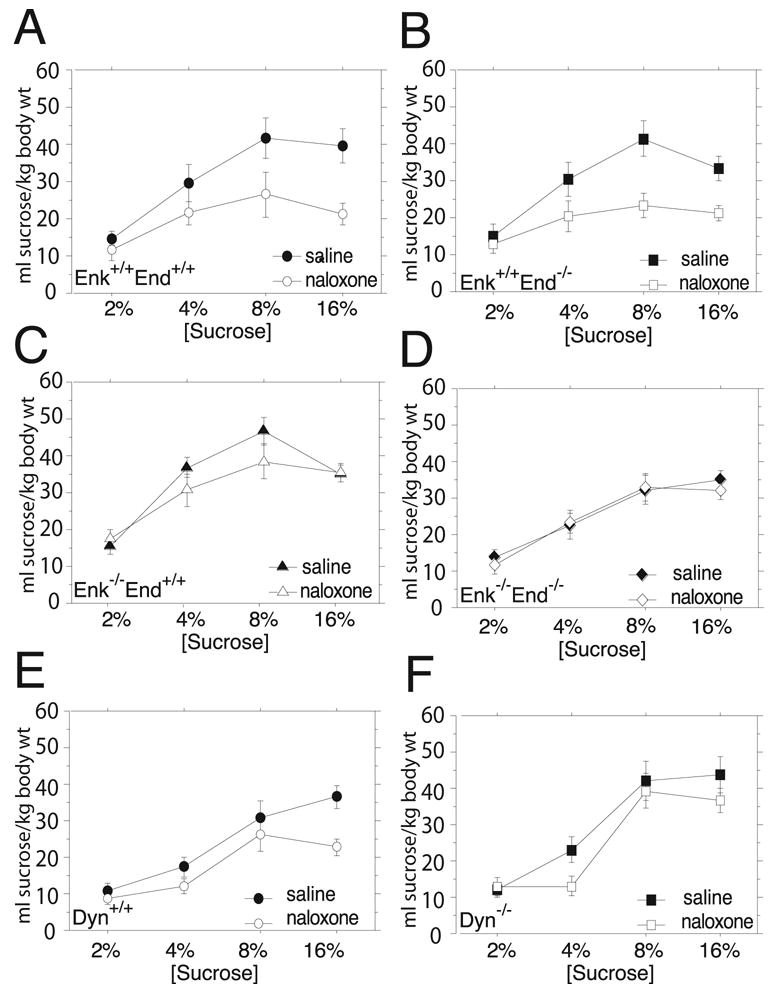
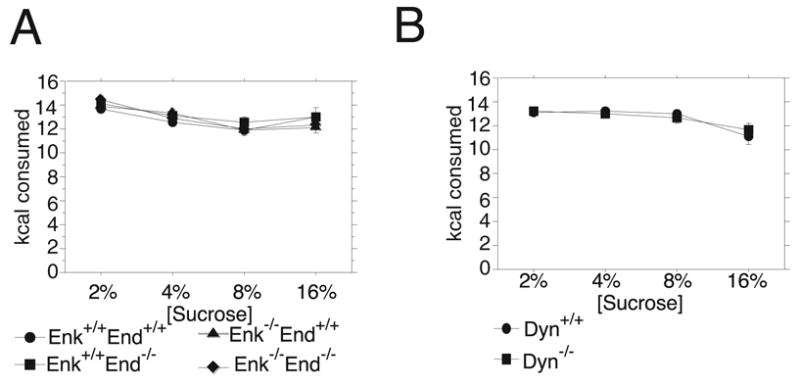
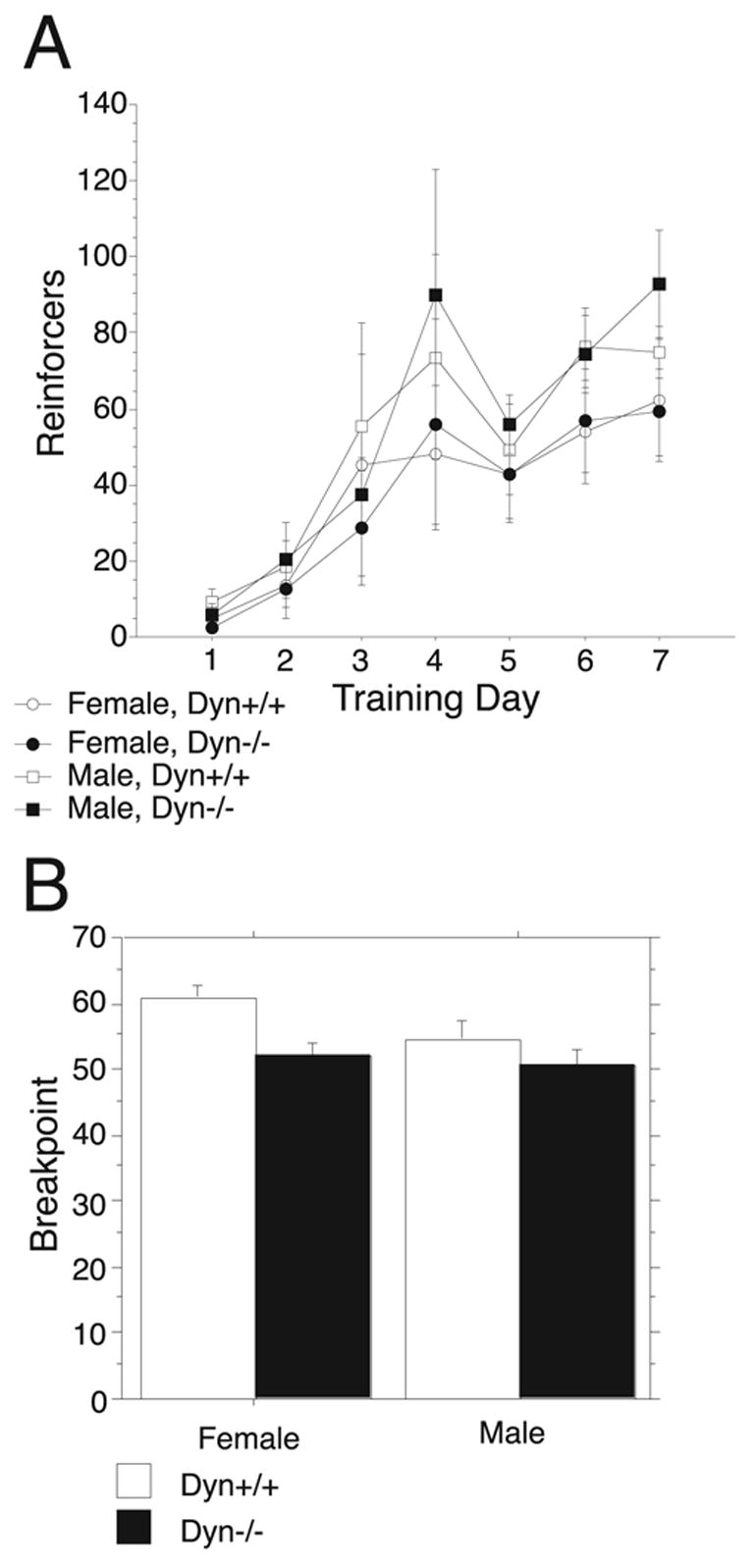
Endogenous opioids within the central nervous system are postulated to mediate hedonic aspects of feeding behavior. To identify the relevant endogenous opioid receptor ligands, mice lacking one or two of the opioid peptide families beta-endorphin, enkephalins or dynorphins were tested for sucrose preference in a two-bottle free-choice drinking paradigm under drug-naïve conditions and following treatment with an opioid antagonist (1 mg/kg naloxone i.p.) or saline. Basal sucrose consumption was unaltered in all of the knockout genotypes compared to their congenic wild-type C57BL/6 littermates during 0.5 and 6 h access to a bottle containing 2, 4, 8, or 16% sucrose and a second bottle containing water. Moreover, all mutant genotypes and wildtype mice exhibited a similar compensatory decrease in overnight food intake following the extra caloric load from 6 h sucrose access. Although these basal responses to sucrose were unaffected by the knockout genotypes, naloxone reduced sucrose consumption by 50% compared to saline treatment during the first 0.5 h in wild-type and beta-endorphin knockout mice, but had no effect in enkephalin knockouts, beta-endorphin and enkephalin double knockouts, or dynorphin knockouts. These data suggest that naloxone reduces sucrose consumption in wild-type mice by blocking endogenous enkephalin and/or dynorphin signaling, but not beta-endorphin. Dynorphin knockouts in the current study had bar-pressing responses for a palatable food reinforcer in an operant procedure under free-feeding conditions similar to wild-type mice while we found in a previous study that beta-endorphin and enkephalin knockout mice had reduced motivation to respond [Hayward MD, Pintar JE, Low MJ. Selective reward deficit in mice lacking beta-endorphin and enkephalin. J Neurosci 2002;22:8251-8258.]. We conclude from these studies directly comparing three strains of opioid peptide knockout mice that enkephalin and dynorphin can modulate sucrose preference but are not necessary to support sucrose consumption. However, dynorphin was not necessary to support wildtype levels of operant responding suggesting that only enkephalin and beta-endorphin modulate conditioned food reinforcement.
Figures
References
-
- Appleyard SM, Hayward M, Young JI, Butler AA, Cone RD, Rubinstein M, Low MJ. A role for the endogenous opioid beta-endorphin in energy homeostasis. Endocrinology. 2003;144:1753–1760. - PubMed
-
- Arjune D, Bodnar RJ. Suppression of nocturnal, palatable and glucoprivic intake in rats by the kappa opioid antagonist, norbinaltorphamine. Brain Res. 1990;534:313–316. - PubMed
-
- Beczkowska IW, Bowen WD, Bodnar RJ. Central opioid receptor subtype antagonists differentially alter sucrose and deprivation-induced water intake in rats. Brain Res. 1992;589:291–301. - PubMed
-
- Belluzzi JD, Stein L. Enkephaline may mediate euphoria and drive-reduction reward. Nature. 1977;266:556–558. - PubMed
-
- Berridge KC. Food reward: brain substrates of wanting and liking. Neurosci Biobehav Rev. 1996;20:1–25. - PubMed
Publication types
MeSH terms
Substances
Grants and funding
LinkOut - more resources
Full Text Sources
