


Acute treatment with the 5-HT(1A) receptor agonist 8-OH-DPAT and chronic environmental enrichment confer neurobehavioral benefit after experimental brain trauma
- PMID: 17166603
- PMCID: PMC1850378
- DOI: 10.1016/j.bbr.2006.11.036
Acute treatment with the 5-HT(1A) receptor agonist 8-OH-DPAT and chronic environmental enrichment confer neurobehavioral benefit after experimental brain trauma
Abstract
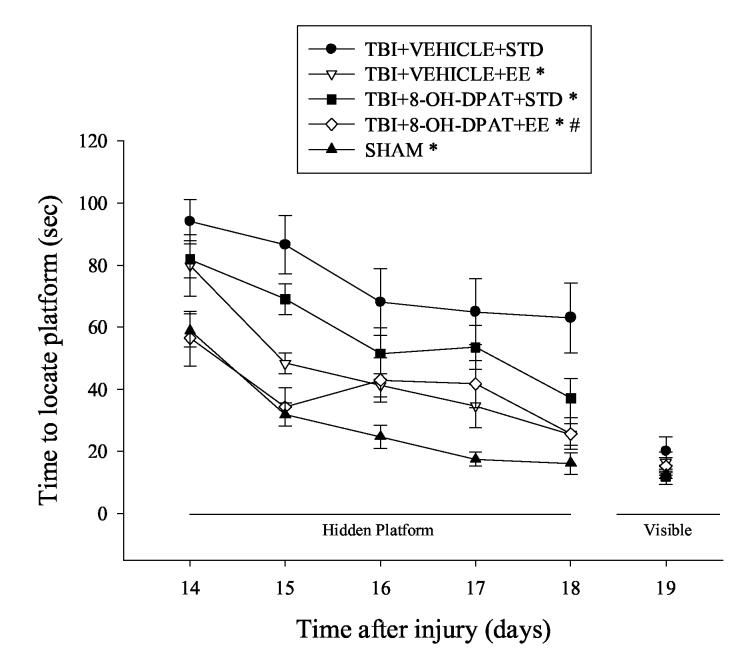
Acute treatment with the 5-HT(1A) receptor agonist 8-hydroxy-2-(di-n-propylamino)tetralin (8-OH-DPAT) or chronic environmental enrichment (EE) hasten behavioral recovery after experimental traumatic brain injury (TBI). The aim of this study was to determine if combining these interventions would confer additional benefit. Anesthetized adult male rats received either a cortical impact or sham injury followed 15min later by a single intraperitoneal injection of 8-OH-DPAT (0.5mg/kg) or saline vehicle (1.0mL/kg) and then randomly assigned to either enriched or standard (STD) housing. Behavioral assessments were conducted utilizing established motor and cognitive tests on post-injury days 1-5 and 14-18, respectively. Hippocampal CA(1)/CA(3) neurons were quantified at 3 weeks. Both 8-OH-DPAT and EE attenuated CA(3) cell loss. 8-OH-DPAT enhanced spatial learning in a Morris water maze (MWM) as revealed by differences between the TBI+8-OH-DPAT+STD and TBI+VEHICLE+STD groups (P=0.0014). EE improved motor function as demonstrated by reduced time to traverse an elevated narrow beam in both the TBI+8-OH-DPAT+EE and TBI+VEHICLE+EE groups versus the TBI+VEHICLE+STD group (P=0.0007 and 0.0016, respectively). EE also facilitated MWM learning as evidenced by both the TBI+8-OH-DPAT+EE and TBI+VEHICLE+EE groups locating the escape platform quicker than the TBI+VEHICLE+STD group (P's<0.0001). MWM differences were also observed between the TBI+8-OH-DPAT+EE and TBI+8-OH-DPAT+STD groups (P=0.0004) suggesting that EE enhanced the effect of 8-OH-DPAT. However, there was no difference between the TBI+8-OH-DPAT+EE and TBI+VEHICLE+EE groups. These data replicate previous results from our laboratory showing that both a single systemic administration of 8-OH-DPAT and EE improve recovery after TBI and extend those findings by elucidating that the combination of treatments in this particular paradigm did not confer additional benefit. One explanation for the lack of an additive effect is that EE is a very effective treatment and thus there is very little room for 8-OH-DPAT to confer additional statistically significant improvement.
Figures



References
-
- Alessandri B, Tsuchida E, Bullock RM. The neuroprotective effect of a new serotonin receptor agonist, BAY x3702, upon focal ischemic brain damage caused by acute subdural hematoma in the rat. Brain Res. 1999;845:232–35. - PubMed
-
- Baranova AI, Whiting MD, Hamm RJ. Delayed, post-injury treatment with aniracetam improves cognitive performance after traumatic brain injury in rats. J Neurotrauma. 2006;23:1233–40. - PubMed
-
- Barnes NM, Sharp T. A review of central 5-HT receptors and their function. Neuropharmacology. 1999;38:1083–152. - PubMed
-
- Bayir H. Reactive oxygen species. Crit Care Med. 2005;33:S498–501. - PubMed
-
- Bayir H, Clark RS, Kochanek PM. Promising strategies to minimize secondary brain injury after head trauma. Crit Care Med. 2003;31:S112–7. - PubMed
Publication types
MeSH terms
Substances
Grants and funding
LinkOut - more resources
Full Text Sources
Research Materials
Miscellaneous
