. 2007 Jan;43(1):37-63.
doi: 10.1016/j.ejop.2006.10.001. Epub 2006 Dec 12.

Phylogeny of the order Choreotrichida (Ciliophora, Spirotricha, Oligotrichea) as inferred from morphology, ultrastructure, ontogenesis, and SSrRNA gene sequences

Affiliations

Phylogeny of the order Choreotrichida (Ciliophora, Spirotricha, Oligotrichea) as inferred from morphology, ultrastructure, ontogenesis, and SSrRNA gene sequences

Sabine Agatha et al. Eur J Protistol. 2007 Jan.

Abstract

The phylogeny within the order Choreotrichida is reconstructed using (i) morphologic, ontogenetic, and ultrastructural evidence for the cladistic approach and (ii) the small subunit ribosomal RNA (SSrRNA) gene sequences, including the new sequence of Rimostrombidium lacustris. The morphologic cladograms and the gene trees converge rather well for the Choreotrichida, demonstrating that hyaline and agglutinated loricae do not characterize distinct lineages, i.e., both lorica types can be associated with the most highly developed ciliary pattern. The position of Rimostrombidium lacustris within the family Strobilidiidae is corroborated by the genealogical analyses. The diagnosis of the genus Tintinnidium is improved, adding cytological features, and the genus is divided into two subgenera based on the structure of the somatic kineties. The diagnosis of the family Lohmanniellidae and the genus Lohmanniella are improved, and Rimostrombidium glacicolum Petz, Song and Wilbert, 1995 is affiliated.


Figures
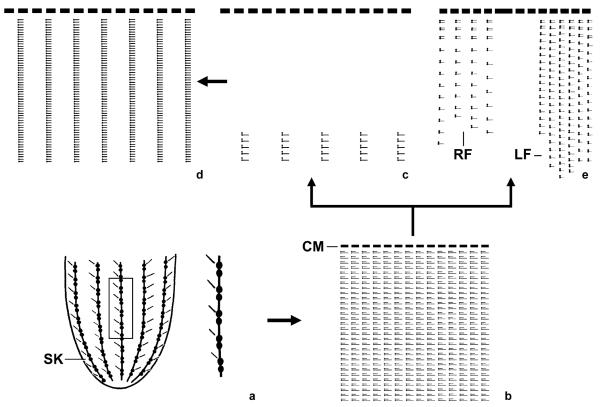
Fig. 1
Fig. 1
Kinetal maps showing the early evolution of the choreotrichid ciliary patterns. (a) The ancestor had many longitudinal somatic kineties consisting of dikinetids, each with a cilium only at the anterior basal body (see detail). (b) The ciliary pattern of Leegaardiella sol and the Strombidinopsidae reveals diciliated somatic dikinetids. (c, d) First, the anterior cilia of the dikinetids were reduced, producing the Lohmanniellidae pattern (c) which probably gave rise to the Strobilidiidae pattern (d) by the reduction of the bare anterior basal bodies of the dikinetids and a condensation of the resulting monokinetids. (e) In the hypothetical ancestor of the tintinnids, a right and left ciliary field developed and the anterior cilia of the dikinetids were reduced in the posterior kinety portions. CM, collar membranelles; LF, left ciliary field; RF, right ciliary field; SK, somatic kineties.
Fig. 2
Fig. 2
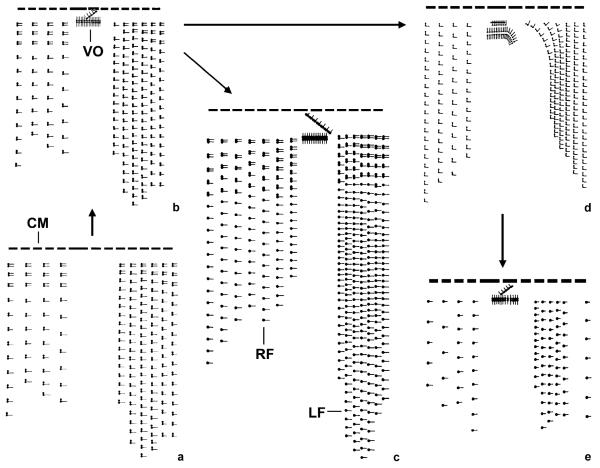
Kinetal maps showing the evolution of ciliary patterns in tintinnids with two ventral organelles. (a) The hypothetical ancestor of the tintinnids probably had a right and left ciliary field, and the anterior cilia of the dikinetids were reduced in the posterior portion of the kineties. (b) Two dikinetidal ventral organelles were introduced, resulting in the Tintinnidium (Tintinnidium) pattern (after Foissner and Wilbert 1979). (c) The bare anterior basal bodies of the dikinetids were partially lost in the posterior portion of the kineties, giving rise to the Tintinnidium (Semitintinnidium) pattern (after Blatterer and Foissner 1990). (d) The anterior cilia of the dikinetids were entirely lost, producing the Membranicola pattern (after Foissner et al. 1999). (e) The bare anterior basal bodies of the dikinetids were lost, creating the pattern of Tintinnopsis cylindrata (after Foissner and Wilbert 1979). CM, collar membranelles; LF, left ciliary field; RF, right ciliary field; VO, ventral organelles.
Fig. 3
Fig. 3
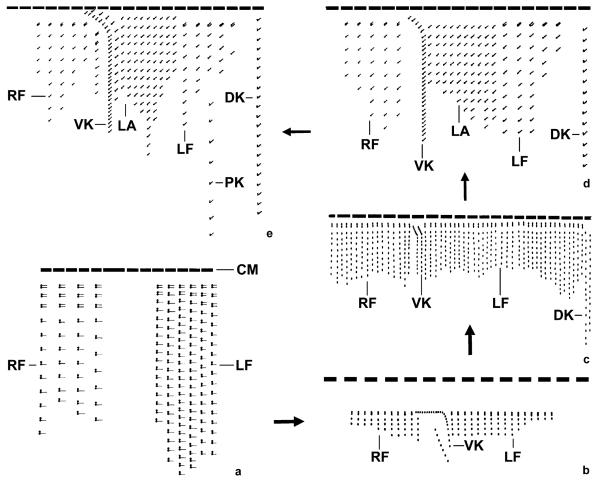
Kinetal maps showing the evolution of the ciliary patterns in tintinnids with a ventral kinety. (a) The hypothetical ancestor of the tintinnids probably had a right and left ciliary field, and the anterior cilia of the dikinetids were reduced in the posterior portion of the kineties. (b) A ventral kinety was created and the dikinetids, except for the anteriormost ones, transformed into monokinetids, generating the Nolaclusilis pattern (after Snyder and Brownlee 1991). (c) Dorsal kineties developed, producing the Eutintinnus pattern (after Choi et al. 1992). (d) The introduction of a lateral ciliary field and the loss of one dorsal kinety yielded the pattern of Tintinnopsis brasiliensis (after Cai et al. 2006). (e) The addition of a posterior kinety gave rise to the most complex ciliary pattern so far known. Such a pattern is found in the genera Codonella, Codonellopsis, Cymatocylis, Stenosemella, and Tintinnopsis (except for Tintinnopsis cylindrata and Tintinnopsis brasiliensis). CM, collar membranelles; DK, dorsal kinety/kineties; LA, lateral ciliary field; LF, left ciliary field; PK, posterior kinety; RF, right ciliary field; VK, ventral kinety.
Fig. 4
Fig. 4
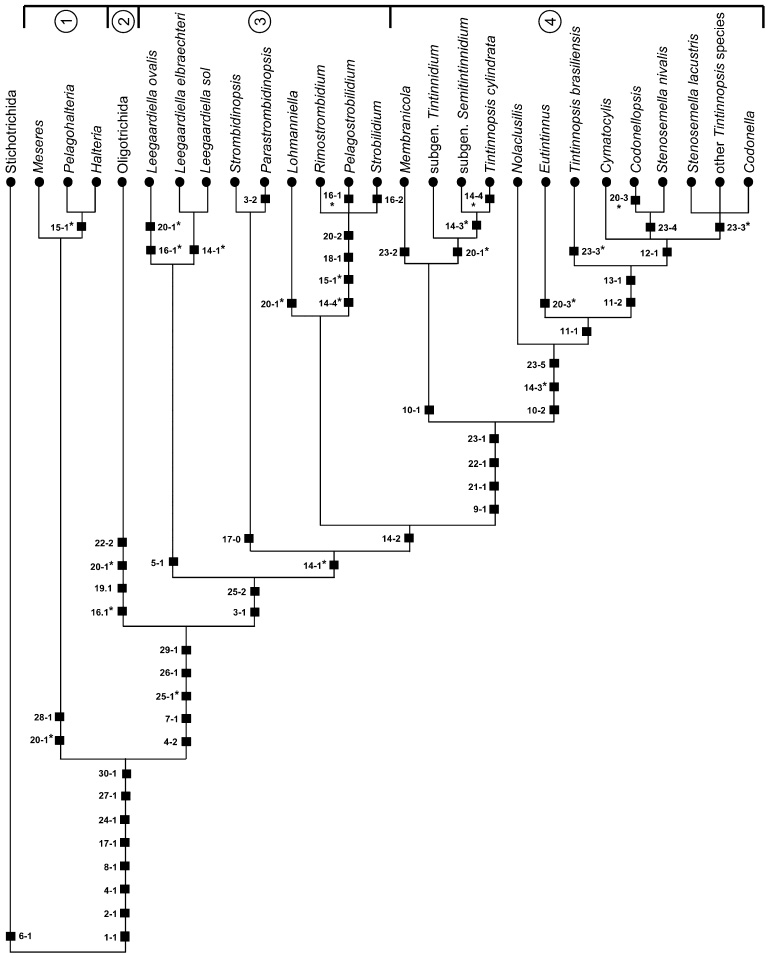
Cladistic scheme generated by the Hennigian argumentation scheme. For character coding, see Table 2 and section on character states. Black squares mark apomorphies. Asterisks denote convergences. 1, order Halteriida (class Oligotrichea, subclass Halteriia); 2, order Oligotrichida (class Oligotrichea, subclass Oligotrichia); 3, suborder Strobilidiina (class Oligotrichea, subclass Oligotrichia, order Choreotrichida); 4, suborder Tintinnina (class Oligotrichea, subclass Oligotrichia, order Choreotrichida).
Fig. 5
Fig. 5
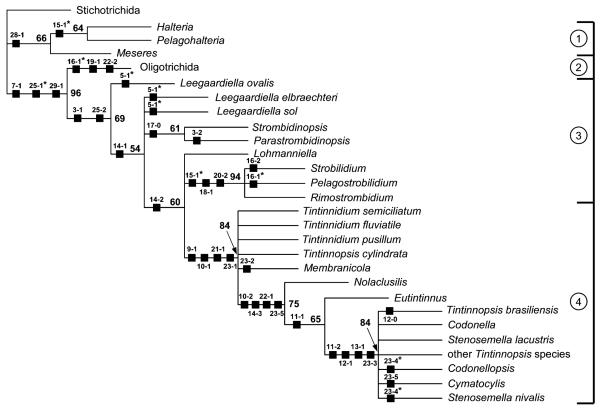
Maximum parsimony tree inferred from equally weighted morphologic data of the class Oligotrichea generated with the computer program PAUP* ver. 4.0b10 (Swofford 2002), using the Stichotrichida as outgroup. For character coding, see Table 3. The tree is the 50% majority-rule consent of 700 trees (length = 58, consistency index = 79, retention index = 93, rescaled consistency index = 73). Numbers on the branches are the bootstrap values (percentage out of 1000 replicates) for the internal nodes. Black squares mark main apomorphies. Asterisks denote convergences. 1, order Halteriida (class Oligotrichea, subclass Halteriia); 2, order Oligotrichida (class Oligotrichea, subclass Oligotrichia); 3, suborder Strobilidiina (class Oligotrichea, subclass Oligotrichia, order Choreotrichida); 4, suborder Tintinnina (class Oligotrichea, subclass Oligotrichia, order Choreotrichida).
Fig. 6
Fig. 6
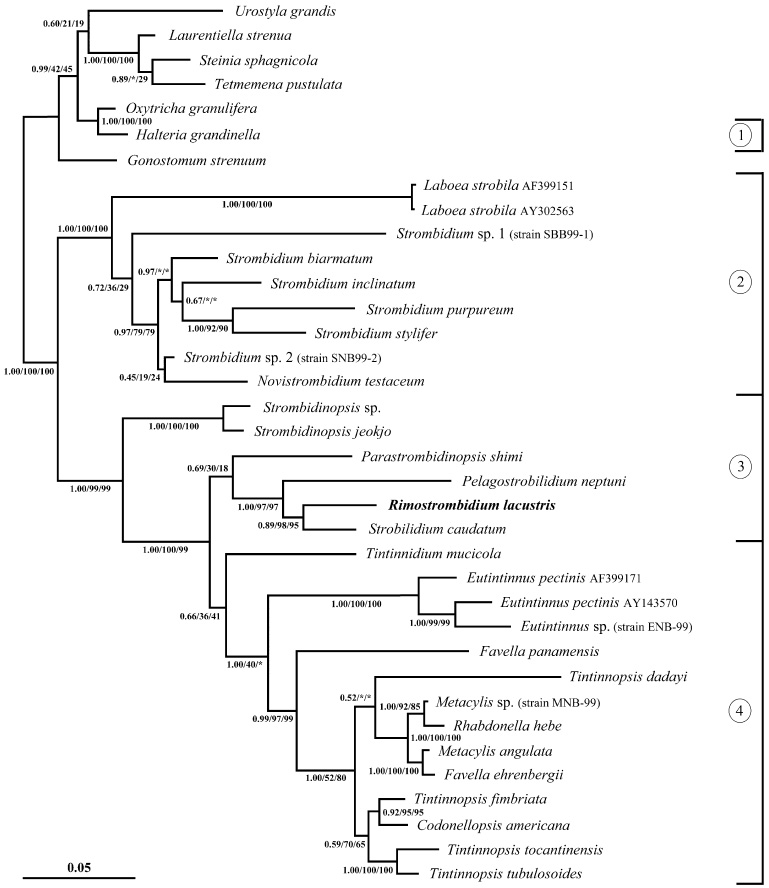
Maximum likelihood tree of SSrRNA gene sequences computed with MrBayes ver. 3.1.1 (Ronquist and Huelsenbeck 2003), based on the GTR model with gamma-distribution plus invariable sites, determined by MrModeltest (Nylander 2004). The first numbers at the nodes are the posterior probability values out of 1,000,000 trees from a maximum likelihood analysis, employing the Bayesian Inference; the second and third numbers are the bootstrap values (percent out of 1000 replicates) for the maximum parsimony (Swofford 2002) and neighbour-joining analysis (Saitou and Nei 1987), respectively. An asterisk indicates bootstrap values of <10%. The scale bar represents five expected changes per 100 positions. The new sequence appears in bold face: 1, order Halteriida (class Oligotrichea, subclass Halteriia); 2, order Oligotrichida (class Oligotrichea, subclass Oligotrichia); 3, suborder Strobilidiina (class Oligotrichea, subclass Oligotrichia, order Choreotrichida); and 4, suborder Tintinnina (class Oligotrichea, subclass Oligotrichia, order Choreotrichida).

References

    1. Agatha S. Morphology and ontogenesis of Novistrombidium apsheronicum nov. comb. and Strombidium arenicola (Protozoa, Ciliophora): a comparative light microscopical and SEM study. Eur. J. Protistol. 2003a;39:245–266.
    1. Agatha S. Redescription of Strombidinopsis minima (Gruber, 1884) Lynn et al., 1991 (Protozoa, Ciliophora), with notes on its ontogenesis and distribution. Eur. J. Protistol. 2003b;39:233–244.
    1. Agatha S. A cladistic approach for the classification of oligotrichid ciliates (Ciliophora: Spirotricha) Acta Protozool. 2004a;43:201–217. - PMC - PubMed
    1. Agatha S. Evolution of ciliary patterns in the Oligotrichida (Ciliophora, Spirotricha) and its taxonomic implications. Zoology. 2004b;107:153–168. - PMC - PubMed
    1. Agatha S. New observations on the tontoniid ciliate Spirotontonia grandis (Suzuki and Han, 2000) Agatha, 2004 (Ciliophora, Oligotrichida, Tontoniidae); comparison with the similar Laboea strobila. Eur. J. Protistol. 2004c;40:295–301.

Publication types

Associated data

LinkOut - more resources